

Role of the Shadow Zone in the Undercurrent Structure
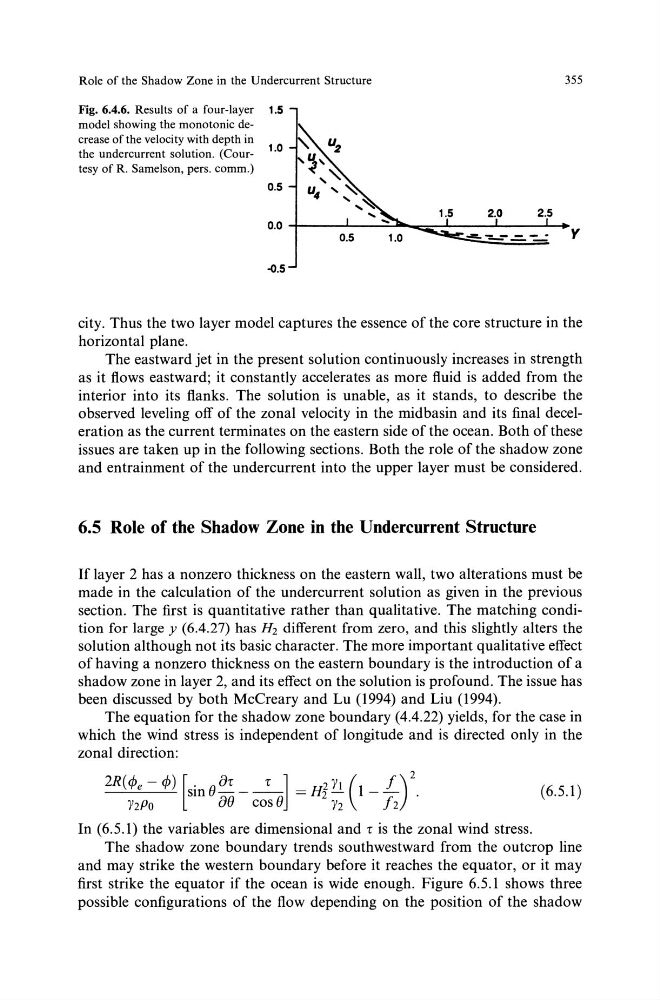
Fig. 6.4.6. Results of a four-layer 1.5
model showing the monotonic decrease of the velocity with depth in
the undercurrent solution. (Cour- 1 · 0
tesy of R. Samelson, pers. comm.)
0.5
-o.5
355
city. Thus the two layer model captures the essence of the core structure in the
horizontal plane.
The eastward jet in the present solution continuously increases in strength
as it flows eastward; it constantly accelerates as more fluid is added from the
interior into its flanks. The solution is unable, as it stands, to describe the
observed leveling off of the zonal velocity in the midbasin and its final deceleration as the current terminates on the eastern side of the ocean. Both of these
issues are taken up in the following sections. Both the role of the shadow zone
and entrainment of the undercurrent into the upper layer must be considered.
6.5 Role of the Shadow Zone in the Undercurrent Structure
If layer 2 has a nonzero thickness on the eastern wall, two alterations must be
made in the calculation of the undercurrent solution as given in the previous
section. The first is quantitative rather than qualitative. The matching condition for large y (6.4.27) has H2 different from zero, and this slightly alters the
solution although not its basic character. The more important qualitative effect
of having a nonzero thickness on the eastern boundary is the introduction of a
shadow zone in layer 2, and its effect on the solution is profound. The issue has
been discussed by both McCreary and Lu (1994) and Liu (1994).
The equation for the shadow zone boundary (4.4.22) yields, for the case in
which the wind stress is independent of longitude and is directed only in the
zonal direction:
2 R( c/Je- ¢) [sin 0 or--"-] =Hi ' 11. (t -L)
2 .
Y2Po
80 cos 0
Y2
h
(6.5.1)
In (6.5.1) the variables are dimensional and r is the zonal wind stress.
The shadow zone boundary trends southwestward from the outcrop line
and may strike the western boundary before it reaches the equator, or it may
first strike the equator if the ocean is wide enough. Figure 6.5.1 shows three
possible configurations of the flow depending on the position of the shadow
Fig. 6.4.6. Results of a four-layer 1.5
model showing the monotonic decrease of the velocity with depth in
the undercurrent solution. (Cour- 1 · 0
tesy of R. Samelson, pers. comm.)
0.5
-o.5
355
city. Thus the two layer model captures the essence of the core structure in the
horizontal plane.
The eastward jet in the present solution continuously increases in strength
as it flows eastward; it constantly accelerates as more fluid is added from the
interior into its flanks. The solution is unable, as it stands, to describe the
observed leveling off of the zonal velocity in the midbasin and its final deceleration as the current terminates on the eastern side of the ocean. Both of these
issues are taken up in the following sections. Both the role of the shadow zone
and entrainment of the undercurrent into the upper layer must be considered.
6.5 Role of the Shadow Zone in the Undercurrent Structure
If layer 2 has a nonzero thickness on the eastern wall, two alterations must be
made in the calculation of the undercurrent solution as given in the previous
section. The first is quantitative rather than qualitative. The matching condition for large y (6.4.27) has H2 different from zero, and this slightly alters the
solution although not its basic character. The more important qualitative effect
of having a nonzero thickness on the eastern boundary is the introduction of a
shadow zone in layer 2, and its effect on the solution is profound. The issue has
been discussed by both McCreary and Lu (1994) and Liu (1994).
The equation for the shadow zone boundary (4.4.22) yields, for the case in
which the wind stress is independent of longitude and is directed only in the
zonal direction:
2 R( c/Je- ¢) [sin 0 or--"-] =Hi ' 11. (t -L)
2 .
Y2Po
80 cos 0
Y2
h
(6.5.1)
In (6.5.1) the variables are dimensional and r is the zonal wind stress.
The shadow zone boundary trends southwestward from the outcrop line
and may strike the western boundary before it reaches the equator, or it may
first strike the equator if the ocean is wide enough. Figure 6.5.1 shows three
possible configurations of the flow depending on the position of the shadow