

356
Equatorial Dynamics of the Thermocline: The Equatorial Undercurrent
zone boundary and its intersection with the equator and/or the western
boundary.
Although the dynamics leading to (6.5.1) is not valid at the equator, it
holds up to the equatorial zone and hence (6.5.1) gives an accurate picture of
the intersection of the ventilated region with the equatorial boundary layer.
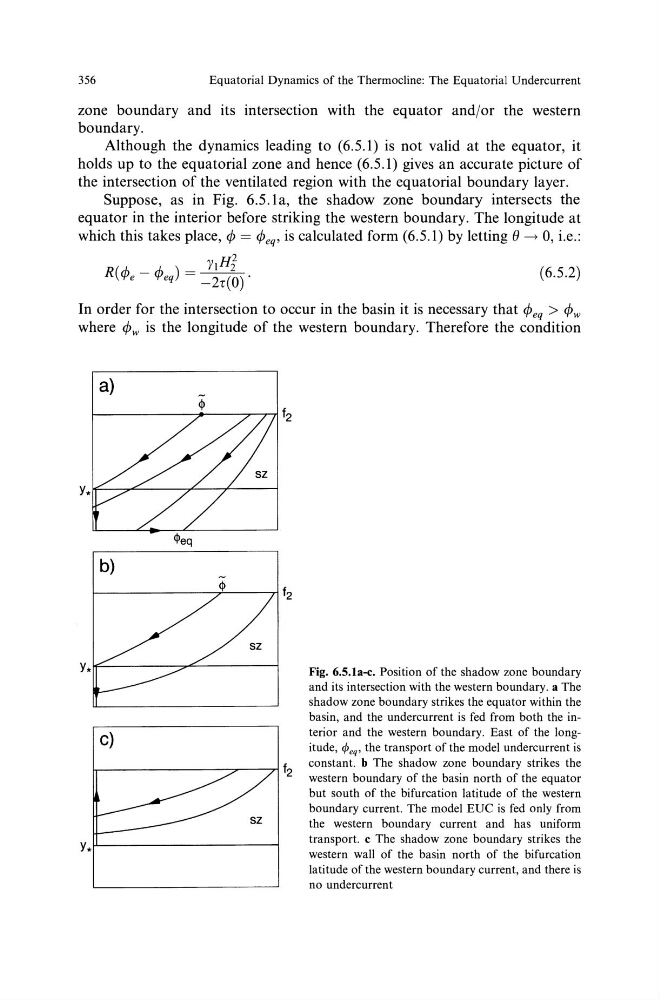
Suppose, as in Fig. 6.5.1a, the shadow zone boundary intersects the
equator in the interior before striking the western boundary. The longitude at
which this takes place,¢= cPeq• is calculated form (6.5.1) by letting()---+ 0, i.e.:
Y!Hi_
R(c/Je- cPeq) = _ 2 -r(O) ·
(6.5.2)
In order for the intersection to occur in the basin it is necessary that cPeq > ¢w
where ¢w is the longitude of the western boundary. Therefore the condition
b)
c)
Fig. 6.5.1a-c. Position of the shadow zone boundary
and its intersection with the western boundary. a The
shadow zone boundary strikes the equator within the
basin, and the undercurrent is fed from both the interior and the western boundary. East of the longitude, c/Jeq• the transport of the model undercurrent is
constant. b The shadow zone boundary strikes the
western boundary of the basin north of the equator
but south of the bifurcation latitude of the western
boundary current. The model EUC is fed only from
the western boundary current and has uniform
transport. c The shadow zone boundary strikes the
western wall of the basin north of the bifurcation
latitude of the western boundary current, and there is
no undercurrent
Equatorial Dynamics of the Thermocline: The Equatorial Undercurrent
zone boundary and its intersection with the equator and/or the western
boundary.
Although the dynamics leading to (6.5.1) is not valid at the equator, it
holds up to the equatorial zone and hence (6.5.1) gives an accurate picture of
the intersection of the ventilated region with the equatorial boundary layer.
Suppose, as in Fig. 6.5.1a, the shadow zone boundary intersects the
equator in the interior before striking the western boundary. The longitude at
which this takes place,¢= cPeq• is calculated form (6.5.1) by letting()---+ 0, i.e.:
Y!Hi_
R(c/Je- cPeq) = _ 2 -r(O) ·
(6.5.2)
In order for the intersection to occur in the basin it is necessary that cPeq > ¢w
where ¢w is the longitude of the western boundary. Therefore the condition
b)
c)
Fig. 6.5.1a-c. Position of the shadow zone boundary
and its intersection with the western boundary. a The
shadow zone boundary strikes the equator within the
basin, and the undercurrent is fed from both the interior and the western boundary. East of the longitude, c/Jeq• the transport of the model undercurrent is
constant. b The shadow zone boundary strikes the
western boundary of the basin north of the equator
but south of the bifurcation latitude of the western
boundary current. The model EUC is fed only from
the western boundary current and has uniform
transport. c The shadow zone boundary strikes the
western wall of the basin north of the bifurcation
latitude of the western boundary current, and there is
no undercurrent