

The Nondissipative Model
347
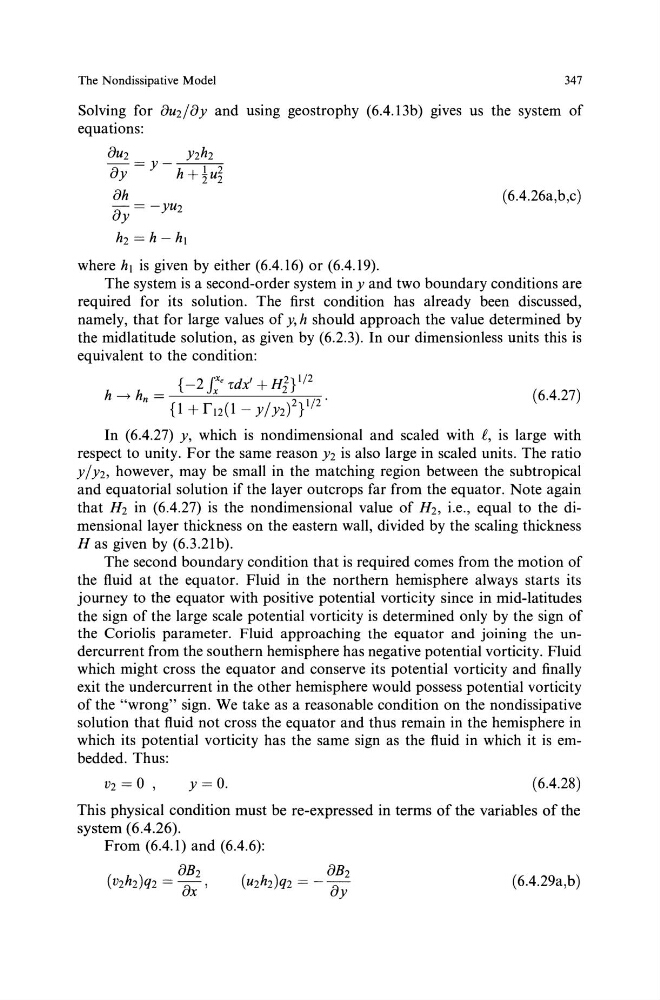
Solving for 8u2/8y and using geostrophy (6.4.13b) gives us the system of
equations:
8u2
Y2h2
ay=y-h+!u~
8h
(6.4.26a,b,c)
- = -yu2
8y
h2 = h- hi
where h1 is given by either (6.4.16) or (6.4.19).
The system is a second-order system in y and two boundary conditions are
required for its solution. The first condition has already been discussed,
namely, that for large values of y, h should approach the value determined by
the midlatitude solution, as given by (6.2.3). In our dimensionless units this is
equivalent to the condition:
_ {-2J:·rdx' +Hi} 1 1 2
h ---+ hn -
2 112 .
( 6.4.27)
{1 + rn(1- yjy2) }
In (6.4.27) y, which is nondimensional and scaled with £, is large with
respect to unity. For the same reason Y2 is also large in scaled units. The ratio
yjy2, however, may be small in the matching region between the subtropical
and equatorial solution if the layer outcrops far from the equator. Note again
that H2 in (6.4.27) is the nondimensional value of H2, i.e., equal to the dimensional layer thickness on the eastern wall, divided by the scaling thickness
Has given by (6.3.21b).
The second boundary condition that is required comes from the motion of
the fluid at the equator. Fluid in the northern hemisphere always starts its
journey to the equator with positive potential vorticity since in mid-latitudes
the sign of the large scale potential vorticity is determined only by the sign of
the Coriolis parameter. Fluid approaching the equator and joining the undercurrent from the southern hemisphere has negative potential vorticity. Fluid
which might cross the equator and conserve its potential vorticity and finally
exit the undercurrent in the other hemisphere would possess potential vorticity
of the "wrong" sign. We take as a reasonable condition on the nondissipative
solution that fluid not cross the equator and thus remain in the hemisphere in
which its potential vorticity has the same sign as the fluid in which it is embedded. Thus:
y=O.
( 6.4.28)
This physical condition must be re-expressed in terms of the variables of the
system (6.4.26).
From (6.4.1) and (6.4.6):
( 6.4.29a, b)
347
Solving for 8u2/8y and using geostrophy (6.4.13b) gives us the system of
equations:
8u2
Y2h2
ay=y-h+!u~
8h
(6.4.26a,b,c)
- = -yu2
8y
h2 = h- hi
where h1 is given by either (6.4.16) or (6.4.19).
The system is a second-order system in y and two boundary conditions are
required for its solution. The first condition has already been discussed,
namely, that for large values of y, h should approach the value determined by
the midlatitude solution, as given by (6.2.3). In our dimensionless units this is
equivalent to the condition:
_ {-2J:·rdx' +Hi} 1 1 2
h ---+ hn -
2 112 .
( 6.4.27)
{1 + rn(1- yjy2) }
In (6.4.27) y, which is nondimensional and scaled with £, is large with
respect to unity. For the same reason Y2 is also large in scaled units. The ratio
yjy2, however, may be small in the matching region between the subtropical
and equatorial solution if the layer outcrops far from the equator. Note again
that H2 in (6.4.27) is the nondimensional value of H2, i.e., equal to the dimensional layer thickness on the eastern wall, divided by the scaling thickness
Has given by (6.3.21b).
The second boundary condition that is required comes from the motion of
the fluid at the equator. Fluid in the northern hemisphere always starts its
journey to the equator with positive potential vorticity since in mid-latitudes
the sign of the large scale potential vorticity is determined only by the sign of
the Coriolis parameter. Fluid approaching the equator and joining the undercurrent from the southern hemisphere has negative potential vorticity. Fluid
which might cross the equator and conserve its potential vorticity and finally
exit the undercurrent in the other hemisphere would possess potential vorticity
of the "wrong" sign. We take as a reasonable condition on the nondissipative
solution that fluid not cross the equator and thus remain in the hemisphere in
which its potential vorticity has the same sign as the fluid in which it is embedded. Thus:
y=O.
( 6.4.28)
This physical condition must be re-expressed in terms of the variables of the
system (6.4.26).
From (6.4.1) and (6.4.6):
( 6.4.29a, b)