

346
Equatorial Dynamics of the Thermocline: The Equatorial Undercurrent
line of constant Bernoulli function in midlatitude as well as in the equatorial
region. It is the relative contribution of the pressure and kinetic energy which
alters along the streamline as the equator is approached. Although both the
potential vorticity and Bernoulli function change from their simple approximate forms in midlatitude to the more complicated representations that are
valid at the equator, the relation between the potential vorticity and Bernoulli
function is retained if the flow is conservative. Once the relation is fixed in
midlatitudes, it is maintained as long as the dynamics is conservative, even in
the region of semi-geostrophic equatorial dynamics.
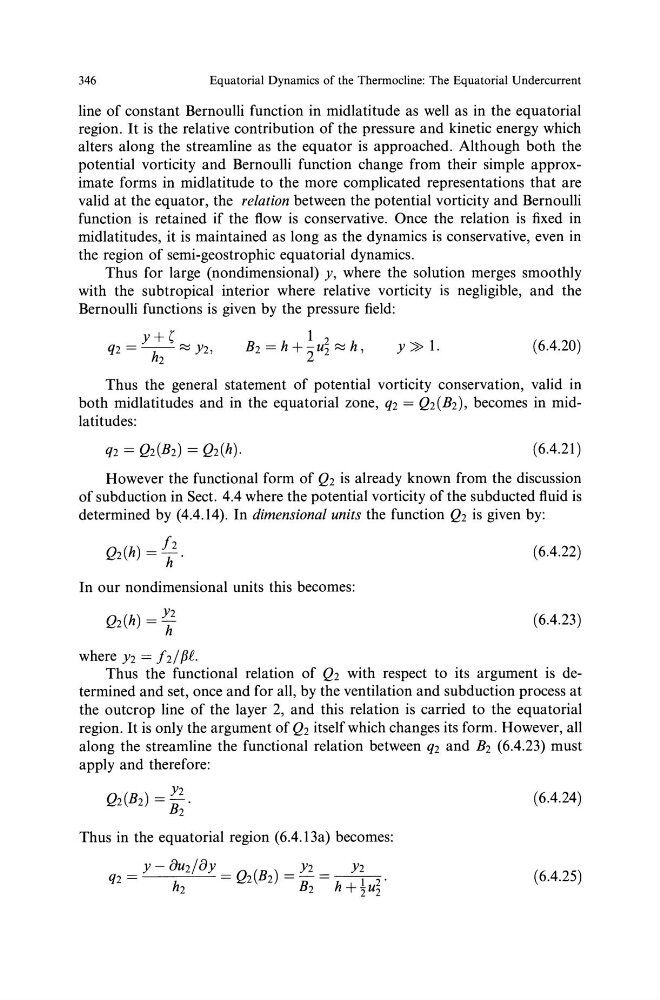
Thus for large (nondimensional) y, where the solution merges smoothly
with the subtropical interior where relative vorticity is negligible, and the
Bernoulli functions is given by the pressure field:
y ::» 1.
(6.4.20)
Thus the general statement of potential vorticity conservation, valid in
both midlatitudes and in the equatorial zone, qz = Qz(Bz), becomes in midlatitudes:
(6.4.21)
However the functional form of Qz is already known from the discussion
of subduction in Sect. 4.4 where the potential vorticity of the subducted fluid is
determined by (4.4.14). In dimensional units the function Qz is given by:
h
Qz(h) =h.
In our nondimensional units this becomes:
where Yz = h/ {3£.
(6.4.22)
(6.4.23)
Thus the functional relation of Qz with respect to its argument is determined and set, once and for all, by the ventilation and subduction process at
the outcrop line of the layer 2, and this relation is carried to the equatorial
region. It is only the argument of Q2 itself which changes its form. However, all
along the streamline the functional relation between qz and Bz (6.4.23) must
apply and therefore:
Yz
Q2(B2) = B 2 .
Thus in the equatorial region (6.4.13a) becomes:
= y- 8uz/8y = Q (B)= Y2 = Y2
q2
h
2 2
B
h + 1 2 •
2
2
2 u2
(6.4.24)
(6.4.25)
Equatorial Dynamics of the Thermocline: The Equatorial Undercurrent
line of constant Bernoulli function in midlatitude as well as in the equatorial
region. It is the relative contribution of the pressure and kinetic energy which
alters along the streamline as the equator is approached. Although both the
potential vorticity and Bernoulli function change from their simple approximate forms in midlatitude to the more complicated representations that are
valid at the equator, the relation between the potential vorticity and Bernoulli
function is retained if the flow is conservative. Once the relation is fixed in
midlatitudes, it is maintained as long as the dynamics is conservative, even in
the region of semi-geostrophic equatorial dynamics.
Thus for large (nondimensional) y, where the solution merges smoothly
with the subtropical interior where relative vorticity is negligible, and the
Bernoulli functions is given by the pressure field:
y ::» 1.
(6.4.20)
Thus the general statement of potential vorticity conservation, valid in
both midlatitudes and in the equatorial zone, qz = Qz(Bz), becomes in midlatitudes:
(6.4.21)
However the functional form of Qz is already known from the discussion
of subduction in Sect. 4.4 where the potential vorticity of the subducted fluid is
determined by (4.4.14). In dimensional units the function Qz is given by:
h
Qz(h) =h.
In our nondimensional units this becomes:
where Yz = h/ {3£.
(6.4.22)
(6.4.23)
Thus the functional relation of Qz with respect to its argument is determined and set, once and for all, by the ventilation and subduction process at
the outcrop line of the layer 2, and this relation is carried to the equatorial
region. It is only the argument of Q2 itself which changes its form. However, all
along the streamline the functional relation between qz and Bz (6.4.23) must
apply and therefore:
Yz
Q2(B2) = B 2 .
Thus in the equatorial region (6.4.13a) becomes:
= y- 8uz/8y = Q (B)= Y2 = Y2
q2
h
2 2
B
h + 1 2 •
2
2
2 u2
(6.4.24)
(6.4.25)