

348
Equatorial Dynamics of the Thermocline: The Equatorial Undercurrent
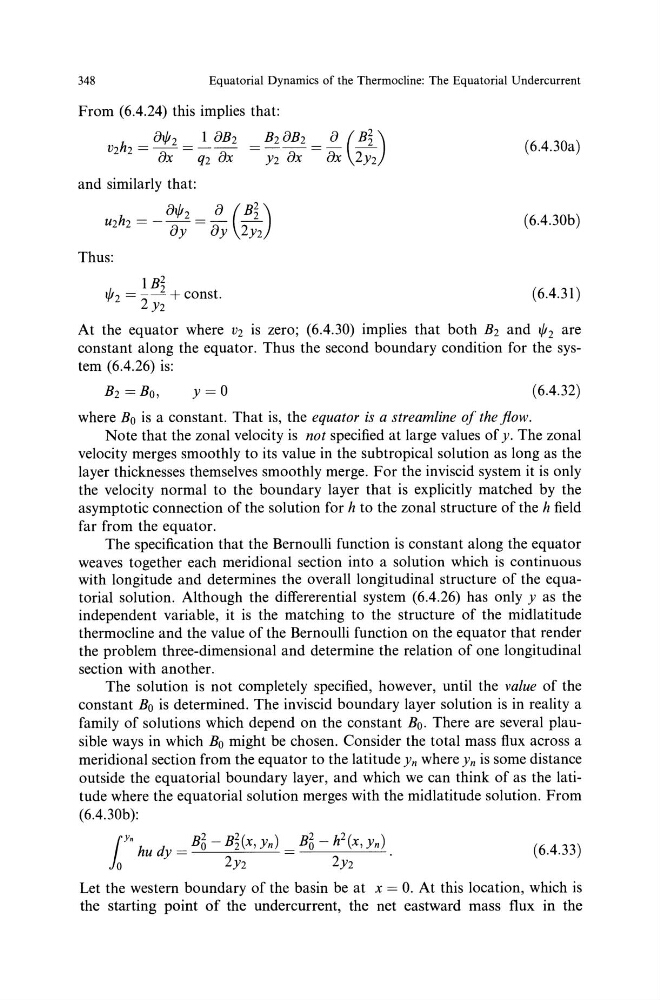
From (6.4.24) this implies that:
v 2 h 2 = at/12 = 2_ aB2 ~ B2 aB2 ~ .!!___ (B~)
ax
q2 ax ~ Y2 ax ~ ax 2y2
(6.4.30a)
and similarly that:
u2h2 = - at/1 2 = !!_ (B~)
ay
ay 2y2
(6.4.30b)
Thus:
1 B 2
t/1 2 = - 2
_1 + const.
Y2
(6.4.31)
At the equator where v2 is zero; (6.4.30) implies that both B2 and t/1 2 are
constant along the equator. Thus the second boundary condition for the system (6.4.26) is:
y=O
( 6.4.32)
where Bo is a constant. That is, the equator is a streamline of the flow.
Note that the zonal velocity is not specified at large values of y. The zonal
velocity merges smoothly to its value in the subtropical solution as long as the
layer thicknesses themselves smoothly merge. For the inviscid system it is only
the velocity normal to the boundary layer that is explicitly matched by the
asymptotic connection of the solution for h to the zonal structure of the h field
far from the equator.
The specification that the Bernoulli function is constant along the equator
weaves together each meridional section into a solution which is continuous
with longitude and determines the overall longitudinal structure of the equatorial solution. Although the differerential system (6.4.26) has only y as the
independent variable, it is the matching to the structure of the midlatitude
thermocline and the value of the Bernoulli function on the equator that render
the problem three-dimensional and determine the relation of one longitudinal
section with another.
The solution is not completely specified, however, until the value of the
constant Bo is determined. The inviscid boundary layer solution is in reality a
family of solutions which depend on the constant Bo. There are several plausible ways in which Bo might be chosen. Consider the total mass flux across a
meridional section from the equator to the latitude Yn where Yn is some distance
outside the equatorial boundary layer, and which we can think of as the latitude where the equatorial solution merges with the midlatitude solution. From
(6.4.30b):
{Y" hu dy = B6- B~(x, Yn) = B6- h2(x, Yn).
h
2n
2n
( 6.4.33)
Let the western boundary of the basin be at x = 0. At this location, which is
the starting point of the undercurrent, the net eastward mass flux in the
Equatorial Dynamics of the Thermocline: The Equatorial Undercurrent
From (6.4.24) this implies that:
v 2 h 2 = at/12 = 2_ aB2 ~ B2 aB2 ~ .!!___ (B~)
ax
q2 ax ~ Y2 ax ~ ax 2y2
(6.4.30a)
and similarly that:
u2h2 = - at/1 2 = !!_ (B~)
ay
ay 2y2
(6.4.30b)
Thus:
1 B 2
t/1 2 = - 2
_1 + const.
Y2
(6.4.31)
At the equator where v2 is zero; (6.4.30) implies that both B2 and t/1 2 are
constant along the equator. Thus the second boundary condition for the system (6.4.26) is:
y=O
( 6.4.32)
where Bo is a constant. That is, the equator is a streamline of the flow.
Note that the zonal velocity is not specified at large values of y. The zonal
velocity merges smoothly to its value in the subtropical solution as long as the
layer thicknesses themselves smoothly merge. For the inviscid system it is only
the velocity normal to the boundary layer that is explicitly matched by the
asymptotic connection of the solution for h to the zonal structure of the h field
far from the equator.
The specification that the Bernoulli function is constant along the equator
weaves together each meridional section into a solution which is continuous
with longitude and determines the overall longitudinal structure of the equatorial solution. Although the differerential system (6.4.26) has only y as the
independent variable, it is the matching to the structure of the midlatitude
thermocline and the value of the Bernoulli function on the equator that render
the problem three-dimensional and determine the relation of one longitudinal
section with another.
The solution is not completely specified, however, until the value of the
constant Bo is determined. The inviscid boundary layer solution is in reality a
family of solutions which depend on the constant Bo. There are several plausible ways in which Bo might be chosen. Consider the total mass flux across a
meridional section from the equator to the latitude Yn where Yn is some distance
outside the equatorial boundary layer, and which we can think of as the latitude where the equatorial solution merges with the midlatitude solution. From
(6.4.30b):
{Y" hu dy = B6- B~(x, Yn) = B6- h2(x, Yn).
h
2n
2n
( 6.4.33)
Let the western boundary of the basin be at x = 0. At this location, which is
the starting point of the undercurrent, the net eastward mass flux in the