

340
Equatorial Dynamics of the Thermocline: The Equatorial Undercurrent
{JM = (AH/P) 1 / 3 is very much greater than the width of the undercurrent would
the mixing of momentum enter the meridional momentum balance. Therefore
we obtain the rather surprising result that the zonal velocity remains in geostrophic balance in the equatorial region for the EUC.
Although the Coriolis parameter becomes very small as the equator is
approached, Vn is so small in comparison to Un due to the latitudinal narrowness of the current, that the meridional advection is simply too feeble to upset
the geostrophic balance for the zonal velocity, even at the e~uator. It is important to note that it is the smallness of the ratio (£/ L) that preserves
geostrophy for the zonal velocity at the equator. The flow is therefore semigeostrophic, i.e., it has one component of the flow in geostrophic balance. This
is the swift zonal component, in the direction along which the current is extended, which remains in geostrophic balance. Thus to O[(£/L) 2 ] (6.3.llb)
reduces to:
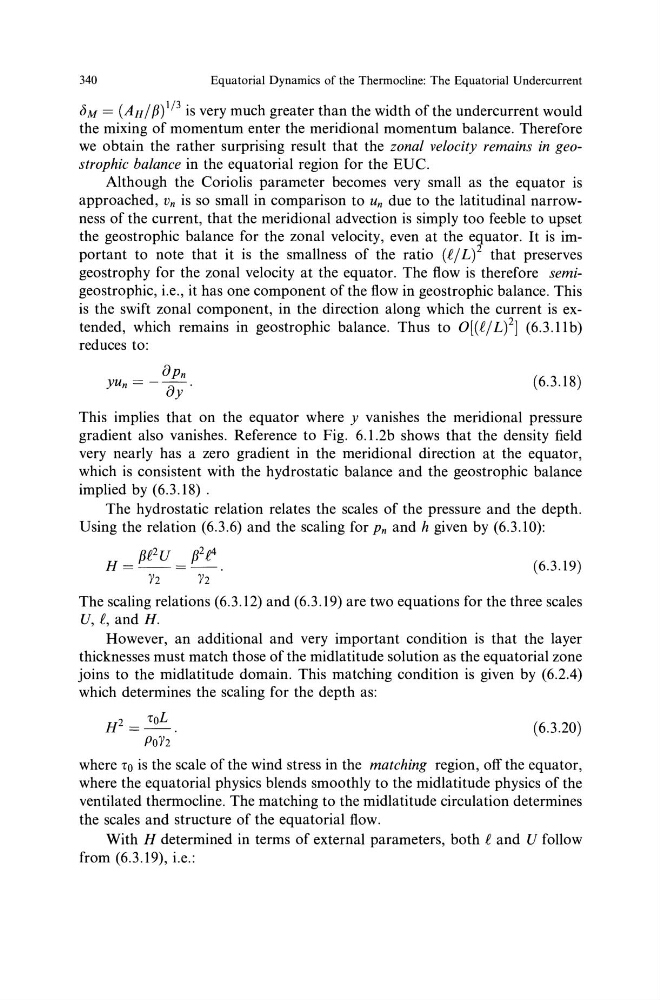
(6.3.18)
This implies that on the equator where y vanishes the meridional pressure
gradient also vanishes. Reference to Fig. 6.1.2b shows that the density field
very nearly has a zero gradient in the meridional direction at the equator,
which is consistent with the hydrostatic balance and the geostrophic balance
implied by (6.3.18) .
The hydrostatic relation relates the scales of the pressure and the depth.
Using the relation (6.3.6) and the scaling for Pn and h given by (6.3.10):
p£2U p2e;4
H = - = - .
(6.3.19)
Y2
Y2
The scaling relations (6.3.12) and (6.3.19) are two equations for the three scales
U, £,and H.
However, an additional and very important condition is that the layer
thicknesses must match those of the midlatitude solution as the equatorial zone
joins to the midlatitude domain. This matching condition is given by (6.2.4)
which determines the scaling for the depth as:
H2 =-coL.
PoY2
(6.3.20)
where -r0 is the scale of the wind stress in the matching region, off the equator,
where the equatorial physics blends smoothly to the midlatitude physics of the
ventilated thermocline. The matching to the midlatitude circulation determines
the scales and structure of the equatorial flow.
With H determined in terms of external parameters, both £ and U follow
from (6.3.19), i.e.:
Equatorial Dynamics of the Thermocline: The Equatorial Undercurrent
{JM = (AH/P) 1 / 3 is very much greater than the width of the undercurrent would
the mixing of momentum enter the meridional momentum balance. Therefore
we obtain the rather surprising result that the zonal velocity remains in geostrophic balance in the equatorial region for the EUC.
Although the Coriolis parameter becomes very small as the equator is
approached, Vn is so small in comparison to Un due to the latitudinal narrowness of the current, that the meridional advection is simply too feeble to upset
the geostrophic balance for the zonal velocity, even at the e~uator. It is important to note that it is the smallness of the ratio (£/ L) that preserves
geostrophy for the zonal velocity at the equator. The flow is therefore semigeostrophic, i.e., it has one component of the flow in geostrophic balance. This
is the swift zonal component, in the direction along which the current is extended, which remains in geostrophic balance. Thus to O[(£/L) 2 ] (6.3.llb)
reduces to:
(6.3.18)
This implies that on the equator where y vanishes the meridional pressure
gradient also vanishes. Reference to Fig. 6.1.2b shows that the density field
very nearly has a zero gradient in the meridional direction at the equator,
which is consistent with the hydrostatic balance and the geostrophic balance
implied by (6.3.18) .
The hydrostatic relation relates the scales of the pressure and the depth.
Using the relation (6.3.6) and the scaling for Pn and h given by (6.3.10):
p£2U p2e;4
H = - = - .
(6.3.19)
Y2
Y2
The scaling relations (6.3.12) and (6.3.19) are two equations for the three scales
U, £,and H.
However, an additional and very important condition is that the layer
thicknesses must match those of the midlatitude solution as the equatorial zone
joins to the midlatitude domain. This matching condition is given by (6.2.4)
which determines the scaling for the depth as:
H2 =-coL.
PoY2
(6.3.20)
where -r0 is the scale of the wind stress in the matching region, off the equator,
where the equatorial physics blends smoothly to the midlatitude physics of the
ventilated thermocline. The matching to the midlatitude circulation determines
the scales and structure of the equatorial flow.
With H determined in terms of external parameters, both £ and U follow
from (6.3.19), i.e.: