

The Nondissipative Model
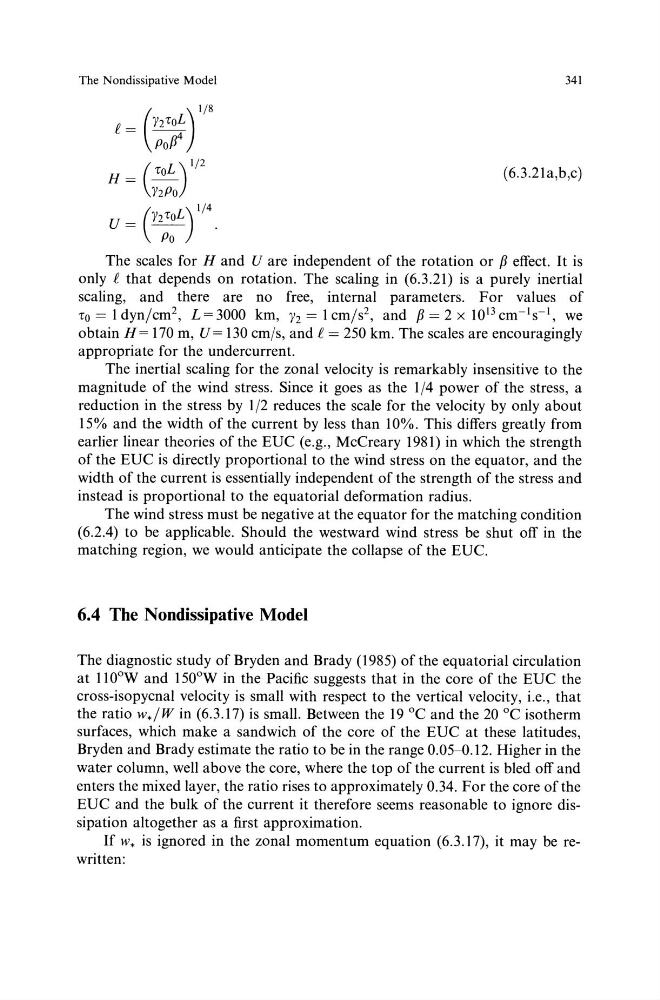
£ = (yzroL) 1/8
Po/3 4
H = (roL) 1/2
YzPo
u = e2::L) 1/4
341
(6.3.2la,b,c)
The scales for H and U are independent of the rotation or f3 effect. It is
only £ that depends on rotation. The scaling in (6.3.21) is a purely inertial
scaling, and there are no free, internal parameters. For values of
r0 =ldynjcm 2 , L=3000 km, y 2 =1cmjs 2 , and f3=2xl0 13 cm- 1 s- 1 , we
obtain H= 170m, U= 130 cmjs, and£= 250 km. The scales are encouragingly
appropriate for the undercurrent.
The inertial scaling for the zonal velocity is remarkably insensitive to the
magnitude of the wind stress. Since it goes as the 1/4 power of the stress, a
reduction in the stress by 1/2 reduces the scale for the velocity by only about
15% and the width of the current by less than 10%. This differs greatly from
earlier linear theories of the EUC (e.g., McCreary 1981) in which the strength
of the EUC is directly proportional to the wind stress on the equator, and the
width of the current is essentially independent of the strength of the stress and
instead is proportional to the equatorial deformation radius.
The wind stress must be negative at the equator for the matching condition
(6.2.4) to be applicable. Should the westward wind stress be shut off in the
matching region, we would anticipate the collapse of the EUC.
6.4 The Nondissipative Model
The diagnostic study of Bryden and Brady (1985) of the equatorial circulation
at ll0°W and 150°W in the Pacific suggests that in the core of the EUC the
cross-isopycnal velocity is small with respect to the vertical velocity, i.e., that
the ratio w./W in (6.3.17) is small. Between the 19 °C and the 20 °C isotherm
surfaces, which make a sandwich of the core of the EUC at these latitudes,
Bryden and Brady estimate the ratio to be in the range 0.05-0.12. Higher in the
water column, well above the core, where the top of the current is bled off and
enters the mixed layer, the ratio rises to approximately 0.34. For the core of the
EUC and the bulk of the current it therefore seems reasonable to ignore dissipation altogether as a first approximation.
If w. is ignored in the zonal momentum equation (6.3.17), it may be rewritten:
£ = (yzroL) 1/8
Po/3 4
H = (roL) 1/2
YzPo
u = e2::L) 1/4
341
(6.3.2la,b,c)
The scales for H and U are independent of the rotation or f3 effect. It is
only £ that depends on rotation. The scaling in (6.3.21) is a purely inertial
scaling, and there are no free, internal parameters. For values of
r0 =ldynjcm 2 , L=3000 km, y 2 =1cmjs 2 , and f3=2xl0 13 cm- 1 s- 1 , we
obtain H= 170m, U= 130 cmjs, and£= 250 km. The scales are encouragingly
appropriate for the undercurrent.
The inertial scaling for the zonal velocity is remarkably insensitive to the
magnitude of the wind stress. Since it goes as the 1/4 power of the stress, a
reduction in the stress by 1/2 reduces the scale for the velocity by only about
15% and the width of the current by less than 10%. This differs greatly from
earlier linear theories of the EUC (e.g., McCreary 1981) in which the strength
of the EUC is directly proportional to the wind stress on the equator, and the
width of the current is essentially independent of the strength of the stress and
instead is proportional to the equatorial deformation radius.
The wind stress must be negative at the equator for the matching condition
(6.2.4) to be applicable. Should the westward wind stress be shut off in the
matching region, we would anticipate the collapse of the EUC.
6.4 The Nondissipative Model
The diagnostic study of Bryden and Brady (1985) of the equatorial circulation
at ll0°W and 150°W in the Pacific suggests that in the core of the EUC the
cross-isopycnal velocity is small with respect to the vertical velocity, i.e., that
the ratio w./W in (6.3.17) is small. Between the 19 °C and the 20 °C isotherm
surfaces, which make a sandwich of the core of the EUC at these latitudes,
Bryden and Brady estimate the ratio to be in the range 0.05-0.12. Higher in the
water column, well above the core, where the top of the current is bled off and
enters the mixed layer, the ratio rises to approximately 0.34. For the core of the
EUC and the bulk of the current it therefore seems reasonable to ignore dissipation altogether as a first approximation.
If w. is ignored in the zonal momentum equation (6.3.17), it may be rewritten: