

An Inertial Theory of the Equatorial Undercurrent
339
where His the vertical scale of the motion, the ratio occurring in the last term
of (6.3.1la) would be of the order:
(x)
L _
(
L )
Fn [3f3U- 0 Av f3£2H2
(6.3.16)
For vertical length scales of the order of 100 m this would require a vertical
mixing coefficient of the order of 400 cm 2 s- 1 , which is much larger than any
present estimates at the level of the EUC core. Johnson and Luther (1994)
report estimates of Av between I cm 2 s- 1 at the EUC core to values of the
order of 50 cm 2 s -I near the surface.
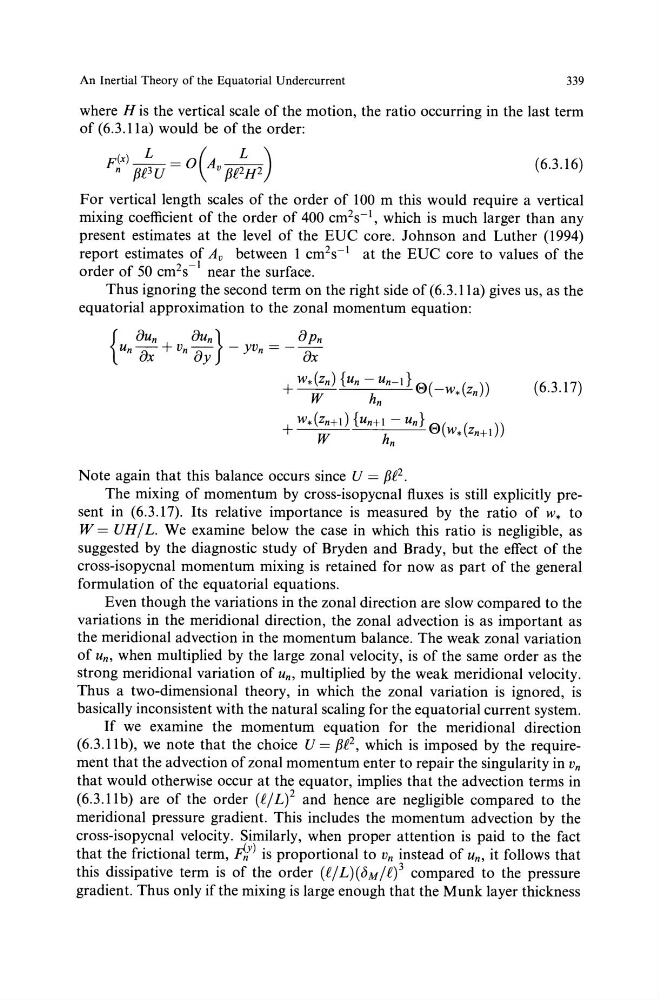
Thus ignoring the second term on the right side of (6.3.lla) gives us, as the
equatorial approximation to the zonal momentum equation:
(6.3.17)
Note again that this balance occurs since U = [3£ 2 .
The mixing of momentum by cross-isopycnal fluxes is still explicitly present in (6.3.17). Its relative importance is measured by the ratio of w. to
W = UHf L. We examine below the case in which this ratio is negligible, as
suggested by the diagnostic study of Bryden and Brady, but the effect of the
cross-isopycnal momentum mixing is retained for now as part of the general
formulation of the equatorial equations.
Even though the variations in the zonal direction are slow compared to the
variations in the meridional direction, the zonal advection is as important as
the meridional advection in the momentum balance. The weak zonal variation
of Un, when multiplied by the large zonal velocity, is of the same order as the
strong meridional variation of un, multiplied by the weak meridional velocity.
Thus a two-dimensional theory, in which the zonal variation is ignored, is
basically inconsistent with the natural scaling for the equatorial current system.
If we examine the momentum equation for the meridional direction
(6.3.1lb), we note that the choice U = [3£ 2 , which is imposed by the requirement that the advection of zonal momentum enter to repair the singularity in vn
that would otherwise occur at the equator, implies that the advection terms in
(6.3.llb) are of the order (C/L) 2 and hence are negligible compared to the
meridional pressure gradient. This includes the momentum advection by the
cross-isopycnal velocity. Similarly, when proper attention is paid to the fact
that the frictional term, F,(l is proportional to Vn instead of un, it follows that
this dissipative term is of the order ( .e j L) ( (J M / £) 3 compared to the pressure
gradient. Thus only if the mixing is large enough that the Munk layer thickness
339
where His the vertical scale of the motion, the ratio occurring in the last term
of (6.3.1la) would be of the order:
(x)
L _
(
L )
Fn [3f3U- 0 Av f3£2H2
(6.3.16)
For vertical length scales of the order of 100 m this would require a vertical
mixing coefficient of the order of 400 cm 2 s- 1 , which is much larger than any
present estimates at the level of the EUC core. Johnson and Luther (1994)
report estimates of Av between I cm 2 s- 1 at the EUC core to values of the
order of 50 cm 2 s -I near the surface.
Thus ignoring the second term on the right side of (6.3.lla) gives us, as the
equatorial approximation to the zonal momentum equation:
(6.3.17)
Note again that this balance occurs since U = [3£ 2 .
The mixing of momentum by cross-isopycnal fluxes is still explicitly present in (6.3.17). Its relative importance is measured by the ratio of w. to
W = UHf L. We examine below the case in which this ratio is negligible, as
suggested by the diagnostic study of Bryden and Brady, but the effect of the
cross-isopycnal momentum mixing is retained for now as part of the general
formulation of the equatorial equations.
Even though the variations in the zonal direction are slow compared to the
variations in the meridional direction, the zonal advection is as important as
the meridional advection in the momentum balance. The weak zonal variation
of Un, when multiplied by the large zonal velocity, is of the same order as the
strong meridional variation of un, multiplied by the weak meridional velocity.
Thus a two-dimensional theory, in which the zonal variation is ignored, is
basically inconsistent with the natural scaling for the equatorial current system.
If we examine the momentum equation for the meridional direction
(6.3.1lb), we note that the choice U = [3£ 2 , which is imposed by the requirement that the advection of zonal momentum enter to repair the singularity in vn
that would otherwise occur at the equator, implies that the advection terms in
(6.3.llb) are of the order (C/L) 2 and hence are negligible compared to the
meridional pressure gradient. This includes the momentum advection by the
cross-isopycnal velocity. Similarly, when proper attention is paid to the fact
that the frictional term, F,(l is proportional to Vn instead of un, it follows that
this dissipative term is of the order ( .e j L) ( (J M / £) 3 compared to the pressure
gradient. Thus only if the mixing is large enough that the Munk layer thickness