

336
Equatorial Dynamics of the Thermocline: The Equatorial Undercurrent
avn avn f3
- -__!__a Pn F(y)
Un a + a + YUn -
a + n
x
y
Po Y
{ Vn - Vn-d
+ w.(zn)
hn
0( -w.(zn))
(6.3.4.b)
{ vn+l- vn}
+ w.(zn+l)
E>(w.(zn+l))
hn
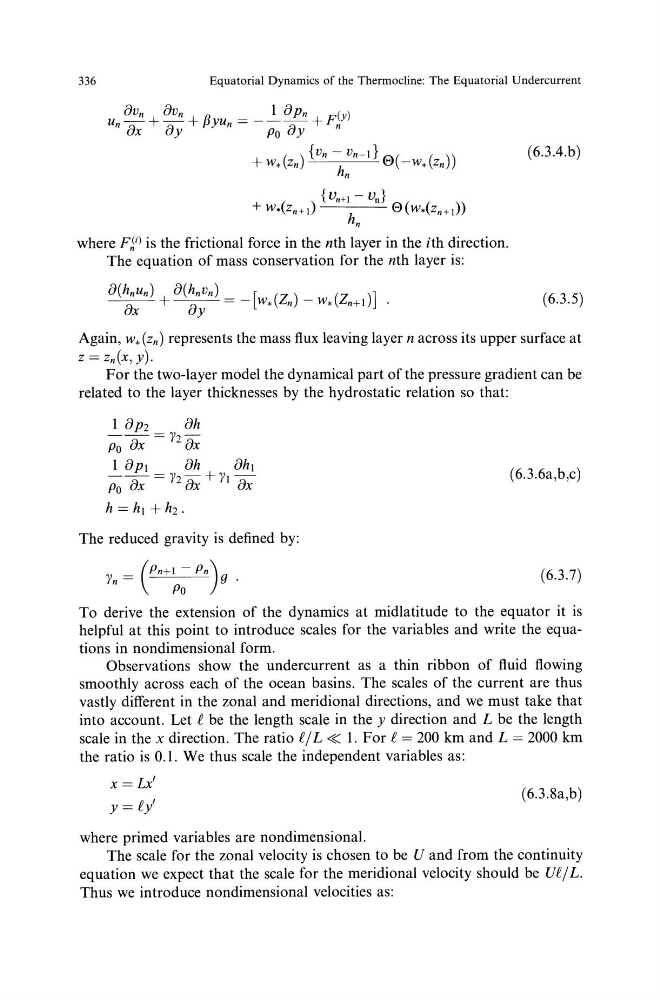
where FJil is the frictional force in the nth layer in the ith direction.
The equation of mass conservation for the nth layer is:
a(hnun) a(hnvn) __ [ (Z ) _
(Z )]
ax + ay - w. n w. n+i 0
( 6.3.5)
Again, w.(zn) represents the mass flux leaving layer n across its upper surface at
z = Zn(x, y).
For the two-layer model the dynamical part of the pressure gradient can be
related to the layer thicknesses by the hydrostatic relation so that:
1 ap2
ah
--=y2Po ax
ax
1 ap,
ah
ah,
--=y2-+y,Po ax
ax
ax
h = h, + h2 0
The reduced gravity is defined by:
Yn = (Pn+~~ Pn)g .
( 6.3.6a,b,c)
(6.3.7)
To derive the extension of the dynamics at midlatitude to the equator it is
helpful at this point to introduce scales for the variables and write the equations in nondimensional form.
Observations show the undercurrent as a thin ribbon of fluid flowing
smoothly across each of the ocean basins. The scales of the current are thus
vastly different in the zonal and meridional directions, and we must take that
into account. Let C be the length scale in the y direction and L be the length
scale in the x direction. The ratio C/ L « 1. For C = 200 km and L = 2000 km
the ratio is 0.1. We thus scale the independent variables as:
x =Lx'
y=Cy'
where primed variables are nondimensional.
(6.3.8a,b)
The scale for the zonal velocity is chosen to be U and from the continuity
equation we expect that the scale for the meridional velocity should be UC/ L.
Thus we introduce nondimensional velocities as:
Equatorial Dynamics of the Thermocline: The Equatorial Undercurrent
avn avn f3
- -__!__a Pn F(y)
Un a + a + YUn -
a + n
x
y
Po Y
{ Vn - Vn-d
+ w.(zn)
hn
0( -w.(zn))
(6.3.4.b)
{ vn+l- vn}
+ w.(zn+l)
E>(w.(zn+l))
hn
where FJil is the frictional force in the nth layer in the ith direction.
The equation of mass conservation for the nth layer is:
a(hnun) a(hnvn) __ [ (Z ) _
(Z )]
ax + ay - w. n w. n+i 0
( 6.3.5)
Again, w.(zn) represents the mass flux leaving layer n across its upper surface at
z = Zn(x, y).
For the two-layer model the dynamical part of the pressure gradient can be
related to the layer thicknesses by the hydrostatic relation so that:
1 ap2
ah
--=y2Po ax
ax
1 ap,
ah
ah,
--=y2-+y,Po ax
ax
ax
h = h, + h2 0
The reduced gravity is defined by:
Yn = (Pn+~~ Pn)g .
( 6.3.6a,b,c)
(6.3.7)
To derive the extension of the dynamics at midlatitude to the equator it is
helpful at this point to introduce scales for the variables and write the equations in nondimensional form.
Observations show the undercurrent as a thin ribbon of fluid flowing
smoothly across each of the ocean basins. The scales of the current are thus
vastly different in the zonal and meridional directions, and we must take that
into account. Let C be the length scale in the y direction and L be the length
scale in the x direction. The ratio C/ L « 1. For C = 200 km and L = 2000 km
the ratio is 0.1. We thus scale the independent variables as:
x =Lx'
y=Cy'
where primed variables are nondimensional.
(6.3.8a,b)
The scale for the zonal velocity is chosen to be U and from the continuity
equation we expect that the scale for the meridional velocity should be UC/ L.
Thus we introduce nondimensional velocities as: