

An Inertial Theory of the Equatorial Undercurrent
335
y=O
P1
z2
h2
P2
z3
P3
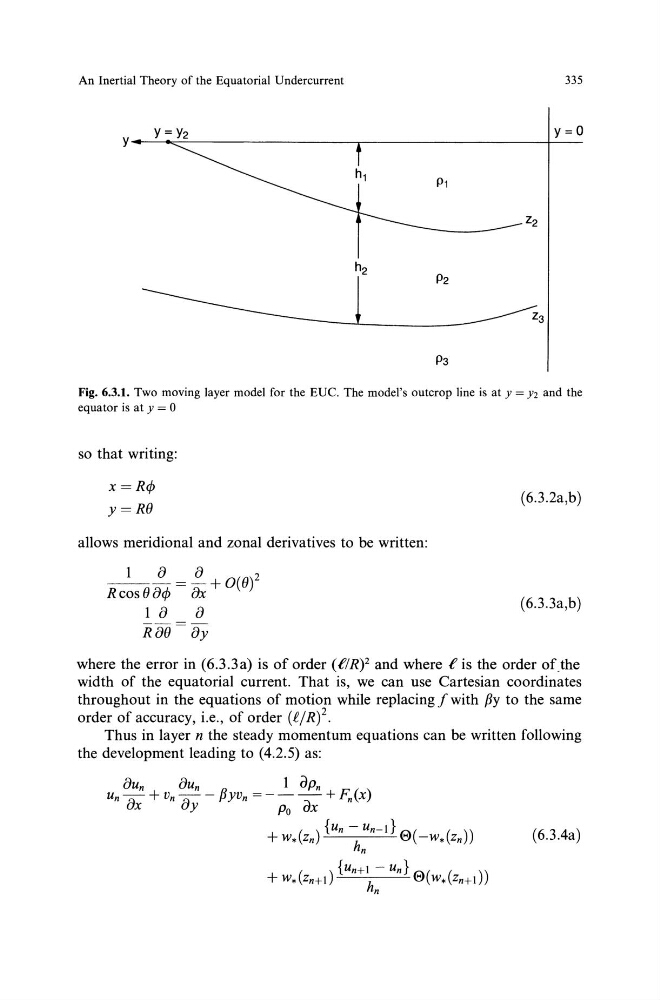
Fig. 6.3.1. Two moving layer model for the EUC. The model's outcrop line is at y = Y2 and the
equator is at y = 0
so that writing:
x=R¢
y = R()
allows meridional and zonal derivatives to be written:
1
a a
2
R cos () acp = ax + O( ())
1 a a
Rae ay
(6.3.2a,b)
(6.3.3a,b)
where the error in (6.3.3a) is of order ( t!R) 2 and where tis the order of_ the
width of the equatorial current. That is, we can use Cartesian coordinates
throughout in the equations of motion while replacing f with f3y to the same
order of accuracy, i.e., of order (f/R) 2 •
Thus in layer n the steady momentum equations can be written following
the development leading to (4.2.5) as:
aun
aun
1 opn
Un-+ Vn-- f3yvn =---+F,(x)
ax
ay
Po ox
{un- Un-1} (
( ))
+ w.(zn)
hn
0 -w. Zn
(6.3.4a)
(
) { Un+l - Un} ( (
))
+ w. Zn+J
hn
0 w. Zn+l
335
y=O
P1
z2
h2
P2
z3
P3
Fig. 6.3.1. Two moving layer model for the EUC. The model's outcrop line is at y = Y2 and the
equator is at y = 0
so that writing:
x=R¢
y = R()
allows meridional and zonal derivatives to be written:
1
a a
2
R cos () acp = ax + O( ())
1 a a
Rae ay
(6.3.2a,b)
(6.3.3a,b)
where the error in (6.3.3a) is of order ( t!R) 2 and where tis the order of_ the
width of the equatorial current. That is, we can use Cartesian coordinates
throughout in the equations of motion while replacing f with f3y to the same
order of accuracy, i.e., of order (f/R) 2 •
Thus in layer n the steady momentum equations can be written following
the development leading to (4.2.5) as:
aun
aun
1 opn
Un-+ Vn-- f3yvn =---+F,(x)
ax
ay
Po ox
{un- Un-1} (
( ))
+ w.(zn)
hn
0 -w. Zn
(6.3.4a)
(
) { Un+l - Un} ( (
))
+ w. Zn+J
hn
0 w. Zn+l