

An Inertial Theory of the Equatorial Undercurrent
337
u= Uu'
£
v = U-v'.
L
(6.3.9a,b)
The horizontal pressure gradient is of the same order as the Coriolis acceleration in the transition zone between the equator and midlatitudes. The
Coriolis acceleration goes to zero right at the equator, but the level of the
pressure is set by the forces in the transition region. The pressure gradient at
the equator is balanced by relative accelerations, but the order of magnitude of
the pressure itself at the equator remains unchanged even though its meridional
gradient may increase. At a distance £ from the equator, for the pressure
gradient to be of the same order as the Coriolis acceleration, the scale of the
pressure, P, should be such that Plf = O(pf3f U). Thus the appropriate
nondimensionalization of the pressure is:
p = PoU/3£2 p'.
(6.3.10a)
Suppose that His the vertical scale of the motion. The layer thicknesses are
then scaled as:
(6.3.10b)
The characteristic scale for the vertical velocity is W = UH j L, and it is this
scale against which the cross-isopycnal velocity is measured.
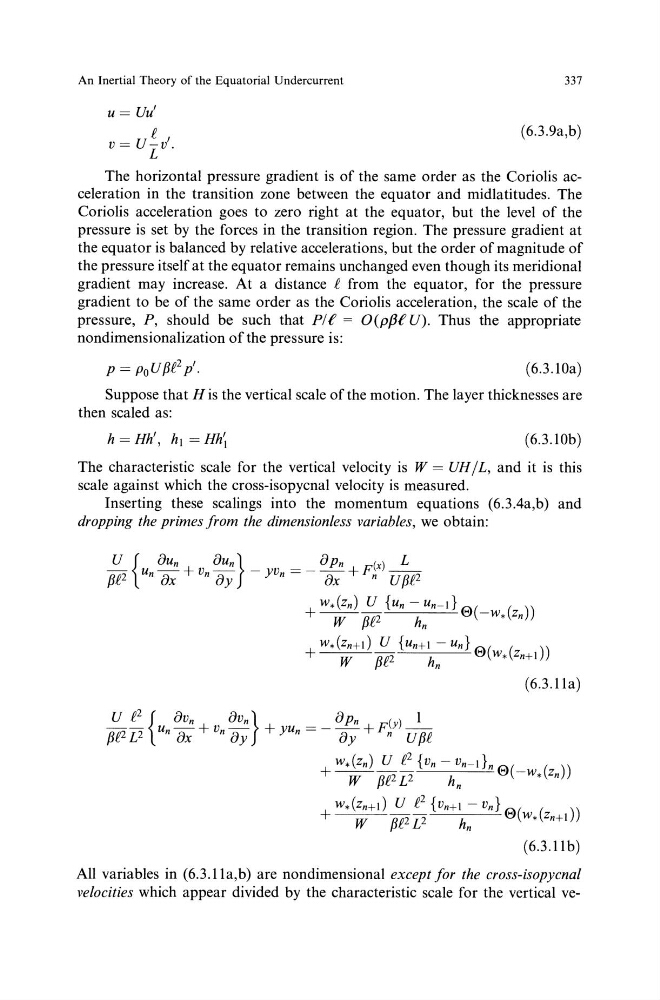
Inserting these scalings into the momentum equations (6.3.4a,b) and
dropping the primes from the dimensionless variables, we obtain:
.!!__ { Bun
Bun} _
_ _ B Pn
(x) ___!:__
f3£2 Un Bx + Vn By
YVn -
Bx + Fn Uf3£2
w.(zn) .!!__ {un- Un-d 0 (- ( ))
+ W f3£2
hn
W* Zn
w.(zn+i) U {un+i- Un} 0 ( (
))
+ W f3£2
hn
W* Zn+i
.!!__ £ 2 { Bvn
Bvn}
__ B Pn
(y) _1_
f3£2 L2 Un Bx + Vn By + YUn- By + Fn Uf3£
(6.3.11a)
w.(zn) .!!__ £ 2 {vn- Vn-dn 0 (- ( ))
+ W f3£2 L2
hn
W* Zn
w.(zn+i) U £ 2 {vn+i- Vn} 0 ( (
))
+ W f3£2 L2
hn
W* Zn+i
(6.3.llb)
All variables in (6.3.lla,b) are nondimensional except for the cross-isopycnal
velocities which appear divided by the characteristic scale for the vertical ve-
337
u= Uu'
£
v = U-v'.
L
(6.3.9a,b)
The horizontal pressure gradient is of the same order as the Coriolis acceleration in the transition zone between the equator and midlatitudes. The
Coriolis acceleration goes to zero right at the equator, but the level of the
pressure is set by the forces in the transition region. The pressure gradient at
the equator is balanced by relative accelerations, but the order of magnitude of
the pressure itself at the equator remains unchanged even though its meridional
gradient may increase. At a distance £ from the equator, for the pressure
gradient to be of the same order as the Coriolis acceleration, the scale of the
pressure, P, should be such that Plf = O(pf3f U). Thus the appropriate
nondimensionalization of the pressure is:
p = PoU/3£2 p'.
(6.3.10a)
Suppose that His the vertical scale of the motion. The layer thicknesses are
then scaled as:
(6.3.10b)
The characteristic scale for the vertical velocity is W = UH j L, and it is this
scale against which the cross-isopycnal velocity is measured.
Inserting these scalings into the momentum equations (6.3.4a,b) and
dropping the primes from the dimensionless variables, we obtain:
.!!__ { Bun
Bun} _
_ _ B Pn
(x) ___!:__
f3£2 Un Bx + Vn By
YVn -
Bx + Fn Uf3£2
w.(zn) .!!__ {un- Un-d 0 (- ( ))
+ W f3£2
hn
W* Zn
w.(zn+i) U {un+i- Un} 0 ( (
))
+ W f3£2
hn
W* Zn+i
.!!__ £ 2 { Bvn
Bvn}
__ B Pn
(y) _1_
f3£2 L2 Un Bx + Vn By + YUn- By + Fn Uf3£
(6.3.11a)
w.(zn) .!!__ £ 2 {vn- Vn-dn 0 (- ( ))
+ W f3£2 L2
hn
W* Zn
w.(zn+i) U £ 2 {vn+i- Vn} 0 ( (
))
+ W f3£2 L2
hn
W* Zn+i
(6.3.llb)
All variables in (6.3.lla,b) are nondimensional except for the cross-isopycnal
velocities which appear divided by the characteristic scale for the vertical ve-