

The Buoyancy- and Wind-Driven Subtropical Gyre: Analytical Solutions
315
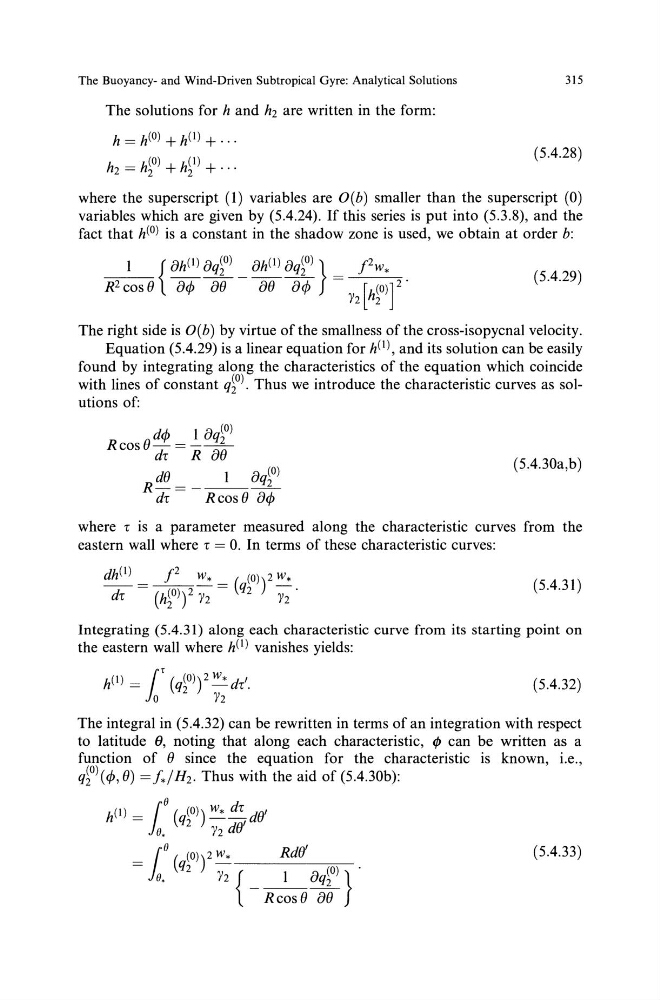
The solutions for h and h2 are written in the form:
h = h(O) +h(!) + · · ·
h2 = h~O) +h~I) + · · ·
(5.4.28)
where the superscript (1) variables are O(b) smaller than the superscript (0)
variables which are given by (5.4.24). If this series is put into (5.3.8), and the
fact that h(o) is a constant in the shadow zone is used, we obtain at order b:
1 { aM'l aq~o) ah<'l aq~ 0 l } _ f 2 w*
R2 cos(} 8¢ 00 - 00 8¢ - ')' 2
[ h~o) r .
(5.4.29)
The right side is O(b) by virtue of the smallness of the cross-isopycnal velocity.
Equation (5.4.29) is a linear equation for h(l), and its solution can be easily
found by integrating along the characteristics of the equation which coincide
with lines of constant q~o). Thus we introduce the characteristic curves as solutions of:
dc/J _ 1 8q~O)
R cos(} dr -ROO
d(}
1 8q(O)
R-=----2dr
Rcos (} 8¢
(5.4.30a,b)
where r is a parameter measured along the characteristic curves from the
eastern wall where r = 0. In terms of these characteristic curves:
(5.4.31)
Integrating (5.4.31) along each characteristic curve from its starting point on
the eastern wall where h(l) vanishes yields:
h(!) = r (q~0))2 w* dr'.
lo
1'2
(5.4.32)
The integral in (5.4.32) can be rewritten in terms of an integration with respect
to latitude 8, noting that along each characteristic, tfJ can be written as a
function of (} since the equation for the characteristic is known, i.e.,
q~o) ( ¢, (}) = f*/ H 2 . Thus with the aid of (5.4.30b):
h(I) = le ( (O)) w* dr d(}'
q2 " d(}'
IJ,
12
= fe (q(o))2 w*
Rde'
le,
2
1'2 { _ _ 1_8q~ 0 ) } •
Rcos (} 8(}
(5.4.33)
315
The solutions for h and h2 are written in the form:
h = h(O) +h(!) + · · ·
h2 = h~O) +h~I) + · · ·
(5.4.28)
where the superscript (1) variables are O(b) smaller than the superscript (0)
variables which are given by (5.4.24). If this series is put into (5.3.8), and the
fact that h(o) is a constant in the shadow zone is used, we obtain at order b:
1 { aM'l aq~o) ah<'l aq~ 0 l } _ f 2 w*
R2 cos(} 8¢ 00 - 00 8¢ - ')' 2
[ h~o) r .
(5.4.29)
The right side is O(b) by virtue of the smallness of the cross-isopycnal velocity.
Equation (5.4.29) is a linear equation for h(l), and its solution can be easily
found by integrating along the characteristics of the equation which coincide
with lines of constant q~o). Thus we introduce the characteristic curves as solutions of:
dc/J _ 1 8q~O)
R cos(} dr -ROO
d(}
1 8q(O)
R-=----2dr
Rcos (} 8¢
(5.4.30a,b)
where r is a parameter measured along the characteristic curves from the
eastern wall where r = 0. In terms of these characteristic curves:
(5.4.31)
Integrating (5.4.31) along each characteristic curve from its starting point on
the eastern wall where h(l) vanishes yields:
h(!) = r (q~0))2 w* dr'.
lo
1'2
(5.4.32)
The integral in (5.4.32) can be rewritten in terms of an integration with respect
to latitude 8, noting that along each characteristic, tfJ can be written as a
function of (} since the equation for the characteristic is known, i.e.,
q~o) ( ¢, (}) = f*/ H 2 . Thus with the aid of (5.4.30b):
h(I) = le ( (O)) w* dr d(}'
q2 " d(}'
IJ,
12
= fe (q(o))2 w*
Rde'
le,
2
1'2 { _ _ 1_8q~ 0 ) } •
Rcos (} 8(}
(5.4.33)