

316
Buoyancy Forced Circulation and Cross-Gyre Flow
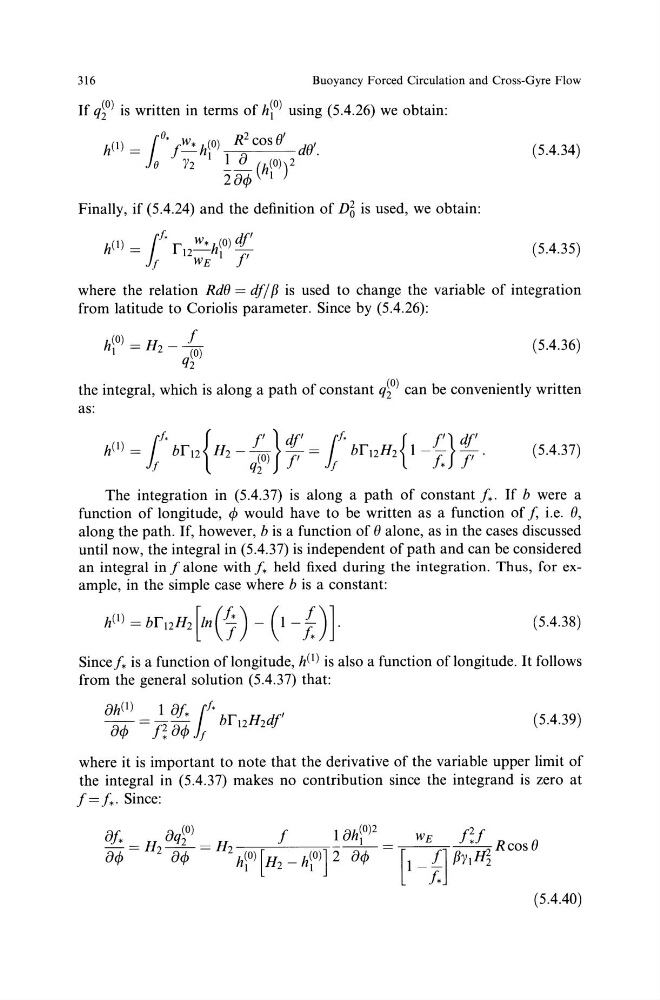
If q~ 0 ) is written in terms of h\ 0 ) using (5.4.26) we obtain:
l
e,
Rz
e'
h(IJ =
fw* h\o)
cos
de'.
e Y2
!~ (h(o))2
28 Finally, if (5.4.24) and the definition of D6 is used, we obtain:
h (l) = 1 1 ' r W*h(O) dj'
12
1 j'
1
WE
(5.4.34)
( 5.4.35)
where the relation Rd8 = df/ [3 is used to change the variable of integration
from latitude to Coriolis parameter. Since by (5.4.26):
(0)f
h 1 -Hz -(0)
q2
( 5.4.36)
the integral, which is along a path of constant q~o) can be conveniently written
as:
h( l =
hr12 H2 - - 0 - , =
br1zHz 1-- -, .
1
1 1 ' { f'} dj' 1 1 ' { f'} dj'
1
q~) f
1
j. f
( 5.4.37)
The integration in (5.4.37) is along a path of constant j.. If b were a
function of longitude, along the path. If, however, b is a function of 8 alone, as in the cases discussed
until now, the integral in (5.4.37) is independent of path and can be considered
an integral in f alone with j. held fixed during the integration. Thus, for example, in the simple case where b is a constant:
( 5.4.38)
Since j. is a function oflongitude, h(ll is also a function of longitude. It follows
from the general solution (5.4.37) that:
8h(IJ
1 8/. 1 1 • ,
8 ( 5.4.39)
where it is important to note that the derivative of the variable upper limit of
the integral in (5.4.37) makes no contribution since the integrand is zero at
f = j.. Since:
( 5.4.40)
Buoyancy Forced Circulation and Cross-Gyre Flow
If q~ 0 ) is written in terms of h\ 0 ) using (5.4.26) we obtain:
l
e,
Rz
e'
h(IJ =
fw* h\o)
cos
de'.
e Y2
!~ (h(o))2
28 Finally, if (5.4.24) and the definition of D6 is used, we obtain:
h (l) = 1 1 ' r W*h(O) dj'
12
1 j'
1
WE
(5.4.34)
( 5.4.35)
where the relation Rd8 = df/ [3 is used to change the variable of integration
from latitude to Coriolis parameter. Since by (5.4.26):
(0)f
h 1 -Hz -(0)
q2
( 5.4.36)
the integral, which is along a path of constant q~o) can be conveniently written
as:
h( l =
hr12 H2 - - 0 - , =
br1zHz 1-- -, .
1
1 1 ' { f'} dj' 1 1 ' { f'} dj'
1
q~) f
1
j. f
( 5.4.37)
The integration in (5.4.37) is along a path of constant j.. If b were a
function of longitude, along the path. If, however, b is a function of 8 alone, as in the cases discussed
until now, the integral in (5.4.37) is independent of path and can be considered
an integral in f alone with j. held fixed during the integration. Thus, for example, in the simple case where b is a constant:
( 5.4.38)
Since j. is a function oflongitude, h(ll is also a function of longitude. It follows
from the general solution (5.4.37) that:
8h(IJ
1 8/. 1 1 • ,
8 ( 5.4.39)
where it is important to note that the derivative of the variable upper limit of
the integral in (5.4.37) makes no contribution since the integrand is zero at
f = j.. Since:
( 5.4.40)