

314
Buoyancy Forced Circulation and Cross-Gyre Flow
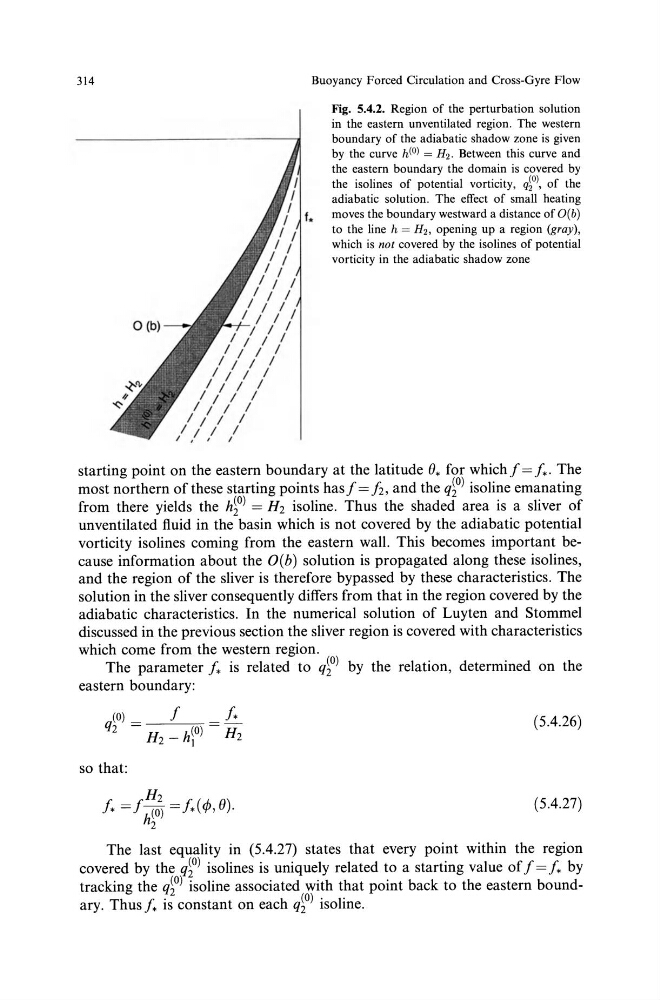
Fig. 5.4.2. Region of the perturbation solution
in the eastern unventilated region. The western
boundary of the adiabatic shadow zone is given
by the curve h(O) = H2 . Between this curve and
the eastern boundary the domain is covered by
the isolines of potential vorticity, q;o), of the
adiabatic solution. The effect of small heating
f.
moves the boundary westward a distance of O(b)
to the line h = H2 , opening up a region (gray) ,
which is not covered by the isolines of potential
vorticity in the adiabatic shadow zone
starting point on the eastern boundary at the latitude e. for which f =f •. The
most northern of these starting points hasf = fi, and the qi 0 ) isoline emanating
from there yields the hi 0 ) = H2 isoline. Thus the shaded area is a sliver of
unventilated fluid in the basin which is not covered by the adiabatic potential
vorticity isolines coming from the eastern wall. This becomes important because information about the O(b) solution is propagated along these isolines,
and the region of the sliver is therefore bypassed by these characteristics. The
solution in the sliver consequently differs from that in the region covered by the
adiabatic characteristics. In the numerical solution of Luyten and Stommel
discussed in the previous section the sliver region is covered with characteristics
which come from the western region.
The parameter f. is related to qi 0 ) by the relation, determined on the
eastern boundary:
(0)
f
f.
q -
2
- H2 - h\o) H2
(5.4.26)
so that:
H2
f. =f(O)=f.(¢,8).
h2
( 5.4.27)
The last equality in (5.4.27) states that every point within the region
covered by the q~o) isolines is uniquely related to a starting value off= f. by
tracking the qi 0 ) isoline associated with that point back to the eastern boundary. Thus f . is constant on each qi 0 l isoline.
Buoyancy Forced Circulation and Cross-Gyre Flow
Fig. 5.4.2. Region of the perturbation solution
in the eastern unventilated region. The western
boundary of the adiabatic shadow zone is given
by the curve h(O) = H2 . Between this curve and
the eastern boundary the domain is covered by
the isolines of potential vorticity, q;o), of the
adiabatic solution. The effect of small heating
f.
moves the boundary westward a distance of O(b)
to the line h = H2 , opening up a region (gray) ,
which is not covered by the isolines of potential
vorticity in the adiabatic shadow zone
starting point on the eastern boundary at the latitude e. for which f =f •. The
most northern of these starting points hasf = fi, and the qi 0 ) isoline emanating
from there yields the hi 0 ) = H2 isoline. Thus the shaded area is a sliver of
unventilated fluid in the basin which is not covered by the adiabatic potential
vorticity isolines coming from the eastern wall. This becomes important because information about the O(b) solution is propagated along these isolines,
and the region of the sliver is therefore bypassed by these characteristics. The
solution in the sliver consequently differs from that in the region covered by the
adiabatic characteristics. In the numerical solution of Luyten and Stommel
discussed in the previous section the sliver region is covered with characteristics
which come from the western region.
The parameter f. is related to qi 0 ) by the relation, determined on the
eastern boundary:
(0)
f
f.
q -
2
- H2 - h\o) H2
(5.4.26)
so that:
H2
f. =f(O)=f.(¢,8).
h2
( 5.4.27)
The last equality in (5.4.27) states that every point within the region
covered by the q~o) isolines is uniquely related to a starting value off= f. by
tracking the qi 0 ) isoline associated with that point back to the eastern boundary. Thus f . is constant on each qi 0 l isoline.