

304
Buoyancy Forced Circulation and Cross-Gyre Flow
(5.3.34)
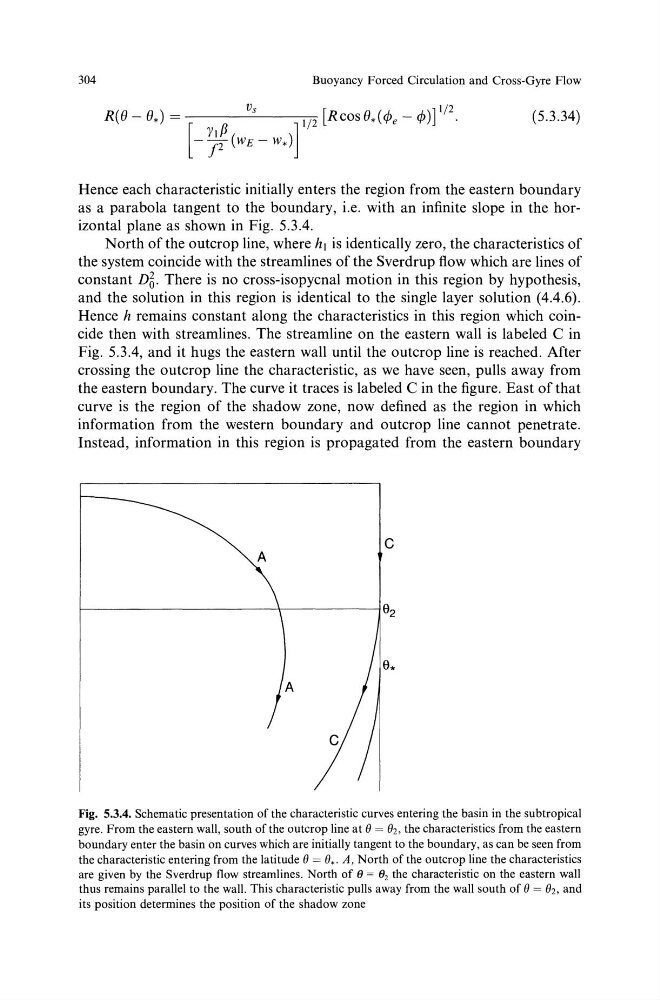
Hence each characteristic initially enters the region from the eastern boundary
as a parabola tangent to the boundary, i.e. with an infinite slope in the horizontal plane as shown in Fig. 5.3.4.
North of the outcrop line, where h1 is identically zero, the characteristics of
the system coincide with the streamlines of the Sverdrup flow which are lines of
constant D6. There is no cross-isopycnal motion in this region by hypothesis,
and the solution in this region is identical to the single layer solution (4.4.6).
Hence h remains constant along the characteristics in this region which coincide then with streamlines. The streamline on the eastern wall is labeled C in
Fig. 5.3.4, and it hugs the eastern wall until the outcrop line is reached. After
crossing the outcrop line the characteristic, as we have seen, pulls away from
the eastern boundary. The curve it traces is labeled C in the figure. East of that
curve is the region of the shadow zone, now defined as the region in which
information from the western boundary and outcrop line cannot penetrate.
Instead, information in this region is propagated from the eastern boundary
c
r---------------------~--------__,92
Fig. 5.3.4. Schematic presentation of the characteristic curves entering the basin in the subtropical
gyre. From the eastern wall, south of the outcrop line at(}= 02, the characteristics from the eastern
boundary enter the basin on curves which are initially tangent to the boundary, as can be seen from
the characteristic entering from the latitude (} = 0 •. A, North of the outcrop line the characteristics
are given by the Sverdrup flow streamlines. North of 6 = 62 the characteristic on the eastern wall
thus remains parallel to the wall. This characteristic pulls away from the wall south of(} = 02, and
its position determines the position of the shadow zone
Buoyancy Forced Circulation and Cross-Gyre Flow
(5.3.34)
Hence each characteristic initially enters the region from the eastern boundary
as a parabola tangent to the boundary, i.e. with an infinite slope in the horizontal plane as shown in Fig. 5.3.4.
North of the outcrop line, where h1 is identically zero, the characteristics of
the system coincide with the streamlines of the Sverdrup flow which are lines of
constant D6. There is no cross-isopycnal motion in this region by hypothesis,
and the solution in this region is identical to the single layer solution (4.4.6).
Hence h remains constant along the characteristics in this region which coincide then with streamlines. The streamline on the eastern wall is labeled C in
Fig. 5.3.4, and it hugs the eastern wall until the outcrop line is reached. After
crossing the outcrop line the characteristic, as we have seen, pulls away from
the eastern boundary. The curve it traces is labeled C in the figure. East of that
curve is the region of the shadow zone, now defined as the region in which
information from the western boundary and outcrop line cannot penetrate.
Instead, information in this region is propagated from the eastern boundary
c
r---------------------~--------__,92
Fig. 5.3.4. Schematic presentation of the characteristic curves entering the basin in the subtropical
gyre. From the eastern wall, south of the outcrop line at(}= 02, the characteristics from the eastern
boundary enter the basin on curves which are initially tangent to the boundary, as can be seen from
the characteristic entering from the latitude (} = 0 •. A, North of the outcrop line the characteristics
are given by the Sverdrup flow streamlines. North of 6 = 62 the characteristic on the eastern wall
thus remains parallel to the wall. This characteristic pulls away from the wall south of(} = 02, and
its position determines the position of the shadow zone