

Nonadiabatic Equations in Characteristic Form
303
and the Rossby wave speed vanish there, the former vanishes linearly with
distance from the eastern wall while, as we see below, h1 and thus c,, vanish as
the square root of the distance from the wall and thus dominate Us near the
wall. Thus, for a characteristic which emanates from the eastern boundary at
the latitude e =e., in the neighborhood of the eastern boundary (5.3.15a) can
be approximated as:
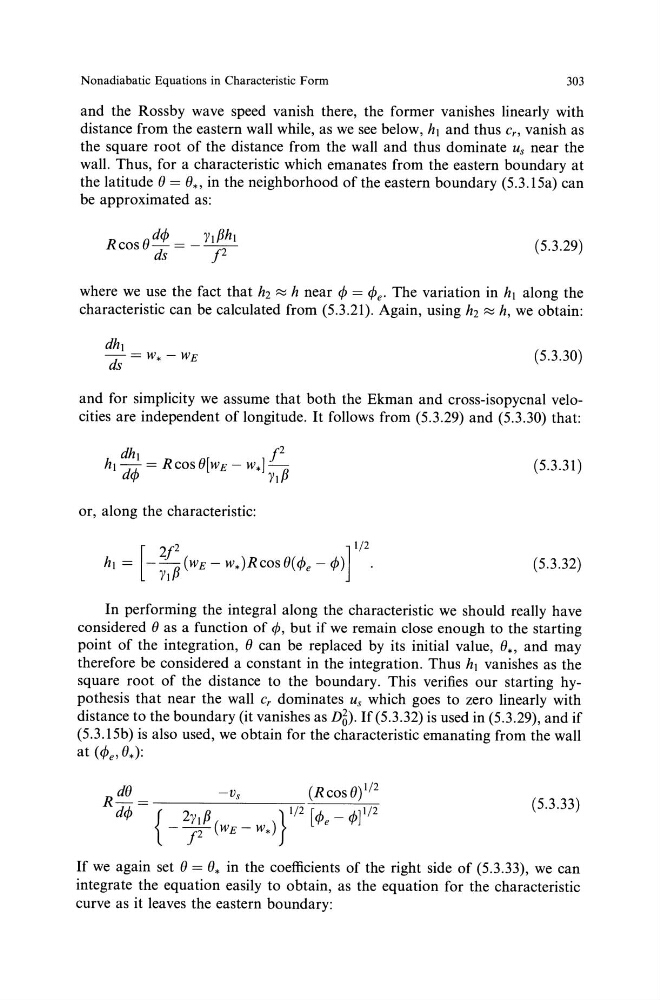
Rcosed ds
j2
( 5.3.29)
where we use the fact that h2 :::::-! h near characteristic can be calculated from (5.3.21). Again, using h2 :::::-! h, we obtain:
dh,
- = W , - W £
ds
( 5.3.30)
and for simplicity we assume that both the Ekman and cross-isopycnal velocities are independent of longitude. It follows from (5.3.29) and (5.3.30) that:
(5.3.31)
or, along the characteristic:
( 5.3.32)
In performing the integral along the characteristic we should really have
considered e as a function of point of the integration, e can be replaced by its initial value, e., and may
therefore be considered a constant in the integration. Thus h1 vanishes as the
square root of the distance to the boundary. This verifies our starting hypothesis that near the wall c, dominates Us which goes to zero linearly with
distance to the boundary (it vanishes as D6). If (5.3.32) is used in (5.3.29), and if
(5.3.15b) is also used, we obtain for the characteristic emanating from the wall
at (
If we again set e = e. in the coefficients of the right side of (5.3.33), we can
integrate the equation easily to obtain, as the equation for the characteristic
curve as it leaves the eastern boundary:
303
and the Rossby wave speed vanish there, the former vanishes linearly with
distance from the eastern wall while, as we see below, h1 and thus c,, vanish as
the square root of the distance from the wall and thus dominate Us near the
wall. Thus, for a characteristic which emanates from the eastern boundary at
the latitude e =e., in the neighborhood of the eastern boundary (5.3.15a) can
be approximated as:
Rcosed ds
j2
( 5.3.29)
where we use the fact that h2 :::::-! h near characteristic can be calculated from (5.3.21). Again, using h2 :::::-! h, we obtain:
dh,
- = W , - W £
ds
( 5.3.30)
and for simplicity we assume that both the Ekman and cross-isopycnal velocities are independent of longitude. It follows from (5.3.29) and (5.3.30) that:
(5.3.31)
or, along the characteristic:
( 5.3.32)
In performing the integral along the characteristic we should really have
considered e as a function of point of the integration, e can be replaced by its initial value, e., and may
therefore be considered a constant in the integration. Thus h1 vanishes as the
square root of the distance to the boundary. This verifies our starting hypothesis that near the wall c, dominates Us which goes to zero linearly with
distance to the boundary (it vanishes as D6). If (5.3.32) is used in (5.3.29), and if
(5.3.15b) is also used, we obtain for the characteristic emanating from the wall
at (
If we again set e = e. in the coefficients of the right side of (5.3.33), we can
integrate the equation easily to obtain, as the equation for the characteristic
curve as it leaves the eastern boundary: