

300
Buoyancy Forced Circulation and Cross-Gyre Flow
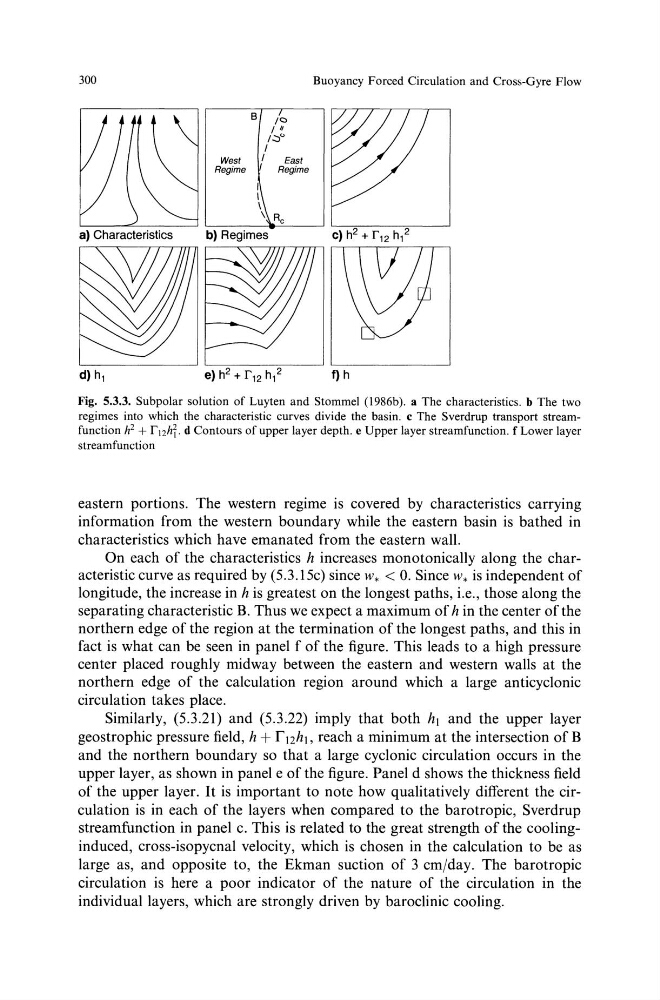
Fig. 5.3.3. Subpolar solution of Luyten and Stommel (1986b). a The characteristics. b The two
regimes into which the characteristic curves divide the basin. c The Sverdrup transport streamfunction h 2 + r1zhi. d Contours of upper layer depth. e Upper layer streamfunction. fLower layer
streamfunction
eastern portions. The western regime is covered by characteristics carrying
information from the western boundary while the eastern basin is bathed in
characteristics which have emanated from the eastern wall.
On each of the characteristics h increases monotonically along the characteristic curve as required by (5.3.15c) since w. < 0. Since w. is independent of
longitude, the increase in h is greatest on the longest paths, i.e., those along the
separating characteristic B. Thus we expect a maximum of h in the center of the
northern edge of the region at the termination of the longest paths, and this in
fact is what can be seen in panel f of the figure. This leads to a high pressure
center placed roughly midway between the eastern and western walls at the
northern edge of the calculation region around which a large anticyclonic
circulation takes place.
Similarly, (5.3.21) and (5.3.22) imply that both h1 and the upper layer
geostrophic pressure field, h + r 12h1, reach a minimum at the intersection of B
and the northern boundary so that a large cyclonic circulation occurs in the
upper layer, as shown in panel e of the figure. Panel d shows the thickness field
of the upper layer. It is important to note how qualitatively different the circulation is in each of the layers when compared to the barotropic, Sverdrup
streamfunction in panel c. This is related to the great strength of the coolinginduced, cross-isopycnal velocity, which is chosen in the calculation to be as
large as, and opposite to, the Ekman suction of 3 em/day. The barotropic
circulation is here a poor indicator of the nature of the circulation in the
individual layers, which are strongly driven by baroclinic cooling.
Buoyancy Forced Circulation and Cross-Gyre Flow
Fig. 5.3.3. Subpolar solution of Luyten and Stommel (1986b). a The characteristics. b The two
regimes into which the characteristic curves divide the basin. c The Sverdrup transport streamfunction h 2 + r1zhi. d Contours of upper layer depth. e Upper layer streamfunction. fLower layer
streamfunction
eastern portions. The western regime is covered by characteristics carrying
information from the western boundary while the eastern basin is bathed in
characteristics which have emanated from the eastern wall.
On each of the characteristics h increases monotonically along the characteristic curve as required by (5.3.15c) since w. < 0. Since w. is independent of
longitude, the increase in h is greatest on the longest paths, i.e., those along the
separating characteristic B. Thus we expect a maximum of h in the center of the
northern edge of the region at the termination of the longest paths, and this in
fact is what can be seen in panel f of the figure. This leads to a high pressure
center placed roughly midway between the eastern and western walls at the
northern edge of the calculation region around which a large anticyclonic
circulation takes place.
Similarly, (5.3.21) and (5.3.22) imply that both h1 and the upper layer
geostrophic pressure field, h + r 12h1, reach a minimum at the intersection of B
and the northern boundary so that a large cyclonic circulation occurs in the
upper layer, as shown in panel e of the figure. Panel d shows the thickness field
of the upper layer. It is important to note how qualitatively different the circulation is in each of the layers when compared to the barotropic, Sverdrup
streamfunction in panel c. This is related to the great strength of the coolinginduced, cross-isopycnal velocity, which is chosen in the calculation to be as
large as, and opposite to, the Ekman suction of 3 em/day. The barotropic
circulation is here a poor indicator of the nature of the circulation in the
individual layers, which are strongly driven by baroclinic cooling.