

Nonadiabatic Equations in Characteristic Form
301
A particularly interesting aspect of the solution is the relationship between
the vertical velocity and the cross-isopycnal velocity. Consider the interface
between layers 1 and 2, where:
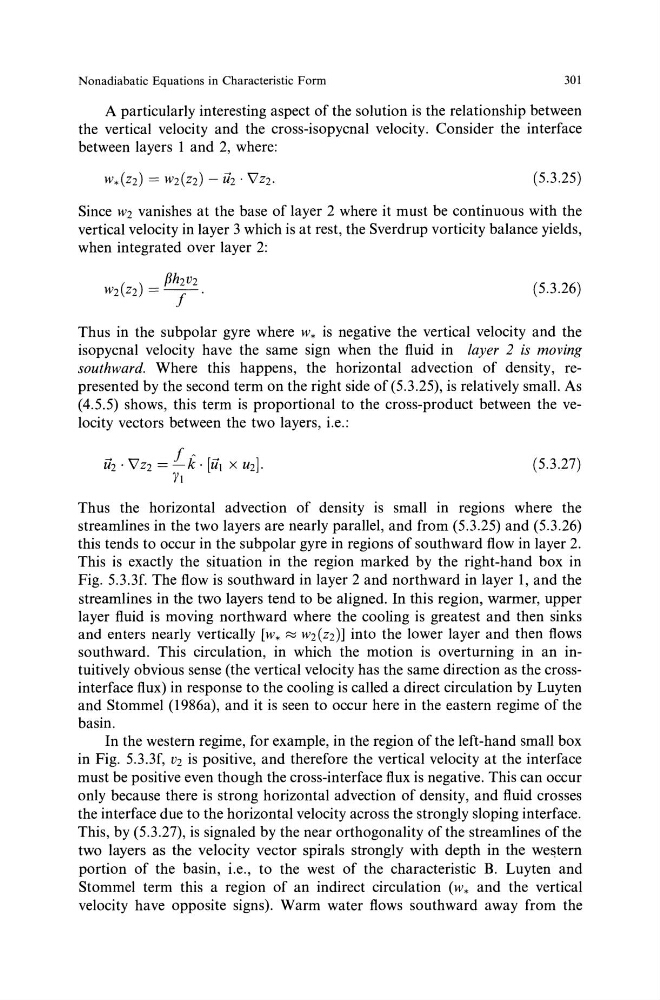
(5.3.25)
Since w2 vanishes at the base of layer 2 where it must be continuous with the
vertical velocity in layer 3 which is at rest, the Sverdrup vorticity balance yields,
when integrated over layer 2:
(5.3.26)
Thus in the subpolar gyre where w. is negative the vertical velocity and the
isopycnal velocity have the same sign when the fluid in layer 2 is moving
southward. Where this happens, the horizontal advection of density, represented by the second term on the right side of (5.3.25), is relatively small. As
(4.5.5) shows, this term is proportional to the cross-product between the velocity vectors between the two layers, i.e.:
(5.3.27)
Thus the horizontal advection of density is small in regions where the
streamlines in the two layers are nearly parallel, and from (5.3.25) and (5.3.26)
this tends to occur in the subpolar gyre in regions of southward flow in layer 2.
This is exactly the situation in the region marked by the right-hand box in
Fig. 5.3.3f. The flow is southward in layer 2 and northward in layer 1, and the
streamlines in the two layers tend to be aligned. In this region, warmer, upper
layer fluid is moving northward where the cooling is greatest and then sinks
and enters nearly vertically [w. ~ wz(zz)] into the lower layer and then flows
southward. This circulation, in which the motion is overturning in an intuitively obvious sense (the vertical velocity has the same direction as the crossinterface flux) in response to the cooling is called a direct circulation by Luyten
and Stommel (1986a), and it is seen to occur here in the eastern regime of the
basin.
In the western regime, for example, in the region of the left-hand small box
in Fig. 5.3.3f, v2 is positive, and therefore the vertical velocity at the interface
must be positive even though the cross-interface flux is negative. This can occur
only because there is strong horizontal advection of density, and fluid crosses
the interface due to the horizontal velocity across the strongly sloping interface.
This, by (5.3.27), is signaled by the near orthogonality of the streamlines of the
two layers as the velocity vector spirals strongly with depth in the we!.!tern
portion of the basin, i.e., to the west of the characteristic B. Luyten and
Stommel term this a region of an indirect circulation (w. and the vertical
velocity have opposite signs). Warm water flows southward away from the
301
A particularly interesting aspect of the solution is the relationship between
the vertical velocity and the cross-isopycnal velocity. Consider the interface
between layers 1 and 2, where:
(5.3.25)
Since w2 vanishes at the base of layer 2 where it must be continuous with the
vertical velocity in layer 3 which is at rest, the Sverdrup vorticity balance yields,
when integrated over layer 2:
(5.3.26)
Thus in the subpolar gyre where w. is negative the vertical velocity and the
isopycnal velocity have the same sign when the fluid in layer 2 is moving
southward. Where this happens, the horizontal advection of density, represented by the second term on the right side of (5.3.25), is relatively small. As
(4.5.5) shows, this term is proportional to the cross-product between the velocity vectors between the two layers, i.e.:
(5.3.27)
Thus the horizontal advection of density is small in regions where the
streamlines in the two layers are nearly parallel, and from (5.3.25) and (5.3.26)
this tends to occur in the subpolar gyre in regions of southward flow in layer 2.
This is exactly the situation in the region marked by the right-hand box in
Fig. 5.3.3f. The flow is southward in layer 2 and northward in layer 1, and the
streamlines in the two layers tend to be aligned. In this region, warmer, upper
layer fluid is moving northward where the cooling is greatest and then sinks
and enters nearly vertically [w. ~ wz(zz)] into the lower layer and then flows
southward. This circulation, in which the motion is overturning in an intuitively obvious sense (the vertical velocity has the same direction as the crossinterface flux) in response to the cooling is called a direct circulation by Luyten
and Stommel (1986a), and it is seen to occur here in the eastern regime of the
basin.
In the western regime, for example, in the region of the left-hand small box
in Fig. 5.3.3f, v2 is positive, and therefore the vertical velocity at the interface
must be positive even though the cross-interface flux is negative. This can occur
only because there is strong horizontal advection of density, and fluid crosses
the interface due to the horizontal velocity across the strongly sloping interface.
This, by (5.3.27), is signaled by the near orthogonality of the streamlines of the
two layers as the velocity vector spirals strongly with depth in the we!.!tern
portion of the basin, i.e., to the west of the characteristic B. Luyten and
Stommel term this a region of an indirect circulation (w. and the vertical
velocity have opposite signs). Warm water flows southward away from the