

Nonadiabatic Equations in Characteristic Form
299
=w
' - - - - - - - - - ' -
8=8 0
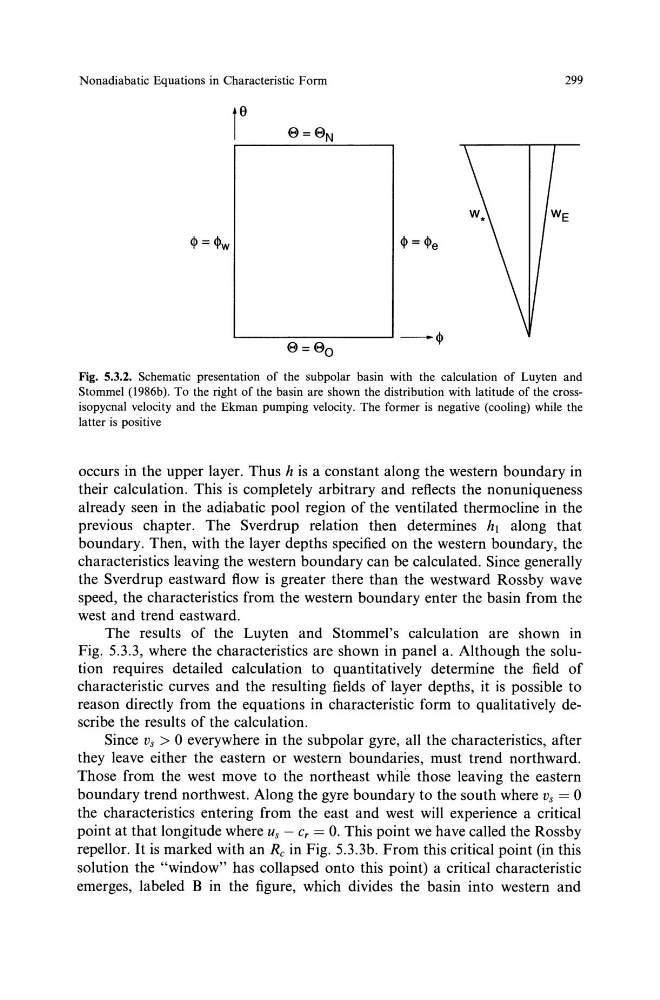
Fig. 5.3.2. Schematic presentation of the subpolar basin with the calculation of Luyten and
Stommel (1986b). To the right of the basin are shown the distribution with latitude of the crossisopycnal velocity and the Ekman pumping velocity. The former is negative (cooling) while the
latter is positive
occurs in the upper layer. Thus h is a constant along the western boundary in
their calculation. This is completely arbitrary and reflects the nonuniqueness
already seen in the adiabatic pool region of the ventilated thermocline in the
previous chapter. The Sverdrup relation then determines h, along that
boundary. Then, with the layer depths specified on the western boundary, the
characteristics leaving the western boundary can be calculated. Since generally
the Sverdrup eastward flow is greater there than the westward Rossby wave
speed, the characteristics from the western boundary enter the basin from the
west and trend eastward.
The results of the Luyten and Stommel's calculation are shown in
Fig. 5.3.3, where the characteristics are shown in panel a. Although the solution requires detailed calculation to quantitatively determine the field of
characteristic curves and the resulting fields of layer depths, it is possible to
reason directly from the equations in characteristic form to qualitatively describe the results of the calculation.
Since Vs > 0 everywhere in the subpolar gyre, all the characteristics, after
they leave either the eastern or western boundaries, must trend northward.
Those from the west move to the northeast while those leaving the eastern
boundary trend northwest. Along the gyre boundary to the south where Vs = 0
the characteristics entering from the east and west will experience a critical
point at that longitude where Us - c, = 0. This point we have called the Ross by
repellor. It is marked with an Rc in Fig. 5.3.3b. From this critical point (in this
solution the "window" has collapsed onto this point) a critical characteristic
emerges, labeled B in the figure, which divides the basin into western and
299
' - - - - - - - - - ' -
8=8 0
Fig. 5.3.2. Schematic presentation of the subpolar basin with the calculation of Luyten and
Stommel (1986b). To the right of the basin are shown the distribution with latitude of the crossisopycnal velocity and the Ekman pumping velocity. The former is negative (cooling) while the
latter is positive
occurs in the upper layer. Thus h is a constant along the western boundary in
their calculation. This is completely arbitrary and reflects the nonuniqueness
already seen in the adiabatic pool region of the ventilated thermocline in the
previous chapter. The Sverdrup relation then determines h, along that
boundary. Then, with the layer depths specified on the western boundary, the
characteristics leaving the western boundary can be calculated. Since generally
the Sverdrup eastward flow is greater there than the westward Rossby wave
speed, the characteristics from the western boundary enter the basin from the
west and trend eastward.
The results of the Luyten and Stommel's calculation are shown in
Fig. 5.3.3, where the characteristics are shown in panel a. Although the solution requires detailed calculation to quantitatively determine the field of
characteristic curves and the resulting fields of layer depths, it is possible to
reason directly from the equations in characteristic form to qualitatively describe the results of the calculation.
Since Vs > 0 everywhere in the subpolar gyre, all the characteristics, after
they leave either the eastern or western boundaries, must trend northward.
Those from the west move to the northeast while those leaving the eastern
boundary trend northwest. Along the gyre boundary to the south where Vs = 0
the characteristics entering from the east and west will experience a critical
point at that longitude where Us - c, = 0. This point we have called the Ross by
repellor. It is marked with an Rc in Fig. 5.3.3b. From this critical point (in this
solution the "window" has collapsed onto this point) a critical characteristic
emerges, labeled B in the figure, which divides the basin into western and