

296
dh
8h d -=--+--. ds 8¢ ds ae ds
Buoyancy Forced Circulation and Cross-Gyre Flow
(5.3.16)
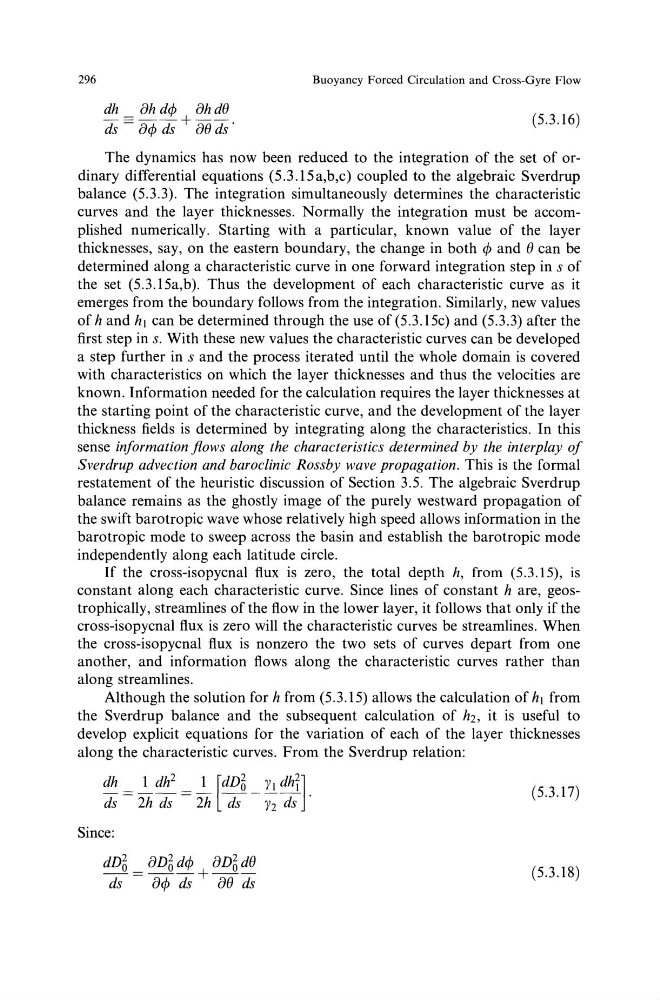
The dynamics has now been reduced to the integration of the set of ordinary differential equations (5.3.15a,b,c) coupled to the algebraic Sverdrup
balance (5.3.3). The integration simultaneously determines the characteristic
curves and the layer thicknesses. Normally the integration must be accomplished numerically. Starting with a particular, known value of the layer
thicknesses, say, on the eastern boundary, the change in both determined along a characteristic curve in one forward integration step in s of
the set (5.3.15a,b). Thus the development of each characteristic curve as it
emerges from the boundary follows from the integration. Similarly, new values
of hand h1 can be determined through the use of (5.3.15c) and (5.3.3) after the
first step ins. With these new values the characteristic curves can be developed
a step further in s and the process iterated until the whole domain is covered
with characteristics on which the layer thicknesses and thus the velocities are
known. Information needed for the calculation requires the layer thicknesses at
the starting point of the characteristic curve, and the development of the layer
thickness fields is determined by integrating along the characteristics. In this
sense information flows along the characteristics determined by the interplay of
Sverdrup advection and baroclinic Rossby wave propagation. This is the formal
restatement of the heuristic discussion of Section 3.5. The algebraic Sverdrup
balance remains as the ghostly image of the purely westward propagation of
the swift barotropic wave whose relatively high speed allows information in the
barotropic mode to sweep across the basin and establish the barotropic mode
independently along each latitude circle.
If the cross-isopycnal flux is zero, the total depth h, from (5.3.15), is
constant along each characteristic curve. Since lines of constant h are, geostrophically, streamlines of the flow in the lower layer, it follows that only if the
cross-isopycnal flux is zero will the characteristic curves be streamlines. When
the cross-isopycnal flux is nonzero the two sets of curves depart from one
another, and information flows along the characteristic curves rather than
along streamlines.
Although the solution for h from (5.3.15) allows the calculation of h1 from
the Sverdrup balance and the subsequent calculation of hz, it is useful to
develop explicit equations for the variation of each of the layer thicknesses
along the characteristic curves. From the Sverdrup relation:
dh _ 1 dh 2 _ 1 [dD5 YJ dhf]
ds - 2h ds - 2h ds - y 2 ds ·
Since:
(5.3.17)
( 5.3.18)
dh
8h d -=--+--. ds 8¢ ds ae ds
Buoyancy Forced Circulation and Cross-Gyre Flow
(5.3.16)
The dynamics has now been reduced to the integration of the set of ordinary differential equations (5.3.15a,b,c) coupled to the algebraic Sverdrup
balance (5.3.3). The integration simultaneously determines the characteristic
curves and the layer thicknesses. Normally the integration must be accomplished numerically. Starting with a particular, known value of the layer
thicknesses, say, on the eastern boundary, the change in both determined along a characteristic curve in one forward integration step in s of
the set (5.3.15a,b). Thus the development of each characteristic curve as it
emerges from the boundary follows from the integration. Similarly, new values
of hand h1 can be determined through the use of (5.3.15c) and (5.3.3) after the
first step ins. With these new values the characteristic curves can be developed
a step further in s and the process iterated until the whole domain is covered
with characteristics on which the layer thicknesses and thus the velocities are
known. Information needed for the calculation requires the layer thicknesses at
the starting point of the characteristic curve, and the development of the layer
thickness fields is determined by integrating along the characteristics. In this
sense information flows along the characteristics determined by the interplay of
Sverdrup advection and baroclinic Rossby wave propagation. This is the formal
restatement of the heuristic discussion of Section 3.5. The algebraic Sverdrup
balance remains as the ghostly image of the purely westward propagation of
the swift barotropic wave whose relatively high speed allows information in the
barotropic mode to sweep across the basin and establish the barotropic mode
independently along each latitude circle.
If the cross-isopycnal flux is zero, the total depth h, from (5.3.15), is
constant along each characteristic curve. Since lines of constant h are, geostrophically, streamlines of the flow in the lower layer, it follows that only if the
cross-isopycnal flux is zero will the characteristic curves be streamlines. When
the cross-isopycnal flux is nonzero the two sets of curves depart from one
another, and information flows along the characteristic curves rather than
along streamlines.
Although the solution for h from (5.3.15) allows the calculation of h1 from
the Sverdrup balance and the subsequent calculation of hz, it is useful to
develop explicit equations for the variation of each of the layer thicknesses
along the characteristic curves. From the Sverdrup relation:
dh _ 1 dh 2 _ 1 [dD5 YJ dhf]
ds - 2h ds - 2h ds - y 2 ds ·
Since:
(5.3.17)
( 5.3.18)