

Nonadiabatic Equations in Characteristic Form
-
-
1'2 A
2
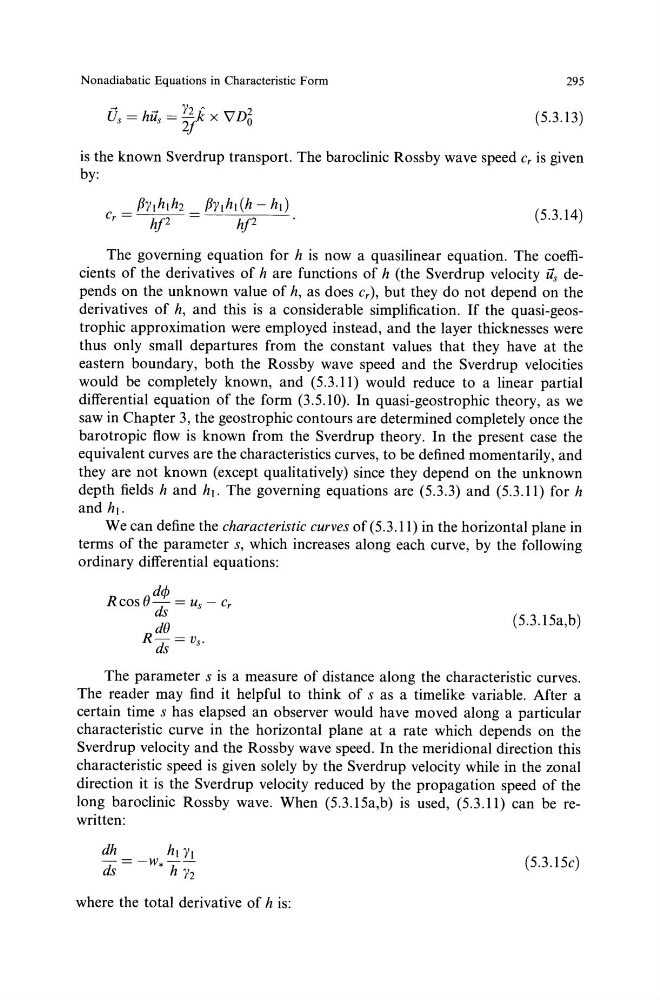
Us= hus = 2J' X \i'D0
295
(5.3.13)
is the known Sverdrup transport. The baroclinic Rossby wave speed c, is given
by:
(5.3.14)
The governing equation for h is now a quasilinear equation. The coefficients of the derivatives of h are functions of h (the Sverdrup velocity ils depends on the unknown value of h, as does c,), but they do not depend on the
derivatives of h, and this is a considerable simplification. If the quasi-geostrophic approximation were employed instead, and the layer thicknesses were
thus only small departures from the constant values that they have at the
eastern boundary, both the Rossby wave speed and the Sverdrup velocities
would be completely known, and (5.3.11) would reduce to a linear partial
differential equation of the form (3.5.10). In quasi-geostrophic theory, as we
saw in Chapter 3, the geostrophic contours are determined completely once the
barotropic flow is known from the Sverdrup theory. In the present case the
equivalent curves are the characteristics curves, to be defined momentarily, and
they are not known (except qualitatively) since they depend on the unknown
depth fields hand h 1• The governing equations are (5.3.3) and (5.3.11) for h
and h,.
We can define the characteristic curves of (5.3.11) in the horizontal plane in
terms of the parameter s, which increases along each curve, by the following
ordinary differential equations:
d¢
Rcos() ds =Us-c,
d()
R ds = Vs.
(5.3.15a,b)
The parameter s is a measure of distance along the characteristic curves.
The reader may find it helpful to think of s as a timelike variable. After a
certain time s has elapsed an observer would have moved along a particular
characteristic curve in the horizontal plane at a rate which depends on the
Sverdrup velocity and the Rossby wave speed. In the meridional direction this
characteristic speed is given solely by the Sverdrup velocity while in the zonal
direction it is the Sverdrup velocity reduced by the propagation speed of the
long baroclinic Rossby wave. When (5.3.15a,b) is used, (5.3.11) can be rewritten:
dh
h, 'Yi
-=-w.-ds
h 1'2
(5.3.15c)
where the total derivative of h is:
-
-
1'2 A
2
Us= hus = 2J' X \i'D0
295
(5.3.13)
is the known Sverdrup transport. The baroclinic Rossby wave speed c, is given
by:
(5.3.14)
The governing equation for h is now a quasilinear equation. The coefficients of the derivatives of h are functions of h (the Sverdrup velocity ils depends on the unknown value of h, as does c,), but they do not depend on the
derivatives of h, and this is a considerable simplification. If the quasi-geostrophic approximation were employed instead, and the layer thicknesses were
thus only small departures from the constant values that they have at the
eastern boundary, both the Rossby wave speed and the Sverdrup velocities
would be completely known, and (5.3.11) would reduce to a linear partial
differential equation of the form (3.5.10). In quasi-geostrophic theory, as we
saw in Chapter 3, the geostrophic contours are determined completely once the
barotropic flow is known from the Sverdrup theory. In the present case the
equivalent curves are the characteristics curves, to be defined momentarily, and
they are not known (except qualitatively) since they depend on the unknown
depth fields hand h 1• The governing equations are (5.3.3) and (5.3.11) for h
and h,.
We can define the characteristic curves of (5.3.11) in the horizontal plane in
terms of the parameter s, which increases along each curve, by the following
ordinary differential equations:
d¢
Rcos() ds =Us-c,
d()
R ds = Vs.
(5.3.15a,b)
The parameter s is a measure of distance along the characteristic curves.
The reader may find it helpful to think of s as a timelike variable. After a
certain time s has elapsed an observer would have moved along a particular
characteristic curve in the horizontal plane at a rate which depends on the
Sverdrup velocity and the Rossby wave speed. In the meridional direction this
characteristic speed is given solely by the Sverdrup velocity while in the zonal
direction it is the Sverdrup velocity reduced by the propagation speed of the
long baroclinic Rossby wave. When (5.3.15a,b) is used, (5.3.11) can be rewritten:
dh
h, 'Yi
-=-w.-ds
h 1'2
(5.3.15c)
where the total derivative of h is: