

Nonadiabatic Equations in Characteristic Form
297
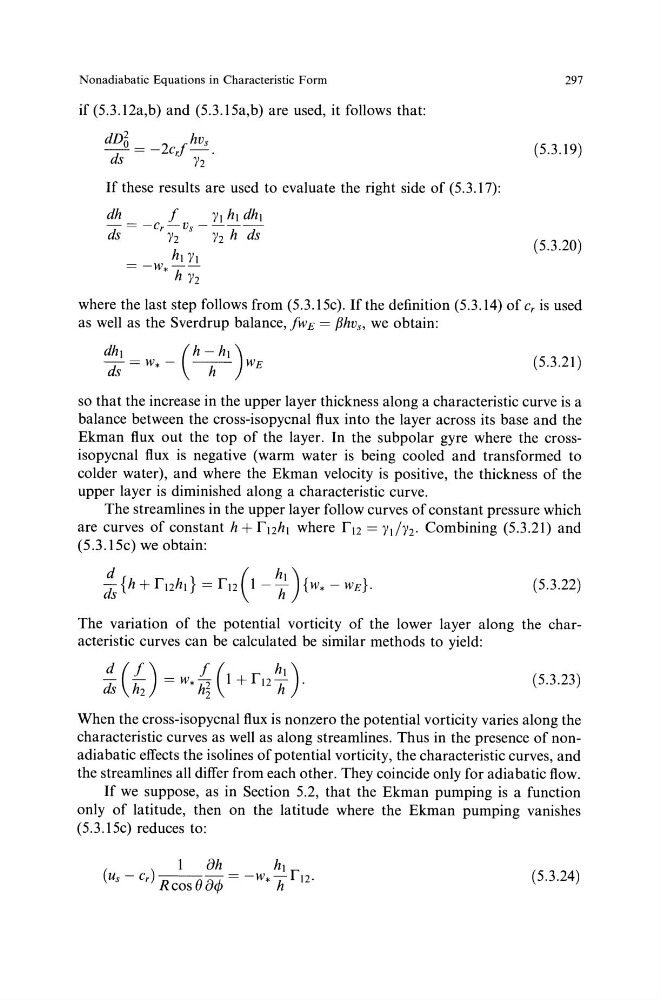
if (5.3.12a,b) and (5.3.15a,b) are used, it follows that:
dD6 = -2crfhvs.
ds
Yz
(5.3.19)
If these results are used to evaluate the right side of (5.3.17):
dh
f
Y1 h1 dh1
- = -cr~Vs- ~-~
ds
y 2
y 2 h ds
h1 Y1
= -w.-~
h Yz
( 5.3.20)
where the last step follows from (5.3.15c). If the definition (5.3.14) of Cr is used
as well as the Sverdrup balance, fw E = f3hv5 , we obtain:
(5.3.21)
so that the increase in the upper layer thickness along a characteristic curve is a
balance between the cross-isopycnal flux into the layer across its base and the
Ekman flux out the top of the layer. In the subpolar gyre where the crossisopycnal flux is negative (warm water is being cooled and transformed to
colder water), and where the Ekman velocity is positive, the thickness of the
upper layer is diminished along a characteristic curve.
The streamlines in the upper layer follow curves of constant pressure which
are curves of constant h + r12h1 where r 12 = y 1 fYz. Combining (5.3.21) and
(5.3.15c) we obtain:
! {h + r12hl} = r 12 (1- : 1 ){w.- wE}.
( 5.3.22)
The variation of the potential vorticity of the lower layer along the characteristic curves can be calculated be similar methods to yield:
! ( ~) = w. ~ ( 1 + r 12 :~ ).
(5.3.23)
When the cross-isopycnal flux is nonzero the potential vorticity varies along the
characteristic curves as well as along streamlines. Thus in the presence of nonadiabatic effects the isolines of potential vorticity, the characteristic curves, and
the streamlines all differ from each other. They coincide only for adiabatic flow.
If we suppose, as in Section 5.2, that the Ekman pumping is a function
only of latitude, then on the latitude where the Ekman pumping vanishes
(5.3.15c) reduces to:
(5.3.24)
297
if (5.3.12a,b) and (5.3.15a,b) are used, it follows that:
dD6 = -2crfhvs.
ds
Yz
(5.3.19)
If these results are used to evaluate the right side of (5.3.17):
dh
f
Y1 h1 dh1
- = -cr~Vs- ~-~
ds
y 2
y 2 h ds
h1 Y1
= -w.-~
h Yz
( 5.3.20)
where the last step follows from (5.3.15c). If the definition (5.3.14) of Cr is used
as well as the Sverdrup balance, fw E = f3hv5 , we obtain:
(5.3.21)
so that the increase in the upper layer thickness along a characteristic curve is a
balance between the cross-isopycnal flux into the layer across its base and the
Ekman flux out the top of the layer. In the subpolar gyre where the crossisopycnal flux is negative (warm water is being cooled and transformed to
colder water), and where the Ekman velocity is positive, the thickness of the
upper layer is diminished along a characteristic curve.
The streamlines in the upper layer follow curves of constant pressure which
are curves of constant h + r12h1 where r 12 = y 1 fYz. Combining (5.3.21) and
(5.3.15c) we obtain:
! {h + r12hl} = r 12 (1- : 1 ){w.- wE}.
( 5.3.22)
The variation of the potential vorticity of the lower layer along the characteristic curves can be calculated be similar methods to yield:
! ( ~) = w. ~ ( 1 + r 12 :~ ).
(5.3.23)
When the cross-isopycnal flux is nonzero the potential vorticity varies along the
characteristic curves as well as along streamlines. Thus in the presence of nonadiabatic effects the isolines of potential vorticity, the characteristic curves, and
the streamlines all differ from each other. They coincide only for adiabatic flow.
If we suppose, as in Section 5.2, that the Ekman pumping is a function
only of latitude, then on the latitude where the Ekman pumping vanishes
(5.3.15c) reduces to:
(5.3.24)