

18
Sverdrup Theory
while using the Sverdrup relation for the geostrophic flow allows us to estimate
U in terms of the Ekman pumping, so that:
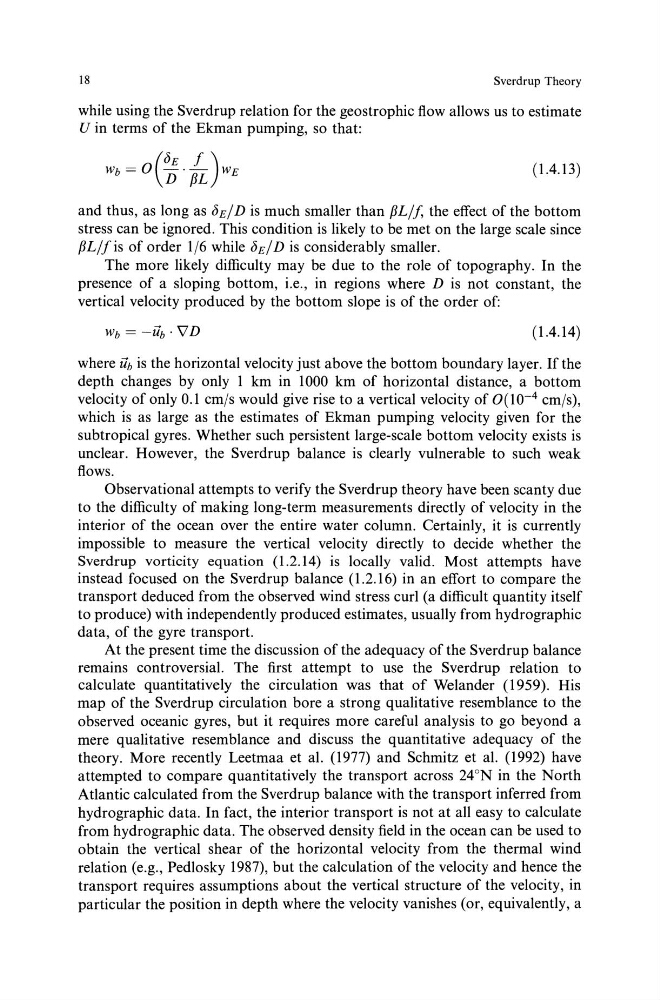
wb = o(fJE · L)wE
D PL
(1.4.13)
and thus, as long as fJE/ Dis much smaller than PL/f, the effect of the bottom
stress can be ignored. This condition is likely to be met on the large scale since
PL/fis of order 1/6 while fJE/ Dis considerably smaller.
The more likely difficulty may be due to the role of topography. In the
presence of a sloping bottom, i.e., in regions where D is not constant, the
vertical velocity produced by the bottom slope is of the order of:
(1.4.14)
where ilb is the horizontal velocity just above the bottom boundary layer. If the
depth changes by only 1 km in 1000 km of horizontal distance, a bottom
velocity of only 0.1 cmjs would give rise to a vertical velocity of 0(10- 4 cm/s),
which is as large as the estimates of Ekman pumping velocity given for the
subtropical gyres. Whether such persistent large-scale bottom velocity exists is
unclear. However, the Sverdrup balance is clearly vulnerable to such weak
flows.
Observational attempts to verify the Sverdrup theory have been scanty due
to the difficulty of making long-term measurements directly of velocity in the
interior of the ocean over the entire water column. Certainly, it is currently
impossible to measure the vertical velocity directly to decide whether the
Sverdrup vorticity equation (1.2.14) is locally valid. Most attempts have
instead focused on the Sverdrup balance (1.2.16) in an effort to compare the
transport deduced from the observed wind stress curl (a difficult quantity itself
to produce) with independently produced estimates, usually from hydrographic
data, of the gyre transport.
At the present time the discussion of the adequacy of the Sverdrup balance
remains controversial. The first attempt to use the Sverdrup relation to
calculate quantitatively the circulation was that of Welander (1959). His
map of the Sverdrup circulation bore a strong qualitative resemblance to the
observed oceanic gyres, but it requires more careful analysis to go beyond a
mere qualitative resemblance and discuss the quantitative adequacy of the
theory. More recently Leetmaa et al. (1977) and Schmitz et al. (1992) have
attempted to compare quantitatively the transport across 24°N in the North
Atlantic calculated from the Sverdrup balance with the transport inferred from
hydrographic data. In fact, the interior transport is not at all easy to calculate
from hydrographic data. The observed density field in the ocean can be used to
obtain the vertical shear of the horizontal velocity from the thermal wind
relation (e.g., Pedlosky 1987), but the calculation of the velocity and hence the
transport requires assumptions about the vertical structure of the velocity, in
particular the position in depth where the velocity vanishes (or, equivalently, a
Sverdrup Theory
while using the Sverdrup relation for the geostrophic flow allows us to estimate
U in terms of the Ekman pumping, so that:
wb = o(fJE · L)wE
D PL
(1.4.13)
and thus, as long as fJE/ Dis much smaller than PL/f, the effect of the bottom
stress can be ignored. This condition is likely to be met on the large scale since
PL/fis of order 1/6 while fJE/ Dis considerably smaller.
The more likely difficulty may be due to the role of topography. In the
presence of a sloping bottom, i.e., in regions where D is not constant, the
vertical velocity produced by the bottom slope is of the order of:
(1.4.14)
where ilb is the horizontal velocity just above the bottom boundary layer. If the
depth changes by only 1 km in 1000 km of horizontal distance, a bottom
velocity of only 0.1 cmjs would give rise to a vertical velocity of 0(10- 4 cm/s),
which is as large as the estimates of Ekman pumping velocity given for the
subtropical gyres. Whether such persistent large-scale bottom velocity exists is
unclear. However, the Sverdrup balance is clearly vulnerable to such weak
flows.
Observational attempts to verify the Sverdrup theory have been scanty due
to the difficulty of making long-term measurements directly of velocity in the
interior of the ocean over the entire water column. Certainly, it is currently
impossible to measure the vertical velocity directly to decide whether the
Sverdrup vorticity equation (1.2.14) is locally valid. Most attempts have
instead focused on the Sverdrup balance (1.2.16) in an effort to compare the
transport deduced from the observed wind stress curl (a difficult quantity itself
to produce) with independently produced estimates, usually from hydrographic
data, of the gyre transport.
At the present time the discussion of the adequacy of the Sverdrup balance
remains controversial. The first attempt to use the Sverdrup relation to
calculate quantitatively the circulation was that of Welander (1959). His
map of the Sverdrup circulation bore a strong qualitative resemblance to the
observed oceanic gyres, but it requires more careful analysis to go beyond a
mere qualitative resemblance and discuss the quantitative adequacy of the
theory. More recently Leetmaa et al. (1977) and Schmitz et al. (1992) have
attempted to compare quantitatively the transport across 24°N in the North
Atlantic calculated from the Sverdrup balance with the transport inferred from
hydrographic data. In fact, the interior transport is not at all easy to calculate
from hydrographic data. The observed density field in the ocean can be used to
obtain the vertical shear of the horizontal velocity from the thermal wind
relation (e.g., Pedlosky 1987), but the calculation of the velocity and hence the
transport requires assumptions about the vertical structure of the velocity, in
particular the position in depth where the velocity vanishes (or, equivalently, a