

On the Validity of Sverdrup Theory
19
value for the velocity at a particular depth is required). The location of this
"level of no motion" is one of the most perplexing issues in observational
oceanography, and its determination is often a matter requiring very subjective
judgments. Instead, the comparison of the Sverdrup transport across 24oN
calculated from the wind stress curl has been made with the more reliable direct
measurements of the return flow in the Florida Current. This is the region
where the Gulf Stream flows through the Straits of Florida, and the transport
of the current can be measured relatively easily there. There is general
agreement that the transport is about 30 sverdrups and represents the return
flow which balances the total net mass transport southward in the interior. The
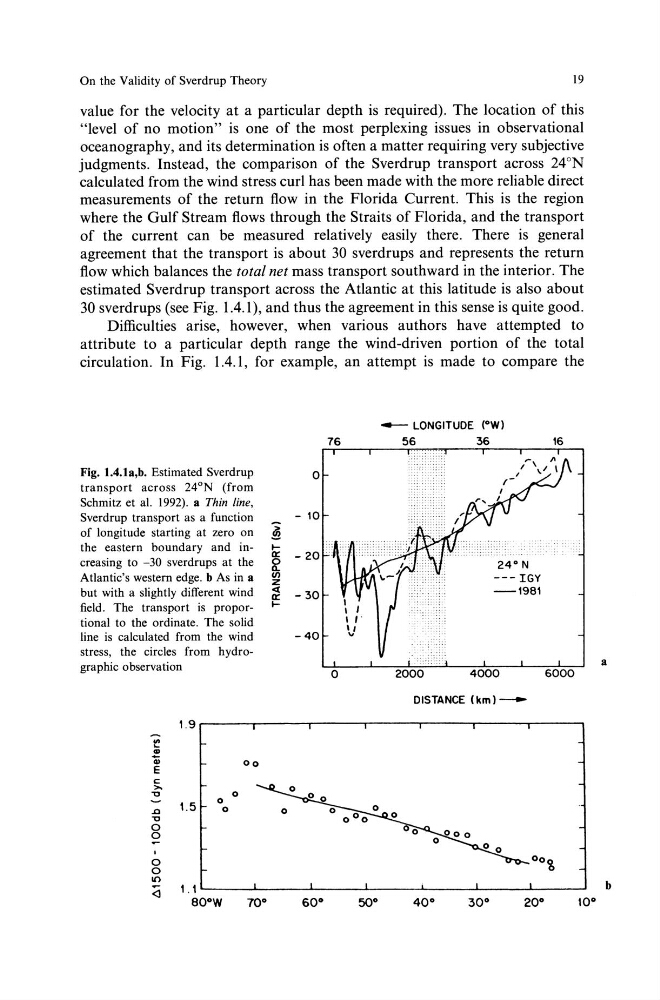
estimated Sverdrup transport across the Atlantic at this latitude is also about
30 sverdrups (see Fig. 1.4.1), and thus the agreement in this sense is quite good.
Difficulties arise, however, when various authors have attempted to
attribute to a particular depth range the wind-driven portion of the total
circulation. In Fig. 1.4.1, for example, an attempt is made to compare the
- - - LONGITUDE ( 0 W)
76
56
36
Fig. 1.4.1a,b. Estimated Sverdrup
0
transport across 24°N (from
Schmitz et al. 1992). a Thin line,
Sverdrup transport as a function
-10
of longitude starting at zero on ~
1IX
creasing to -30 sverdrups at the
0
Q.
Atlantic's western edge. b As in a
Ill
z
but with a slightly different wind
<(
-30
IX
1tiona! to the ordinate. The solid
line is calculated from the wind
-40
stress, the circles from hydrographic observation
0
4000
6000
DISTANCE ( km)--1.9
~
"'
a;
oo
E
c
>.
"0
0
1.5
0
..0
0
"0
0
0
0
oo%
0
I{)
80°W
70°
60°
5QO
40°
30°
20°
10°
a
b
19
value for the velocity at a particular depth is required). The location of this
"level of no motion" is one of the most perplexing issues in observational
oceanography, and its determination is often a matter requiring very subjective
judgments. Instead, the comparison of the Sverdrup transport across 24oN
calculated from the wind stress curl has been made with the more reliable direct
measurements of the return flow in the Florida Current. This is the region
where the Gulf Stream flows through the Straits of Florida, and the transport
of the current can be measured relatively easily there. There is general
agreement that the transport is about 30 sverdrups and represents the return
flow which balances the total net mass transport southward in the interior. The
estimated Sverdrup transport across the Atlantic at this latitude is also about
30 sverdrups (see Fig. 1.4.1), and thus the agreement in this sense is quite good.
Difficulties arise, however, when various authors have attempted to
attribute to a particular depth range the wind-driven portion of the total
circulation. In Fig. 1.4.1, for example, an attempt is made to compare the
- - - LONGITUDE ( 0 W)
76
56
36
Fig. 1.4.1a,b. Estimated Sverdrup
0
transport across 24°N (from
Schmitz et al. 1992). a Thin line,
Sverdrup transport as a function
-10
of longitude starting at zero on ~
1IX
creasing to -30 sverdrups at the
0
Q.
Atlantic's western edge. b As in a
Ill
z
but with a slightly different wind
<(
-30
IX
1tiona! to the ordinate. The solid
line is calculated from the wind
-40
stress, the circles from hydrographic observation
0
4000
6000
DISTANCE ( km)--1.9
~
"'
a;
oo
E
c
>.
"0
0
1.5
0
..0
0
"0
0
0
0
oo%
0
I{)
80°W
70°
60°
5QO
40°
30°
20°
10°
a
b