

On the Validity of Sverdrup Theory
17
a
1 a 2 2
u' = - ( uv) + - - ( v - u-),
ax
2ay
a
1 a 2 2
v' = --(uv) +--(v - u)
ay
2ax
(1.4.9)
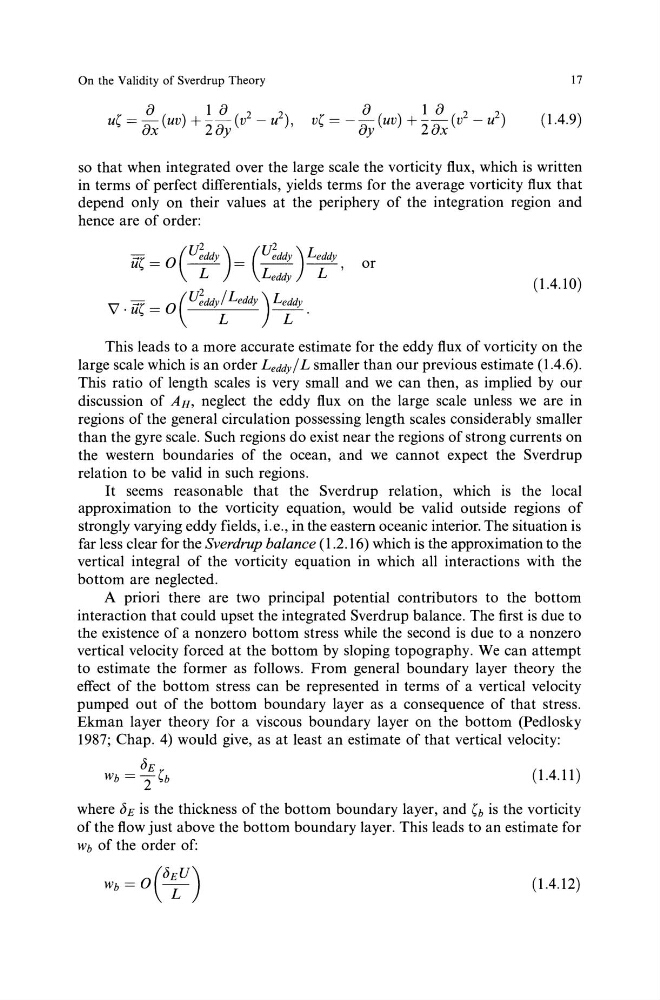
so that when integrated over the large scale the vorticity flux, which is written
in terms of perfect differentials, yields terms for the average vorticity flux that
depend only on their values at the periphery of the integration region and
hence are of order:
a, = O ( u;ddy ) = ( u;ddy ) Leddy , or
L
Leddy
L
V' . a, = O ( u;ddyi Leddy) L~dy .
(1.4.10)
This leads to a more accurate estimate for the eddy flux of vorticity on the
large scale which is an order Leddy/ L smaller than our previous estimate (1.4.6).
This ratio of length scales is very small and we can then, as implied by our
discussion of AH, neglect the eddy flux on the large scale unless we are in
regions of the general circulation possessing length scales considerably smaller
than the gyre scale. Such regions do exist near the regions of strong currents on
the western boundaries of the ocean, and we cannot expect the Sverdrup
relation to be valid in such regions.
It seems reasonable that the Sverdrup relation, which is the local
approximation to the vorticity equation, would be valid outside regions of
strongly varying eddy fields, i.e., in the eastern oceanic interior. The situation is
far less clear for the Sverdrup balance ( 1.2.16) which is the approximation to the
vertical integral of the vorticity equation in which all interactions with the
bottom are neglected.
A priori there are two principal potential contributors to the bottom
interaction that could upset the integrated Sverdrup balance. The first is due to
the existence of a nonzero bottom stress while the second is due to a nonzero
vertical velocity forced at the bottom by sloping topography. We can attempt
to estimate the former as follows. From general boundary layer theory the
effect of the bottom stress can be represented in terms of a vertical velocity
pumped out of the bottom boundary layer as a consequence of that stress.
Ekman layer theory for a viscous boundary layer on the bottom (Pedlosky
1987; Chap. 4) would give, as at least an estimate of that vertical velocity:
bE
Wb = 2'b
(1.4.11)
where bE is the thickness of the bottom boundary layer, and ' b is the vorticity
of the flow just above the bottom boundary layer. This leads to an estimate for
Wb of the order of:
Wb = o(b~U)
(1.4.12)
17
a
1 a 2 2
u' = - ( uv) + - - ( v - u-),
ax
2ay
a
1 a 2 2
v' = --(uv) +--(v - u)
ay
2ax
(1.4.9)
so that when integrated over the large scale the vorticity flux, which is written
in terms of perfect differentials, yields terms for the average vorticity flux that
depend only on their values at the periphery of the integration region and
hence are of order:
a, = O ( u;ddy ) = ( u;ddy ) Leddy , or
L
Leddy
L
V' . a, = O ( u;ddyi Leddy) L~dy .
(1.4.10)
This leads to a more accurate estimate for the eddy flux of vorticity on the
large scale which is an order Leddy/ L smaller than our previous estimate (1.4.6).
This ratio of length scales is very small and we can then, as implied by our
discussion of AH, neglect the eddy flux on the large scale unless we are in
regions of the general circulation possessing length scales considerably smaller
than the gyre scale. Such regions do exist near the regions of strong currents on
the western boundaries of the ocean, and we cannot expect the Sverdrup
relation to be valid in such regions.
It seems reasonable that the Sverdrup relation, which is the local
approximation to the vorticity equation, would be valid outside regions of
strongly varying eddy fields, i.e., in the eastern oceanic interior. The situation is
far less clear for the Sverdrup balance ( 1.2.16) which is the approximation to the
vertical integral of the vorticity equation in which all interactions with the
bottom are neglected.
A priori there are two principal potential contributors to the bottom
interaction that could upset the integrated Sverdrup balance. The first is due to
the existence of a nonzero bottom stress while the second is due to a nonzero
vertical velocity forced at the bottom by sloping topography. We can attempt
to estimate the former as follows. From general boundary layer theory the
effect of the bottom stress can be represented in terms of a vertical velocity
pumped out of the bottom boundary layer as a consequence of that stress.
Ekman layer theory for a viscous boundary layer on the bottom (Pedlosky
1987; Chap. 4) would give, as at least an estimate of that vertical velocity:
bE
Wb = 2'b
(1.4.11)
where bE is the thickness of the bottom boundary layer, and ' b is the vorticity
of the flow just above the bottom boundary layer. This leads to an estimate for
Wb of the order of:
Wb = o(b~U)
(1.4.12)