

284
Buoyancy Forced Circulation and Cross-Gyre Flow
aD 2
___ o
{)()
(5.2.18)
where Po is the value of P on()= ()0 • If both sides of (5.2.18) are multiplied by
the factor (y 2 /2f0R), and comparison is made with (4.9.14), we see that the
condition for cross-gyre flow can be written in the revealing form:
h = YzPoh2h3 = U = ___1:i_ aD~
c, -
f~
s - 2foR 8() ·
(5.2.19)
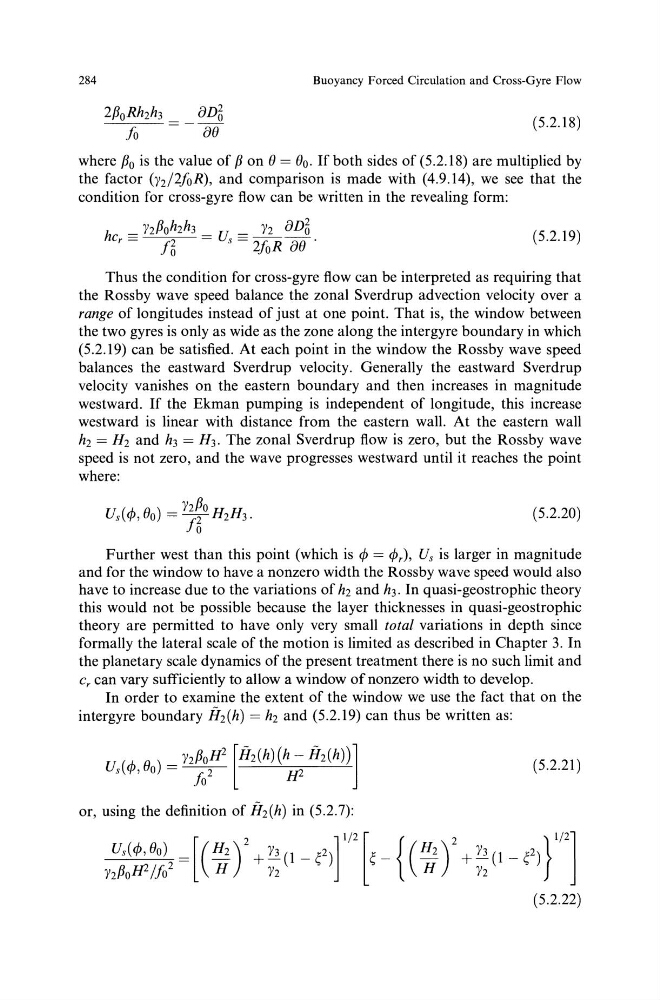
Thus the condition for cross-gyre flow can be interpreted as requiring that
the Rossby wave speed balance the zonal Sverdrup advection velocity over a
range of longitudes instead of just at one point. That is, the window between
the two gyres is only as wide as the zone along the intergyre boundary in which
(5.2.19) can be satisfied. At each point in the window the Rossby wave speed
balances the eastward Sverdrup velocity. Generally the eastward Sverdrup
velocity vanishes on the eastern boundary and then increases in magnitude
westward. If the Ekman pumping is independent of longitude, this increase
westward is linear with distance from the eastern wall. At the eastern wall
h2 = H 2 and h3 = H 3 • The zonal Sverdrup flow is zero, but the Rossby wave
speed is not zero, and the wave progresses westward until it reaches the point
where:
(5.2.20)
Further west than this point (which is and for the window to have a nonzero width the Ross by wave speed would also
have to increase due to the variations of hz and h3. In quasi-geostrophic theory
this would not be possible because the layer thicknesses in quasi-geostrophic
theory are permitted to have only very small total variations in depth since
formally the lateral scale of the motion is limited as described in Chapter 3. In
the planetary scale dynamics of the present treatment there is no such limit and
c, can vary sufficiently to allow a window of nonzero width to develop.
In order to examine the extent of the window we use the fact that on the
intergyre boundary H2(h) = h2 and (5.2.19) can thus be written as:
Us(
or, using the definition of H2(h) in (5.2.7):
Buoyancy Forced Circulation and Cross-Gyre Flow
aD 2
___ o
{)()
(5.2.18)
where Po is the value of P on()= ()0 • If both sides of (5.2.18) are multiplied by
the factor (y 2 /2f0R), and comparison is made with (4.9.14), we see that the
condition for cross-gyre flow can be written in the revealing form:
h = YzPoh2h3 = U = ___1:i_ aD~
c, -
f~
s - 2foR 8() ·
(5.2.19)
Thus the condition for cross-gyre flow can be interpreted as requiring that
the Rossby wave speed balance the zonal Sverdrup advection velocity over a
range of longitudes instead of just at one point. That is, the window between
the two gyres is only as wide as the zone along the intergyre boundary in which
(5.2.19) can be satisfied. At each point in the window the Rossby wave speed
balances the eastward Sverdrup velocity. Generally the eastward Sverdrup
velocity vanishes on the eastern boundary and then increases in magnitude
westward. If the Ekman pumping is independent of longitude, this increase
westward is linear with distance from the eastern wall. At the eastern wall
h2 = H 2 and h3 = H 3 • The zonal Sverdrup flow is zero, but the Rossby wave
speed is not zero, and the wave progresses westward until it reaches the point
where:
(5.2.20)
Further west than this point (which is and for the window to have a nonzero width the Ross by wave speed would also
have to increase due to the variations of hz and h3. In quasi-geostrophic theory
this would not be possible because the layer thicknesses in quasi-geostrophic
theory are permitted to have only very small total variations in depth since
formally the lateral scale of the motion is limited as described in Chapter 3. In
the planetary scale dynamics of the present treatment there is no such limit and
c, can vary sufficiently to allow a window of nonzero width to develop.
In order to examine the extent of the window we use the fact that on the
intergyre boundary H2(h) = h2 and (5.2.19) can thus be written as:
Us(
or, using the definition of H2(h) in (5.2.7):