

Cross-Gyre Flow
283
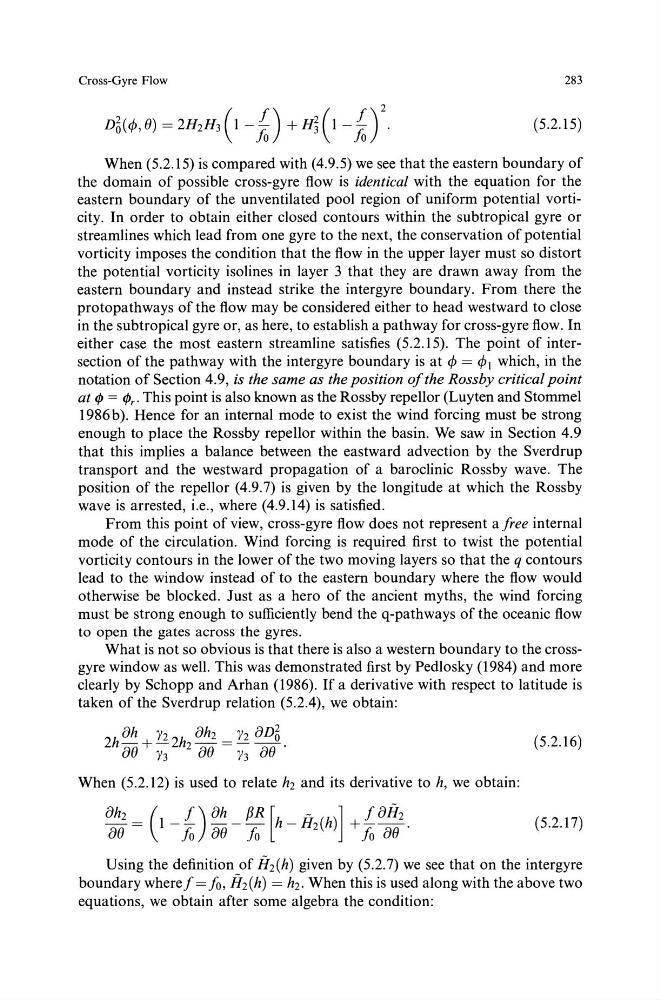
D~(¢, ()) = 2H2H3 ( 1-%) + H~ (1-for
(5.2.15)
When (5.2.15) is compared with (4.9.5) we see that the eastern boundary of
the domain of possible cross-gyre flow is identical with the equation for the
eastern boundary of the unventilated pool region of uniform potential vorticity. In order to obtain either closed contours within the subtropical gyre or
streamlines which lead from one gyre to the next, the conservation of potential
vorticity imposes the condition that the flow in the upper layer must so distort
the potential vorticity isolines in layer 3 that they are drawn away from the
eastern boundary and instead strike the intergyre boundary. From there the
protopathways of the flow may be considered either to head westward to close
in the subtropical gyre or, as here, to establish a pathway for cross-gyre flow. In
either case the most eastern streamline satisfies (5.2.15). The point of intersection of the pathway with the intergyre boundary is at ¢ = ¢ 1 which, in the
notation of Section 4.9, is the same as the position of the Rossby critical point
at cp = cp,. This point is also known as the Rossby repellor (Luyten and Stommel
1986b). Hence for an internal mode to exist the wind forcing must be strong
enough to place the Rossby repellor within the basin. We saw in Section 4.9
that this implies a balance between the eastward advection by the Sverdrup
transport and the westward propagation of a baroclinic Rossby wave. The
position of the repellor (4.9.7) is given by the longitude at which the Rossby
wave is arrested, i.e., where (4.9.14) is satisfied.
From this point of view, cross-gyre flow does not represent a free internal
mode of the circulation. Wind forcing is required first to twist the potential
vorticity contours in the lower of the two moving layers so that the q contours
lead to the window instead of to the eastern boundary where the flow would
otherwise be blocked. Just as a hero of the ancient myths, the wind forcing
must be strong enough to sufficiently bend the q-pathways of the oceanic flow
to open the gates across the gyres.
What is not so obvious is that there is also a western boundary to the crossgyre window as well. This was demonstrated first by Pedlosky (1984) and more
clearly by Schopp and Arhan (1986). If a derivative with respect to latitude is
taken of the Sverdrup relation (5.2.4), we obtain:
2 h 8h + 1'2 2 h 2 8h2 = 1'2 8D6 .
8() 1'3
8()
1'3 8()
(5.2.16)
When (5.2.12) is used to relate h2 and its derivative to h, we obtain:
8h2 (
f) 8h PR [ - ] f 8ih
ae = 1 -To ae- fo h- H 2 (h) +To ae ·
(5.2.17)
Using the definition of ih(h) given by (5.2.7) we see that on the intergyre
boundary wheref = fo, ih(h) = h2. When this is used along with the above two
equations, we obtain after some algebra the condition:
283
D~(¢, ()) = 2H2H3 ( 1-%) + H~ (1-for
(5.2.15)
When (5.2.15) is compared with (4.9.5) we see that the eastern boundary of
the domain of possible cross-gyre flow is identical with the equation for the
eastern boundary of the unventilated pool region of uniform potential vorticity. In order to obtain either closed contours within the subtropical gyre or
streamlines which lead from one gyre to the next, the conservation of potential
vorticity imposes the condition that the flow in the upper layer must so distort
the potential vorticity isolines in layer 3 that they are drawn away from the
eastern boundary and instead strike the intergyre boundary. From there the
protopathways of the flow may be considered either to head westward to close
in the subtropical gyre or, as here, to establish a pathway for cross-gyre flow. In
either case the most eastern streamline satisfies (5.2.15). The point of intersection of the pathway with the intergyre boundary is at ¢ = ¢ 1 which, in the
notation of Section 4.9, is the same as the position of the Rossby critical point
at cp = cp,. This point is also known as the Rossby repellor (Luyten and Stommel
1986b). Hence for an internal mode to exist the wind forcing must be strong
enough to place the Rossby repellor within the basin. We saw in Section 4.9
that this implies a balance between the eastward advection by the Sverdrup
transport and the westward propagation of a baroclinic Rossby wave. The
position of the repellor (4.9.7) is given by the longitude at which the Rossby
wave is arrested, i.e., where (4.9.14) is satisfied.
From this point of view, cross-gyre flow does not represent a free internal
mode of the circulation. Wind forcing is required first to twist the potential
vorticity contours in the lower of the two moving layers so that the q contours
lead to the window instead of to the eastern boundary where the flow would
otherwise be blocked. Just as a hero of the ancient myths, the wind forcing
must be strong enough to sufficiently bend the q-pathways of the oceanic flow
to open the gates across the gyres.
What is not so obvious is that there is also a western boundary to the crossgyre window as well. This was demonstrated first by Pedlosky (1984) and more
clearly by Schopp and Arhan (1986). If a derivative with respect to latitude is
taken of the Sverdrup relation (5.2.4), we obtain:
2 h 8h + 1'2 2 h 2 8h2 = 1'2 8D6 .
8() 1'3
8()
1'3 8()
(5.2.16)
When (5.2.12) is used to relate h2 and its derivative to h, we obtain:
8h2 (
f) 8h PR [ - ] f 8ih
ae = 1 -To ae- fo h- H 2 (h) +To ae ·
(5.2.17)
Using the definition of ih(h) given by (5.2.7) we see that on the intergyre
boundary wheref = fo, ih(h) = h2. When this is used along with the above two
equations, we obtain after some algebra the condition: