

282
Buoyancy Forced Circulation and Cross-Gyre Flow
and H 3 differ from zero, potential vorticity conserving flow along the eastern
boundary is inconsistent with the condition of no zonal flow there. This is the
same basic reasoning that leads to the existence of the shadow zone described
in Section 4.4. Thus we anticipate that there is an eastern edge, or limit, to the
cross-gyre window (if the window exists). East of this edge layer 3 is at rest.
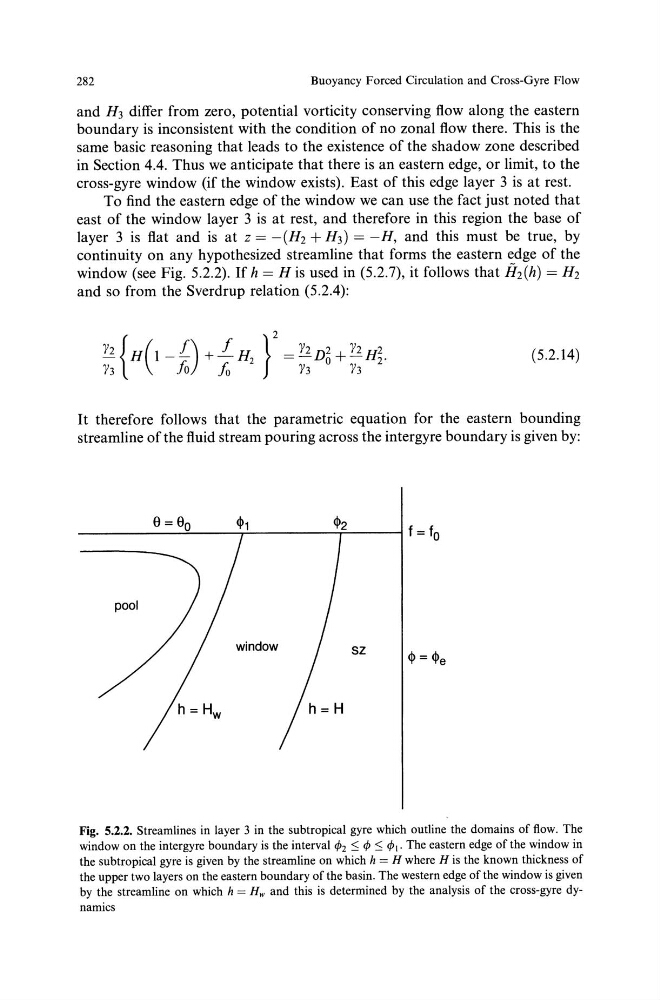
To find the eastern edge of the window we can use the fact just noted that
east of the window layer 3 is at rest, and therefore in this region the base of
layer 3 is flat and is at z = -(H2 + H 3 ) = -H, and this must be true, by
continuity on any hypothesized streamline that forms the eastern edge of the
window (see Fig. 5.2.2). If h =His used in (5.2.7), it follows that H2(h) = H2
and so from the Sverdrup relation (5.2.4):
(5.2.14)
It therefore follows that the parametric equation for the eastern bounding
streamline of the fluid stream pouring across the intergyre boundary is given by:
____ e_=_e-=o' --__ <1>-r1-------r----; t =to
pool
window
sz
Fig. 5.2.2. Streamlines in layer 3 in the subtropical gyre which outline the domains of flow. The
window on the intergyre boundary is the interval r/>2 :::; rf> :::; r/> 1. The eastern edge of the window in
the subtropical gyre is given by the streamline on which h = H where His the known thickness of
the upper two layers on the eastern boundary of the basin. The western edge of the window is given
by the streamline on which h = Hw and this is determined by the analysis of the cross-gyre dynamics
Buoyancy Forced Circulation and Cross-Gyre Flow
and H 3 differ from zero, potential vorticity conserving flow along the eastern
boundary is inconsistent with the condition of no zonal flow there. This is the
same basic reasoning that leads to the existence of the shadow zone described
in Section 4.4. Thus we anticipate that there is an eastern edge, or limit, to the
cross-gyre window (if the window exists). East of this edge layer 3 is at rest.
To find the eastern edge of the window we can use the fact just noted that
east of the window layer 3 is at rest, and therefore in this region the base of
layer 3 is flat and is at z = -(H2 + H 3 ) = -H, and this must be true, by
continuity on any hypothesized streamline that forms the eastern edge of the
window (see Fig. 5.2.2). If h =His used in (5.2.7), it follows that H2(h) = H2
and so from the Sverdrup relation (5.2.4):
(5.2.14)
It therefore follows that the parametric equation for the eastern bounding
streamline of the fluid stream pouring across the intergyre boundary is given by:
____ e_=_e-=o' --__ <1>-r1-------r----; t =to
pool
window
sz
Fig. 5.2.2. Streamlines in layer 3 in the subtropical gyre which outline the domains of flow. The
window on the intergyre boundary is the interval r/>2 :::; rf> :::; r/> 1. The eastern edge of the window in
the subtropical gyre is given by the streamline on which h = H where His the known thickness of
the upper two layers on the eastern boundary of the basin. The western edge of the window is given
by the streamline on which h = Hw and this is determined by the analysis of the cross-gyre dynamics