

Effect of Finite Mixed Layer Depth
239
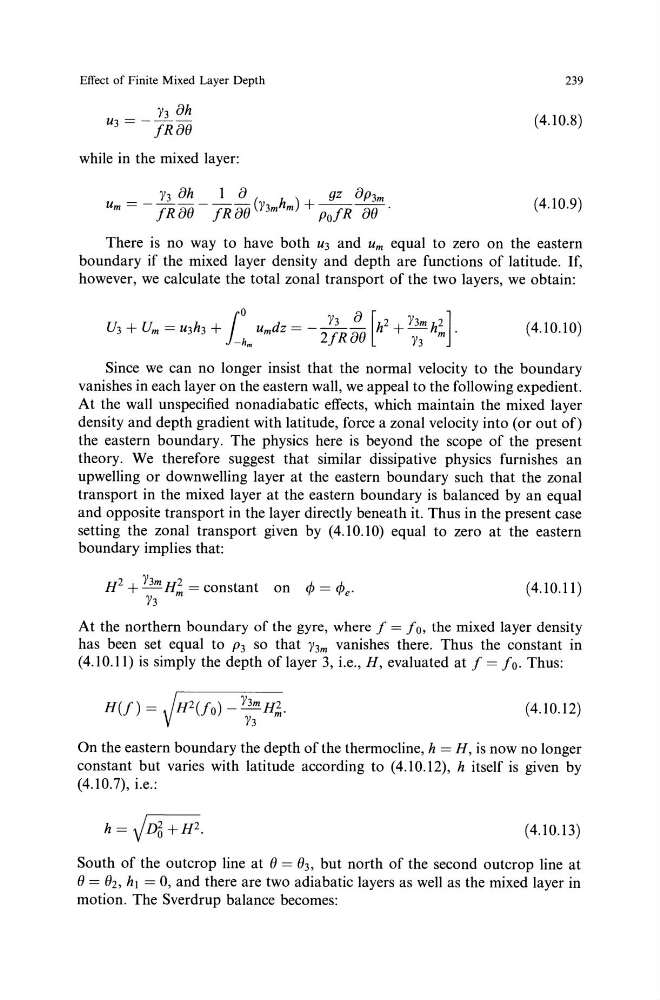
Y3 ah
U3 = - - -
jRo8
(4.10.8)
while in the mixed layer:
(4.10.9)
There is no way to have both u3 and um equal to zero on the eastern
boundary if the mixed layer density and depth are functions of latitude. If,
however, we calculate the total zonal transport of the two layers, we obtain:
h
1 ° d Y3 8 [hz Y3m h2]
u3 + Um = U3 3 + -hm Um z = - 2fR ae +-:;- m •
(4.10.10)
Since we can no longer insist that the normal velocity to the boundary
vanishes in each layer on the eastern wall, we appeal to the following expedient.
At the wall unspecified nonadiabatic effects, which maintain the mixed layer
density and depth gradient with latitude, force a zonal velocity into (or out of)
the eastern boundary. The physics here is beyond the scope of the present
theory. We therefore suggest that similar dissipative physics furnishes an
upwelling or downwelling layer at the eastern boundary such that the zonal
transport in the mixed layer at the eastern boundary is balanced by an equal
and opposite transport in the layer directly beneath it. Thus in the present case
setting the zonal transport given by ( 4.1 0.10) equal to zero at the eastern
boundary implies that:
H 2 + Y 3 m H 2 = constant on ¢ = ¢e·
Y3 m
( 4.10.11)
At the northern boundary of the gyre, where f = j 0 , the mixed layer density
has been set equal to p 3 so that y 3 m vanishes there. Thus the constant in
(4.10.11) is simply the depth of layer 3, i.e., H, evaluated at f = f 0 . Thus:
H(f) =
H2(Jo) _ Y3m H!;,.
Y3
(4.10.12)
On the eastern boundary the depth of the thermocline, h = H, is now no longer
constant but varies with latitude according to (4.10.12), h itself is given by
(4.10.7), i.e.:
(4.10.13)
South of the outcrop line at e = 83, but north of the second outcrop line at
8 = 82, h1 = 0, and there are two adiabatic layers as well as the mixed layer in
motion. The Sverdrup balance becomes:
239
Y3 ah
U3 = - - -
jRo8
(4.10.8)
while in the mixed layer:
(4.10.9)
There is no way to have both u3 and um equal to zero on the eastern
boundary if the mixed layer density and depth are functions of latitude. If,
however, we calculate the total zonal transport of the two layers, we obtain:
h
1 ° d Y3 8 [hz Y3m h2]
u3 + Um = U3 3 + -hm Um z = - 2fR ae +-:;- m •
(4.10.10)
Since we can no longer insist that the normal velocity to the boundary
vanishes in each layer on the eastern wall, we appeal to the following expedient.
At the wall unspecified nonadiabatic effects, which maintain the mixed layer
density and depth gradient with latitude, force a zonal velocity into (or out of)
the eastern boundary. The physics here is beyond the scope of the present
theory. We therefore suggest that similar dissipative physics furnishes an
upwelling or downwelling layer at the eastern boundary such that the zonal
transport in the mixed layer at the eastern boundary is balanced by an equal
and opposite transport in the layer directly beneath it. Thus in the present case
setting the zonal transport given by ( 4.1 0.10) equal to zero at the eastern
boundary implies that:
H 2 + Y 3 m H 2 = constant on ¢ = ¢e·
Y3 m
( 4.10.11)
At the northern boundary of the gyre, where f = j 0 , the mixed layer density
has been set equal to p 3 so that y 3 m vanishes there. Thus the constant in
(4.10.11) is simply the depth of layer 3, i.e., H, evaluated at f = f 0 . Thus:
H(f) =
H2(Jo) _ Y3m H!;,.
Y3
(4.10.12)
On the eastern boundary the depth of the thermocline, h = H, is now no longer
constant but varies with latitude according to (4.10.12), h itself is given by
(4.10.7), i.e.:
(4.10.13)
South of the outcrop line at e = 83, but north of the second outcrop line at
8 = 82, h1 = 0, and there are two adiabatic layers as well as the mixed layer in
motion. The Sverdrup balance becomes: