

240
Theory of the Ventilated Thermocline
(4.10.14)
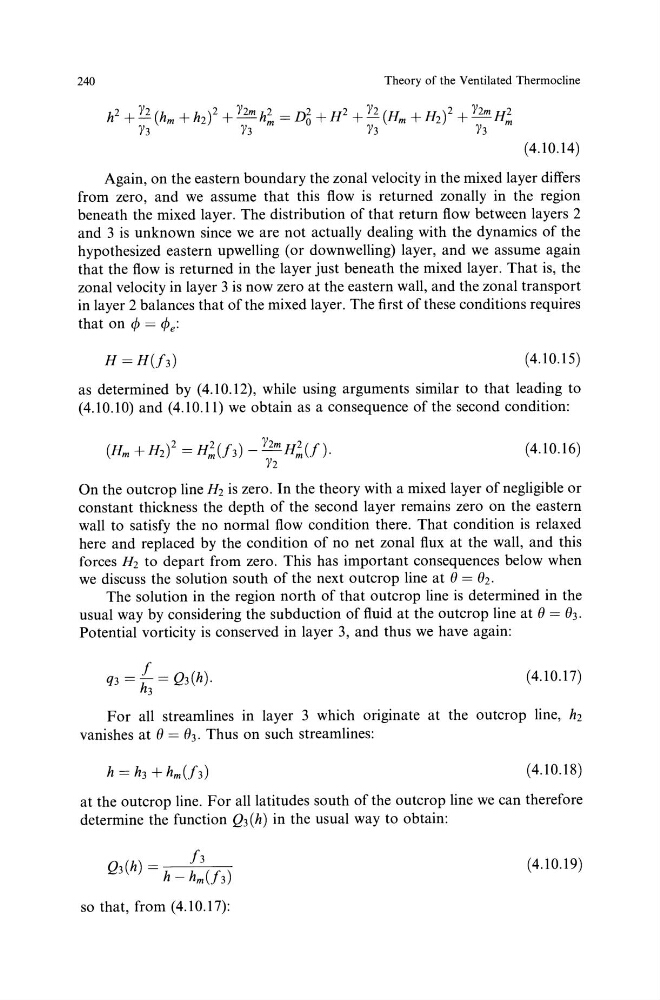
Again, on the eastern boundary the zonal velocity in the mixed layer differs
from zero, and we assume that this flow is returned zonally in the region
beneath the mixed layer. The distribution of that return flow between layers 2
and 3 is unknown since we are not actually dealing with the dynamics of the
hypothesized eastern upwelling (or downwelling) layer, and we assume again
that the flow is returned in the layer just beneath the mixed layer. That is, the
zonal velocity in layer 3 is now zero at the eastern wall, and the zonal transport
in layer 2 balances that of the mixed layer. The first of these conditions requires
that on ¢ = ¢e:
H=H(/3)
(4.10.15)
as determined by ( 4.1 0.12), while using arguments similar to that leading to
(4.10.10) and (4.10.11) we obtain as a consequence of the second condition:
(Hm + H2) 2 = H?,(/3)- Yzm H?,(f ).
Yz
(4.10.16)
On the outcrop line H 2 is zero. In the theory with a mixed layer of negligible or
constant thickness the depth of the second layer remains zero on the eastern
wall to satisfy the no normal flow condition there. That condition is relaxed
here and replaced by the condition of no net zonal flux at the wall, and this
forces H 2 to depart from zero. This has important consequences below when
we discuss the solution south of the next outcrop line at 8 = 82.
The solution in the region north of that outcrop line is determined in the
usual way by considering the subduction of fluid at the outcrop line at 8 = 83.
Potential vorticity is conserved in layer 3, and thus we have again:
(4.10.17)
For all streamlines in layer 3 which originate at the outcrop line, hz
vanishes at 8 = 83. Thus on such streamlines:
( 4.1 0.18)
at the outcrop line. For all latitudes south of the outcrop line we can therefore
determine the function Q3(h) in the usual way to obtain:
h
Q 3 (h) = h- hm(/3)
so that, from (4.10.17):
(4.10.19)
Theory of the Ventilated Thermocline
(4.10.14)
Again, on the eastern boundary the zonal velocity in the mixed layer differs
from zero, and we assume that this flow is returned zonally in the region
beneath the mixed layer. The distribution of that return flow between layers 2
and 3 is unknown since we are not actually dealing with the dynamics of the
hypothesized eastern upwelling (or downwelling) layer, and we assume again
that the flow is returned in the layer just beneath the mixed layer. That is, the
zonal velocity in layer 3 is now zero at the eastern wall, and the zonal transport
in layer 2 balances that of the mixed layer. The first of these conditions requires
that on ¢ = ¢e:
H=H(/3)
(4.10.15)
as determined by ( 4.1 0.12), while using arguments similar to that leading to
(4.10.10) and (4.10.11) we obtain as a consequence of the second condition:
(Hm + H2) 2 = H?,(/3)- Yzm H?,(f ).
Yz
(4.10.16)
On the outcrop line H 2 is zero. In the theory with a mixed layer of negligible or
constant thickness the depth of the second layer remains zero on the eastern
wall to satisfy the no normal flow condition there. That condition is relaxed
here and replaced by the condition of no net zonal flux at the wall, and this
forces H 2 to depart from zero. This has important consequences below when
we discuss the solution south of the next outcrop line at 8 = 82.
The solution in the region north of that outcrop line is determined in the
usual way by considering the subduction of fluid at the outcrop line at 8 = 83.
Potential vorticity is conserved in layer 3, and thus we have again:
(4.10.17)
For all streamlines in layer 3 which originate at the outcrop line, hz
vanishes at 8 = 83. Thus on such streamlines:
( 4.1 0.18)
at the outcrop line. For all latitudes south of the outcrop line we can therefore
determine the function Q3(h) in the usual way to obtain:
h
Q 3 (h) = h- hm(/3)
so that, from (4.10.17):
(4.10.19)