

Ventilation and Homogenization: A Unified Theory
229
boundary, layer 3 is at rest and its base is flat. Thus east of the pool boundary
and by continuity of the solution for the layer thicknesses, on the pool
boundary itself:
(4.9.24)
while within the pool, and hence also on its boundary ( 4.9 .17) applies. Using
both of these continuity conditions allows us to rewrite (4.9.23) on the pool
boundary as:
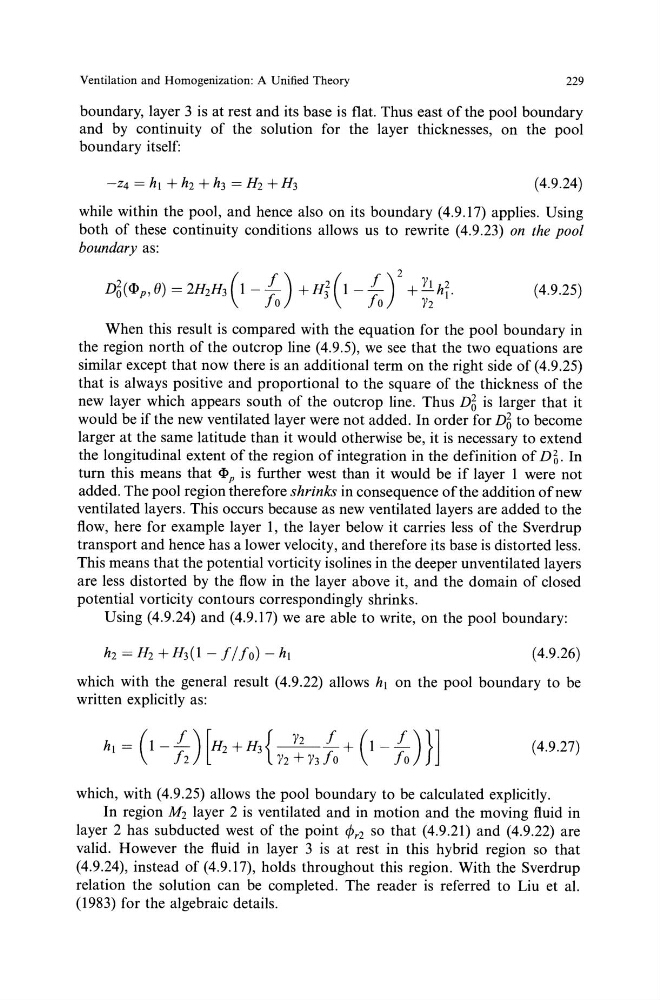
(4.9.25)
When this result is compared with the equation for the pool boundary in
the region north of the outcrop line (4.9.5), we see that the two equations are
similar except that now there is an additional term on the right side of (4.9.25)
that is always positive and proportional to the square of the thickness of the
new layer which appears south of the outcrop line. Thus D6 is larger that it
would be if the new ventilated layer were not added. In order for D6 to become
larger at the same latitude than it would otherwise be, it is necessary to extend
the longitudinal extent of the region of integration in the definition of D ~. In
turn this means that P is further west than it would be if layer 1 were not
added. The pool region therefore shrinks in consequence of the addition of new
ventilated layers. This occurs because as new ventilated layers are added to the
flow, here for example layer 1, the layer below it carries less of the Sverdrup
transport and hence has a lower velocity, and therefore its base is distorted less.
This means that the potential vorticity isolines in the deeper unventilated layers
are less distorted by the flow in the layer above it, and the domain of closed
potential vorticity contours correspondingly shrinks.
Using (4.9.24) and (4.9.17) we are able to write, on the pool boundary:
(4.9.26)
which with the general result (4.9.22) allows h1 on the pool boundary to be
written explicitly as:
(4.9.27)
which, with (4.9.25) allows the pool boundary to be calculated explicitly.
In region M2 layer 2 is ventilated and in motion and the moving fluid in
layer 2 has subducted west of the point ¢r 2 so that (4.9.21) and (4.9.22) are
valid. However the fluid in layer 3 is at rest in this hybrid region so that
(4.9.24), instead of (4.9.17), holds throughout this region. With the Sverdrup
relation the solution can be completed. The reader is referred to Liu et al.
(1983) for the algebraic details.
229
boundary, layer 3 is at rest and its base is flat. Thus east of the pool boundary
and by continuity of the solution for the layer thicknesses, on the pool
boundary itself:
(4.9.24)
while within the pool, and hence also on its boundary ( 4.9 .17) applies. Using
both of these continuity conditions allows us to rewrite (4.9.23) on the pool
boundary as:
(4.9.25)
When this result is compared with the equation for the pool boundary in
the region north of the outcrop line (4.9.5), we see that the two equations are
similar except that now there is an additional term on the right side of (4.9.25)
that is always positive and proportional to the square of the thickness of the
new layer which appears south of the outcrop line. Thus D6 is larger that it
would be if the new ventilated layer were not added. In order for D6 to become
larger at the same latitude than it would otherwise be, it is necessary to extend
the longitudinal extent of the region of integration in the definition of D ~. In
turn this means that P is further west than it would be if layer 1 were not
added. The pool region therefore shrinks in consequence of the addition of new
ventilated layers. This occurs because as new ventilated layers are added to the
flow, here for example layer 1, the layer below it carries less of the Sverdrup
transport and hence has a lower velocity, and therefore its base is distorted less.
This means that the potential vorticity isolines in the deeper unventilated layers
are less distorted by the flow in the layer above it, and the domain of closed
potential vorticity contours correspondingly shrinks.
Using (4.9.24) and (4.9.17) we are able to write, on the pool boundary:
(4.9.26)
which with the general result (4.9.22) allows h1 on the pool boundary to be
written explicitly as:
(4.9.27)
which, with (4.9.25) allows the pool boundary to be calculated explicitly.
In region M2 layer 2 is ventilated and in motion and the moving fluid in
layer 2 has subducted west of the point ¢r 2 so that (4.9.21) and (4.9.22) are
valid. However the fluid in layer 3 is at rest in this hybrid region so that
(4.9.24), instead of (4.9.17), holds throughout this region. With the Sverdrup
relation the solution can be completed. The reader is referred to Liu et al.
(1983) for the algebraic details.