

230
Theory of the Ventilated Thermocline
1
1
c 0.6
c
-
-
.........
.........
-
-
0.4
a
b
x/L
xfl
zonal section
meridional section
0
0 -........
.. .-0.5
-
~ ......... ?
--- ---1
.r.
--II
-1
----N
-1.5
-2
c -2
-3
d
-1
-0.5
0
0.5
X
f/fn
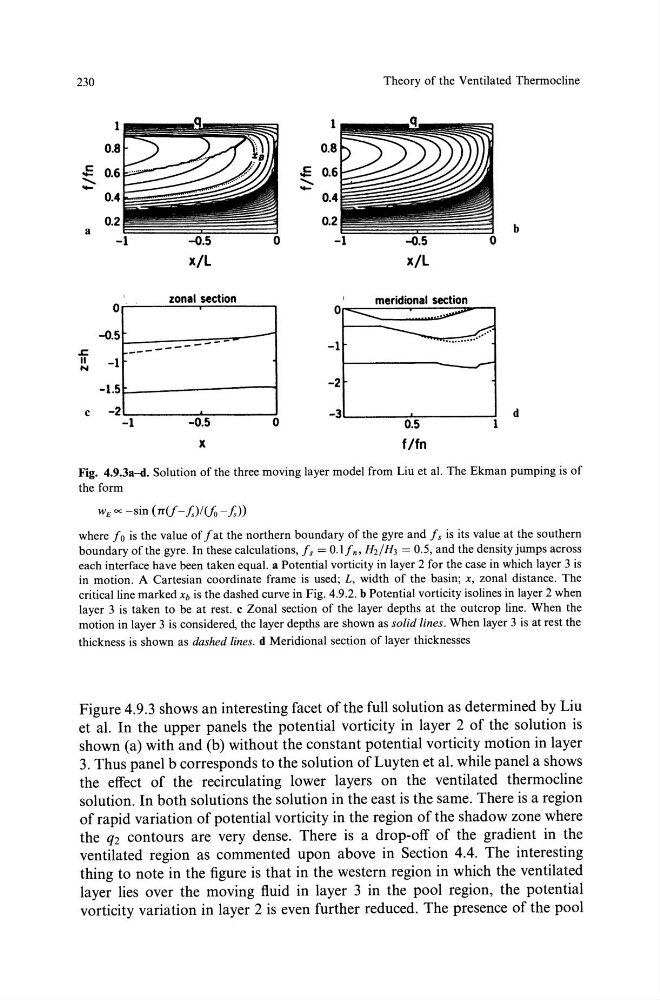
Fig. 4.9.3a-d. Solution of the three moving layer model from Liu et a!. The Ekman pumping is of
the form
wE= -sin ( n(f- f,)/(fo- /,))
where lo is the value off at the northern boundary of the gyre and Is is its value at the southern
boundary of the gyre. In these calculations, Is= O.lln, H2 /H3 = 0.5, and the density jumps across
each interface have been taken equal. a Potential vorticity in layer 2 for the case in which layer 3 is
in motion. A Cartesian coordinate frame is used; L, width of the basin; x, zonal distance. The
critical line marked xb is the dashed curve in Fig. 4.9.2. b Potential vorticity isolines in layer 2 when
layer 3 is taken to be at rest. c Zonal section of the layer depths at the outcrop line. When the
motion in layer 3 is considered, the layer depths are shown as solid lines. When layer 3 is at rest the
thickness is shown as dashed lines. d Meridional section of layer thicknesses
Figure 4.9.3 shows an interesting facet of the full solution as determined by Liu
et al. In the upper panels the potential vorticity in layer 2 of the solution is
shown (a) with and (b) without the constant potential vorticity motion in layer
3. Thus panel b corresponds to the solution of Luyten et al. while panel a shows
the effect of the recirculating lower layers on the ventilated thermocline
solution. In both solutions the solution in the east is the same. There is a region
of rapid variation of potential vorticity in the region of the shadow zone where
the q2 contours are very dense. There is a drop-off of the gradient in the
ventilated region as commented upon above in Section 4.4. The interesting
thing to note in the figure is that in the western region in which the ventilated
layer lies over the moving fluid in layer 3 in the pool region, the potential
vorticity variation in layer 2 is even further reduced. The presence of the pool
Theory of the Ventilated Thermocline
1
1
c 0.6
c
-
-
.........
.........
-
-
0.4
a
b
x/L
xfl
zonal section
meridional section
0
0 -........
.. .-0.5
-
~ ......... ?
--- ---1
.r.
--II
-1
----N
-1.5
-2
c -2
-3
d
-1
-0.5
0
0.5
X
f/fn
Fig. 4.9.3a-d. Solution of the three moving layer model from Liu et a!. The Ekman pumping is of
the form
wE= -sin ( n(f- f,)/(fo- /,))
where lo is the value off at the northern boundary of the gyre and Is is its value at the southern
boundary of the gyre. In these calculations, Is= O.lln, H2 /H3 = 0.5, and the density jumps across
each interface have been taken equal. a Potential vorticity in layer 2 for the case in which layer 3 is
in motion. A Cartesian coordinate frame is used; L, width of the basin; x, zonal distance. The
critical line marked xb is the dashed curve in Fig. 4.9.2. b Potential vorticity isolines in layer 2 when
layer 3 is taken to be at rest. c Zonal section of the layer depths at the outcrop line. When the
motion in layer 3 is considered, the layer depths are shown as solid lines. When layer 3 is at rest the
thickness is shown as dashed lines. d Meridional section of layer thicknesses
Figure 4.9.3 shows an interesting facet of the full solution as determined by Liu
et al. In the upper panels the potential vorticity in layer 2 of the solution is
shown (a) with and (b) without the constant potential vorticity motion in layer
3. Thus panel b corresponds to the solution of Luyten et al. while panel a shows
the effect of the recirculating lower layers on the ventilated thermocline
solution. In both solutions the solution in the east is the same. There is a region
of rapid variation of potential vorticity in the region of the shadow zone where
the q2 contours are very dense. There is a drop-off of the gradient in the
ventilated region as commented upon above in Section 4.4. The interesting
thing to note in the figure is that in the western region in which the ventilated
layer lies over the moving fluid in layer 3 in the pool region, the potential
vorticity variation in layer 2 is even further reduced. The presence of the pool