

228
Theory of the Ventilated Thermocline
point cPrz· Thus its potential vorticity is determined along that portion of the
outcrop line in which layer 3 is at rest. This is identical to the situation in layer
2 discussed in Section 4.4, and the solution in Vz east of the dotted curve is
therefore identical to that given by (4.4.18). Thus east of the dotted curve the
entire solution is no different from the solution in which layer 3 is completely at
rest and is given by the results of Section 4.4.
However, for fluid in layer 2 that subducts west of the intersection of the
pool boundary with the outcrop line, i.e., west of cPrz the potential vorticity of
the subducting fluid is determined where layer 3 is in motion so that the
relationship between qz and nz is determined differently west of cPrz than it is to
the east of that point. Thus in the pool region where layer 3 is in motion and
layer 2 has subducted:
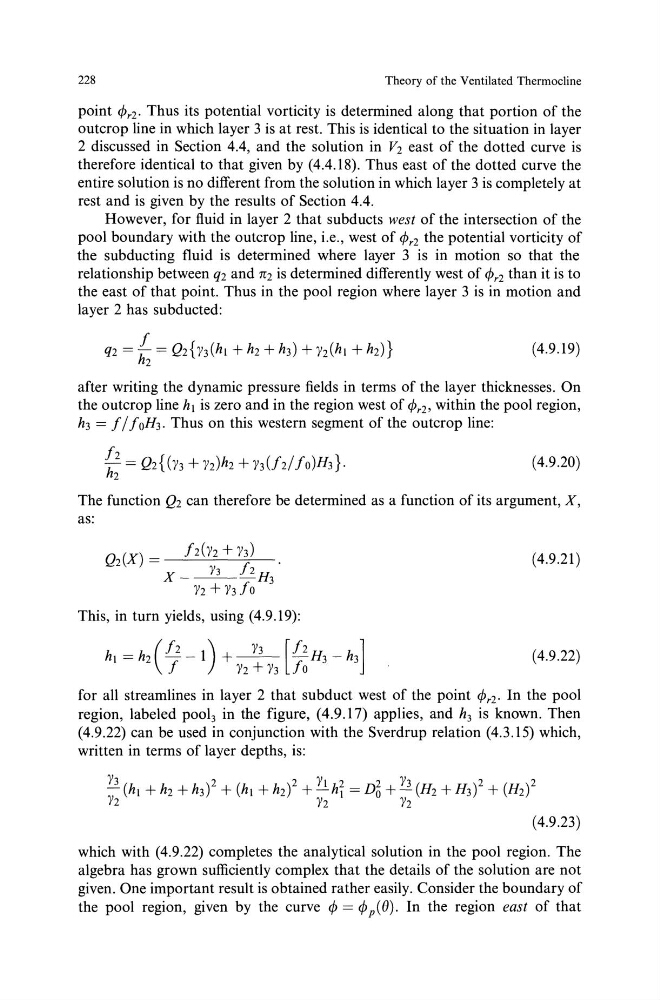
(4.9.19)
after writing the dynamic pressure fields in terms of the layer thicknesses. On
the outcrop line h1 is zero and in the region west of cPrz, within the pool region,
h3 = f / foH3. Thus on this western segment of the outcrop line:
(4.9.20)
The function Qz can therefore be determined as a function of its argument, X,
as:
Qz(X) =
fz(yz + Y3)
X--Y_3_hH3
Yz+Y3fo
This, in tum yields, using (4.9.19):
h1 = hz(fz- 1) +-y- 3 - [Iz H3- h3]
f
Yz + Y3 fo
(4.9.21)
(4.9.22)
for all streamlines in layer 2 that subduct west of the point cPrz· In the pool
region, labeled pool 3 in the figure, ( 4.9 .17) applies, and h3 is known. Then
(4.9.22) can be used in conjunction with the Sverdrup relation (4.3.15) which,
written in terms of layer depths, is:
Y3 (
)z (h
h )z Y1 hz
z Y3 (
)z ( )z
- h1 + hz + h3 + 1 + z +- 1 = D0 +- Hz + H3 + Hz
Yz
Yz
Yz
(4.9.23)
which with (4.9.22) completes the analytical solution in the pool region. The
algebra has grown sufficiently complex that the details of the solution are not
given. One important result is obtained rather easily. Consider the boundary of
the pool region, given by the curve c/J = cPp(O). In the region east of that
Theory of the Ventilated Thermocline
point cPrz· Thus its potential vorticity is determined along that portion of the
outcrop line in which layer 3 is at rest. This is identical to the situation in layer
2 discussed in Section 4.4, and the solution in Vz east of the dotted curve is
therefore identical to that given by (4.4.18). Thus east of the dotted curve the
entire solution is no different from the solution in which layer 3 is completely at
rest and is given by the results of Section 4.4.
However, for fluid in layer 2 that subducts west of the intersection of the
pool boundary with the outcrop line, i.e., west of cPrz the potential vorticity of
the subducting fluid is determined where layer 3 is in motion so that the
relationship between qz and nz is determined differently west of cPrz than it is to
the east of that point. Thus in the pool region where layer 3 is in motion and
layer 2 has subducted:
(4.9.19)
after writing the dynamic pressure fields in terms of the layer thicknesses. On
the outcrop line h1 is zero and in the region west of cPrz, within the pool region,
h3 = f / foH3. Thus on this western segment of the outcrop line:
(4.9.20)
The function Qz can therefore be determined as a function of its argument, X,
as:
Qz(X) =
fz(yz + Y3)
X--Y_3_hH3
Yz+Y3fo
This, in tum yields, using (4.9.19):
h1 = hz(fz- 1) +-y- 3 - [Iz H3- h3]
f
Yz + Y3 fo
(4.9.21)
(4.9.22)
for all streamlines in layer 2 that subduct west of the point cPrz· In the pool
region, labeled pool 3 in the figure, ( 4.9 .17) applies, and h3 is known. Then
(4.9.22) can be used in conjunction with the Sverdrup relation (4.3.15) which,
written in terms of layer depths, is:
Y3 (
)z (h
h )z Y1 hz
z Y3 (
)z ( )z
- h1 + hz + h3 + 1 + z +- 1 = D0 +- Hz + H3 + Hz
Yz
Yz
Yz
(4.9.23)
which with (4.9.22) completes the analytical solution in the pool region. The
algebra has grown sufficiently complex that the details of the solution are not
given. One important result is obtained rather easily. Consider the boundary of
the pool region, given by the curve c/J = cPp(O). In the region east of that