

Ventilation and Homogenization: A Unified Theory
227
at
r
f=fo
U
.-------------~~------------~------------~
/
\
\ \
I
I
I
I
I
I
I
I
M2
I
I@
I
v 2
1
I
I
I
I
I
/
/
/
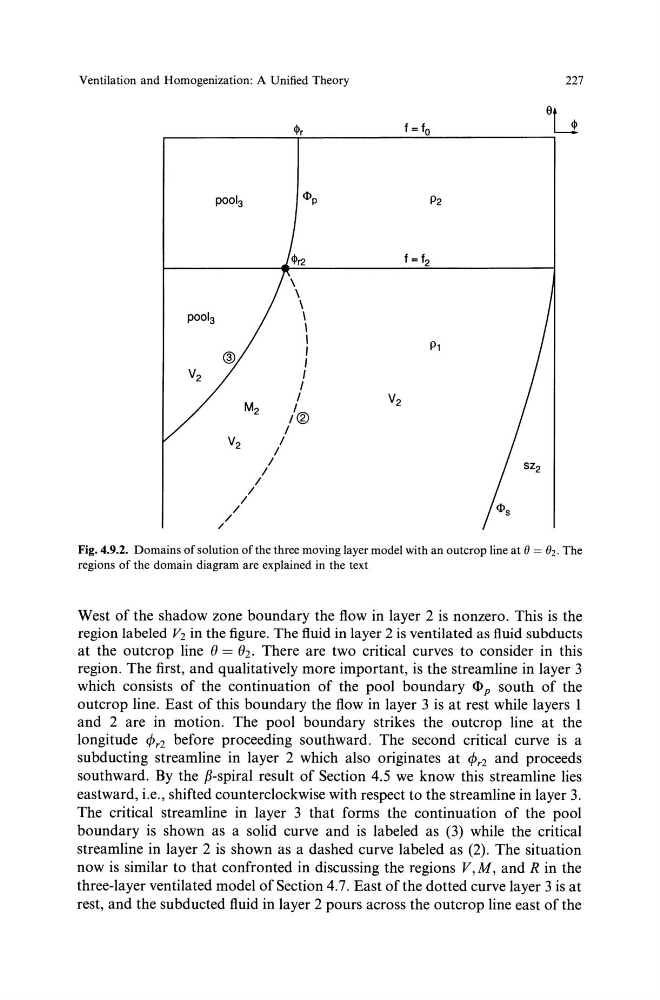
Fig. 4.9.2. Domains of solution of the three moving layer model with an outcrop line at fJ = 82. The
regions of the domain diagram are explained in the text
West of the shadow zone boundary the flow in layer 2 is nonzero. This is the
region labeled V2 in the figure. The fluid in layer 2 is ventilated as fluid subducts
at the outcrop line 8 = 82. There are two critical curves to consider in this
region. The first, and qualitatively more important, is the streamline in layer 3
which consists of the continuation of the pool boundary P south of the
outcrop line. East of this boundary the flow in layer 3 is at rest while layers 1
and 2 are in motion. The pool boundary strikes the outcrop line at the
longitude ¢, 2 before proceeding southward. The second critical curve is a
subducting streamline in layer 2 which also originates at ¢, 2 and proceeds
southward. By the /)-spiral result of Section 4.5 we know this streamline lies
eastward, i.e., shifted counterclockwise with respect to the streamline in layer 3.
The critical streamline in layer 3 that forms the continuation of the pool
boundary is shown as a solid curve and is labeled as (3) while the critical
streamline in layer 2 is shown as a dashed curve labeled as (2). The situation
now is similar to that confronted in discussing the regions V, M, and R in the
three-layer ventilated model of Section 4.7. East of the dotted curve layer 3 is at
rest, and the subducted fluid in layer 2 pours across the outcrop line east of the
227
at
f=fo
U
.-------------~~------------~------------~
/
\
\ \
I
I
I
I
I
I
I
I
M2
I
I@
I
v 2
1
I
I
I
I
I
/
/
/
Fig. 4.9.2. Domains of solution of the three moving layer model with an outcrop line at fJ = 82. The
regions of the domain diagram are explained in the text
West of the shadow zone boundary the flow in layer 2 is nonzero. This is the
region labeled V2 in the figure. The fluid in layer 2 is ventilated as fluid subducts
at the outcrop line 8 = 82. There are two critical curves to consider in this
region. The first, and qualitatively more important, is the streamline in layer 3
which consists of the continuation of the pool boundary P south of the
outcrop line. East of this boundary the flow in layer 3 is at rest while layers 1
and 2 are in motion. The pool boundary strikes the outcrop line at the
longitude ¢, 2 before proceeding southward. The second critical curve is a
subducting streamline in layer 2 which also originates at ¢, 2 and proceeds
southward. By the /)-spiral result of Section 4.5 we know this streamline lies
eastward, i.e., shifted counterclockwise with respect to the streamline in layer 3.
The critical streamline in layer 3 that forms the continuation of the pool
boundary is shown as a solid curve and is labeled as (3) while the critical
streamline in layer 2 is shown as a dashed curve labeled as (2). The situation
now is similar to that confronted in discussing the regions V, M, and R in the
three-layer ventilated model of Section 4.7. East of the dotted curve layer 3 is at
rest, and the subducted fluid in layer 2 pours across the outcrop line east of the