

The Geostrophic Sverdrup Relation
11
over the entire range of longitude of the basin. In the narrow region of the
western boundary current the physics that we have retained for the Sverdrup
relation must be supplemented by physics that we have neglected, either
frictional dissipation or nonlinearity or both.
Sverdrup (1947), without comment, used (1.2.21) to satisfy the boundary
condition on the eastern edge of the basin. No doubt he took the very
reasonable view that the observed fact of the existence of strong western
boundary currents precluded its application in the vicinity of the western
boundary. It is important to realize that there is nothing in the Sverdrup
balance itself that determines which boundary should be singled out for such
treatment.
From a theoretical viewpoint it is necessary first to examine on which
boundary it is possible to construct a boundary layer which connects smoothly
with the Sverdrup interior solution and satisfies the conditions of no normal
flow. Assuming that this can occur on only one boundary forces us to choose
the other boundary as the one where the solution of (1.2.21) must satisfy the no
normal flow condition. Since the theory of Stommel (1948) for the western
intensification of the circulation, and the subsequent prescient discussion of
Stewart (1964; both of which we take up in more detail in Chap. 2), it has
become clear that ifthere is to be a Sverdrup interior, the Sverdrup theory must
satisfy the boundary condition on the eastern boundary.
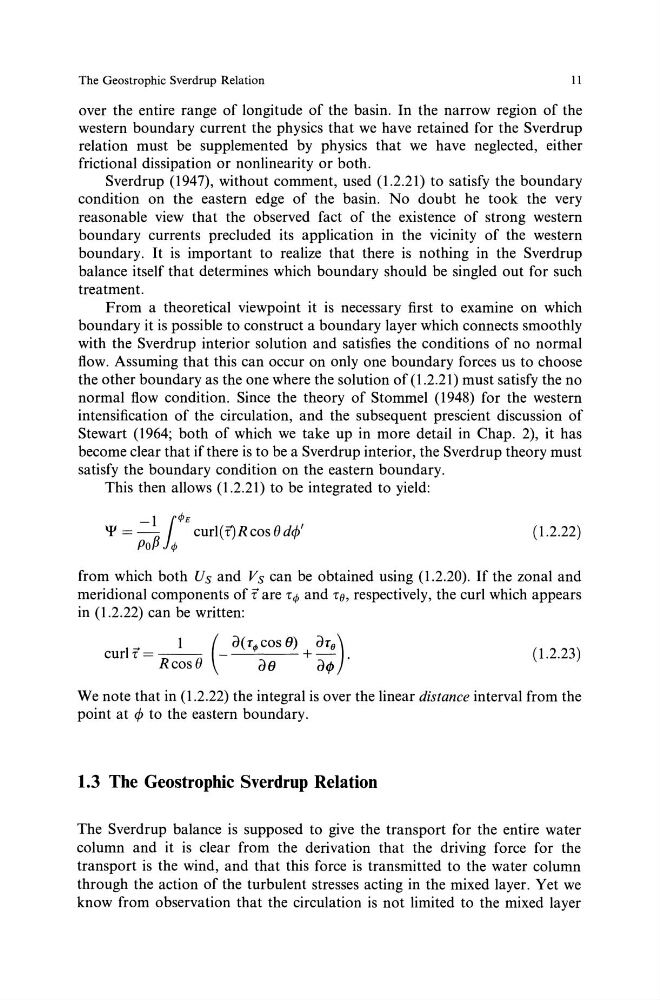
This then allows (1.2.21) to be integrated to yield:
-11E
'¥ = -p
curl(i')R cos 0 dqy'
Po <1>
(1.2.22)
from which both Us and Vs can be obtained using (1.2.20). If the zonal and
meridional components of i are 7:¢ and 7:1J, respectively, the curl which appears
in (1.2.22) can be written:
curl7:=--- -
+- .
-
1
( o( T"' cos 8) OTe)
Rcos 0
o8
otfJ
(1.2.23)
We note that in (1.2.22) the integral is over the linear distance interval from the
point at 4J to the eastern boundary.
1.3 The Geostrophic Sverdrup Relation
The Sverdrup balance is supposed to give the transport for the entire water
column and it is clear from the derivation that the driving force for the
transport is the wind, and that this force is transmitted to the water column
through the action of the turbulent stresses acting in the mixed layer. Yet we
know from observation that the circulation is not limited to the mixed layer
11
over the entire range of longitude of the basin. In the narrow region of the
western boundary current the physics that we have retained for the Sverdrup
relation must be supplemented by physics that we have neglected, either
frictional dissipation or nonlinearity or both.
Sverdrup (1947), without comment, used (1.2.21) to satisfy the boundary
condition on the eastern edge of the basin. No doubt he took the very
reasonable view that the observed fact of the existence of strong western
boundary currents precluded its application in the vicinity of the western
boundary. It is important to realize that there is nothing in the Sverdrup
balance itself that determines which boundary should be singled out for such
treatment.
From a theoretical viewpoint it is necessary first to examine on which
boundary it is possible to construct a boundary layer which connects smoothly
with the Sverdrup interior solution and satisfies the conditions of no normal
flow. Assuming that this can occur on only one boundary forces us to choose
the other boundary as the one where the solution of (1.2.21) must satisfy the no
normal flow condition. Since the theory of Stommel (1948) for the western
intensification of the circulation, and the subsequent prescient discussion of
Stewart (1964; both of which we take up in more detail in Chap. 2), it has
become clear that ifthere is to be a Sverdrup interior, the Sverdrup theory must
satisfy the boundary condition on the eastern boundary.
This then allows (1.2.21) to be integrated to yield:
-11E
'¥ = -p
curl(i')R cos 0 dqy'
Po <1>
(1.2.22)
from which both Us and Vs can be obtained using (1.2.20). If the zonal and
meridional components of i are 7:¢ and 7:1J, respectively, the curl which appears
in (1.2.22) can be written:
curl7:=--- -
+- .
-
1
( o( T"' cos 8) OTe)
Rcos 0
o8
otfJ
(1.2.23)
We note that in (1.2.22) the integral is over the linear distance interval from the
point at 4J to the eastern boundary.
1.3 The Geostrophic Sverdrup Relation
The Sverdrup balance is supposed to give the transport for the entire water
column and it is clear from the derivation that the driving force for the
transport is the wind, and that this force is transmitted to the water column
through the action of the turbulent stresses acting in the mixed layer. Yet we
know from observation that the circulation is not limited to the mixed layer