

10
Sverdrup Theory
Y' ·Us= 0
(1.2.17)
where:
1
0
~
~
Us=
udz.
-H
(1.2.18)
Thus the total horizontal transport is horizontally nondivergent, and (1.2.17)
implies that it may be derived from a stream function, thus:
(1.2.19)
where 'I' is the stream function for the horizontal Sverdrup transport, i.e., the
transport for the entire water column. In spherical polar coordinates ( 1.2.19)
can be written:
1 8'1'
V s = - - -
Rcos () 8¢
(1.2.20)
where Us and Vs are the zonal and meridional components of the transport,
and ¢ is the longitude.
The Sverdrup balance (1.2.16) can then be rewritten as:
f3 8'1'
( i)
R cos () 8¢ = curl Po .
(1.2.21)
This form of the Sverdrup balance illustrates the first difficulty associated with
the theory. The equation for 'I' is first order in¢, and yet 'I' must at least satisfy
the condition of no normal flow at the two longitudes that span the basin at
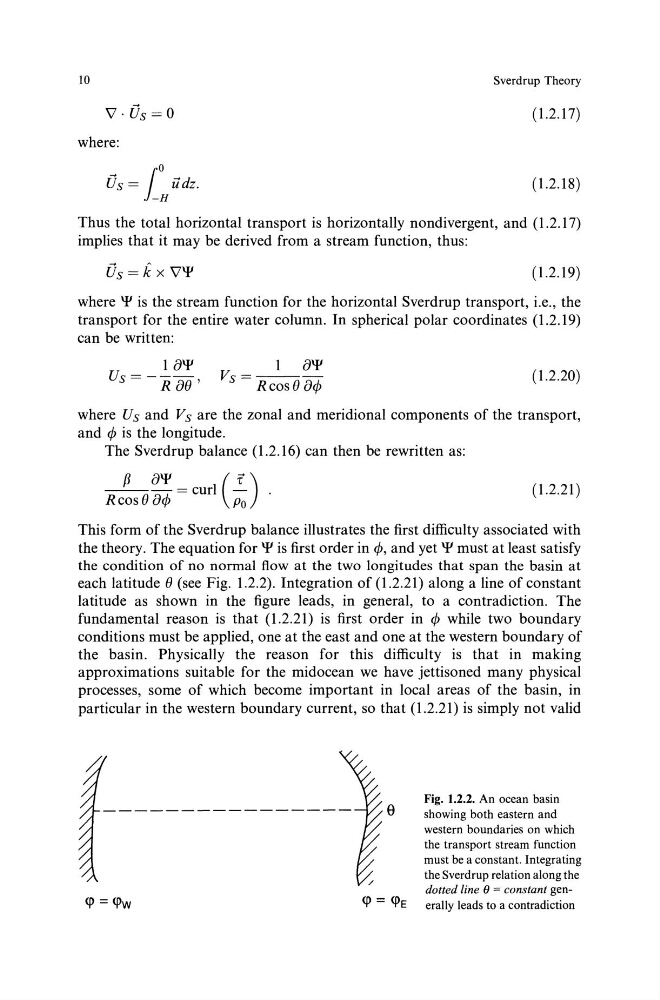
each latitude ()(see Fig. 1.2.2). Integration of (1.2.21) along a line of constant
latitude as shown in the figure leads, in general, to a contradiction. The
fundamental reason is that (1.2.21) is first order in ¢ while two boundary
conditions must be applied, one at the east and one at the western boundary of
the basin. Physically the reason for this difficulty is that in making
approximations suitable for the midocean we have jettisoned many physical
processes, some of which become important in local areas of the basin, in
particular in the western boundary current, so that (1.2.21) is simply not valid
Fig. 1.2.2. An ocean basin
showing both eastern and
western boundaries on which
the transport stream function
must be a constant. Integrating
the Sverdrup relation along the
dotted line B = constant generally leads to a contradiction
Sverdrup Theory
Y' ·Us= 0
(1.2.17)
where:
1
0
~
~
Us=
udz.
-H
(1.2.18)
Thus the total horizontal transport is horizontally nondivergent, and (1.2.17)
implies that it may be derived from a stream function, thus:
(1.2.19)
where 'I' is the stream function for the horizontal Sverdrup transport, i.e., the
transport for the entire water column. In spherical polar coordinates ( 1.2.19)
can be written:
1 8'1'
V s = - - -
Rcos () 8¢
(1.2.20)
where Us and Vs are the zonal and meridional components of the transport,
and ¢ is the longitude.
The Sverdrup balance (1.2.16) can then be rewritten as:
f3 8'1'
( i)
R cos () 8¢ = curl Po .
(1.2.21)
This form of the Sverdrup balance illustrates the first difficulty associated with
the theory. The equation for 'I' is first order in¢, and yet 'I' must at least satisfy
the condition of no normal flow at the two longitudes that span the basin at
each latitude ()(see Fig. 1.2.2). Integration of (1.2.21) along a line of constant
latitude as shown in the figure leads, in general, to a contradiction. The
fundamental reason is that (1.2.21) is first order in ¢ while two boundary
conditions must be applied, one at the east and one at the western boundary of
the basin. Physically the reason for this difficulty is that in making
approximations suitable for the midocean we have jettisoned many physical
processes, some of which become important in local areas of the basin, in
particular in the western boundary current, so that (1.2.21) is simply not valid
Fig. 1.2.2. An ocean basin
showing both eastern and
western boundaries on which
the transport stream function
must be a constant. Integrating
the Sverdrup relation along the
dotted line B = constant generally leads to a contradiction