

Scaling for Sverdrup Theory
9
A further balance can be obtained by integrating (1.2.12) over the entire
water column. If, again, the slight variations of density are ignored in (1.2.12),
the density may be replaced by its average value p 0 and thus:
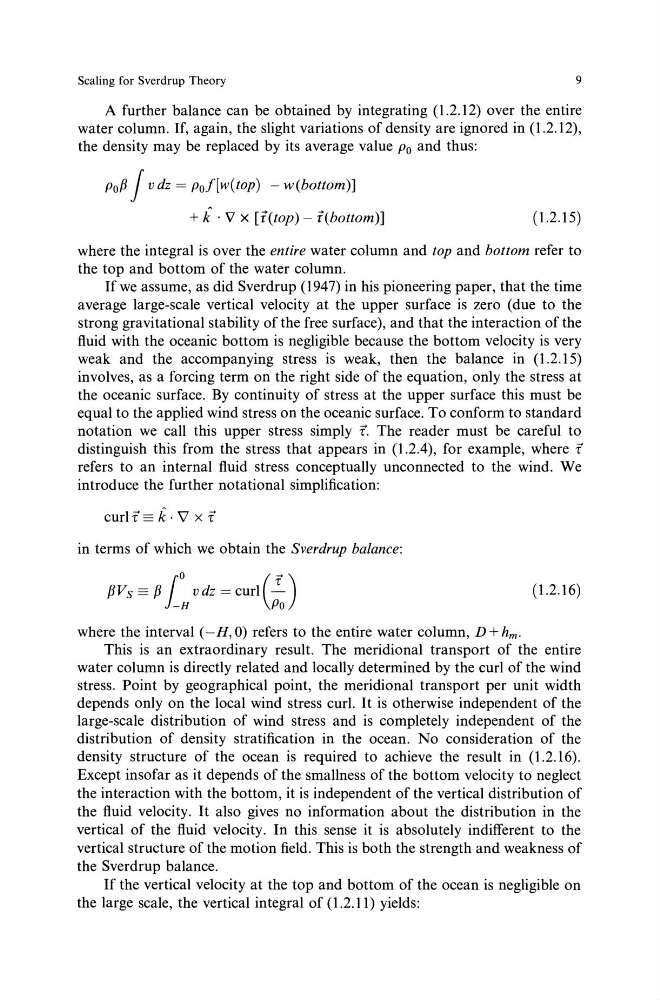
Po/3 J vdz = p0 f[w(top) - w(bottom)]
+ k · V x [i(top)- i(bottom)]
(1.2.15)
where the integral is over the entire water column and top and bottom refer to
the top and bottom of the water column.
If we assume, as did Sverdrup (1947) in his pioneering paper, that the time
average large-scale vertical velocity at the upper surface is zero (due to the
strong gravitational stability of the free surface), and that the interaction of the
fluid with the oceanic bottom is negligible because the bottom velocity is very
weak and the accompanying stress is weak, then the balance in (1.2.15)
involves, as a forcing term on the right side of the equation, only the stress at
the oceanic surface. By continuity of stress at the upper surface this must be
equal to the applied wind stress on the oceanic surface. To conform to standard
notation we call this upper stress simply f. The reader must be careful to
distinguish this from the stress that appears in (1.2.4), for example, where i
refers to an internal fluid stress conceptually unconnected to the wind. We
introduce the further notational simplification:
curli=k·Vxi
in terms of which we obtain the Sverdrup balance:
f3Vs = /31° vdz =curl( i)
-H
Po
where the interval (-H, 0) refers to the entire water column, D + hm.
(1.2.16)
This is an extraordinary result. The meridional transport of the entire
water column is directly related and locally determined by the curl of the wind
stress. Point by geographical point, the meridional transport per unit width
depends only on the local wind stress curl. It is otherwise independent of the
large-scale distribution of wind stress and is completely independent of the
distribution of density stratification in the ocean. No consideration of the
density structure of the ocean is required to achieve the result in (1.2.16).
Except insofar as it depends of the smallness of the bottom velocity to neglect
the interaction with the bottom, it is independent of the vertical distribution of
the fluid velocity. It also gives no information about the distribution in the
vertical of the fluid velocity. In this sense it is absolutely indifferent to the
vertical structure of the motion field. This is both the strength and weakness of
the Sverdrup balance.
If the vertical velocity at the top and bottom of the ocean is negligible on
the large scale, the vertical integral of (1.2.11) yields:
9
A further balance can be obtained by integrating (1.2.12) over the entire
water column. If, again, the slight variations of density are ignored in (1.2.12),
the density may be replaced by its average value p 0 and thus:
Po/3 J vdz = p0 f[w(top) - w(bottom)]
+ k · V x [i(top)- i(bottom)]
(1.2.15)
where the integral is over the entire water column and top and bottom refer to
the top and bottom of the water column.
If we assume, as did Sverdrup (1947) in his pioneering paper, that the time
average large-scale vertical velocity at the upper surface is zero (due to the
strong gravitational stability of the free surface), and that the interaction of the
fluid with the oceanic bottom is negligible because the bottom velocity is very
weak and the accompanying stress is weak, then the balance in (1.2.15)
involves, as a forcing term on the right side of the equation, only the stress at
the oceanic surface. By continuity of stress at the upper surface this must be
equal to the applied wind stress on the oceanic surface. To conform to standard
notation we call this upper stress simply f. The reader must be careful to
distinguish this from the stress that appears in (1.2.4), for example, where i
refers to an internal fluid stress conceptually unconnected to the wind. We
introduce the further notational simplification:
curli=k·Vxi
in terms of which we obtain the Sverdrup balance:
f3Vs = /31° vdz =curl( i)
-H
Po
where the interval (-H, 0) refers to the entire water column, D + hm.
(1.2.16)
This is an extraordinary result. The meridional transport of the entire
water column is directly related and locally determined by the curl of the wind
stress. Point by geographical point, the meridional transport per unit width
depends only on the local wind stress curl. It is otherwise independent of the
large-scale distribution of wind stress and is completely independent of the
distribution of density stratification in the ocean. No consideration of the
density structure of the ocean is required to achieve the result in (1.2.16).
Except insofar as it depends of the smallness of the bottom velocity to neglect
the interaction with the bottom, it is independent of the vertical distribution of
the fluid velocity. It also gives no information about the distribution in the
vertical of the fluid velocity. In this sense it is absolutely indifferent to the
vertical structure of the motion field. This is both the strength and weakness of
the Sverdrup balance.
If the vertical velocity at the top and bottom of the ocean is negligible on
the large scale, the vertical integral of (1.2.11) yields: