

The Three-Layer Model
213
fluid in layer 3; it is the eastern bounding streamline for the moving, ventilated
fluid in that layer. It is not a streamline for fluid in layer 2. In fact, as our
discussion of the /3-spiral in Section 4.5 showed, the streamlines of layer 2 are
swiveled counterclockwise with respect to those in layer 3. In particular, the
streamline in layer 2 which passes the point ( a curve shown schematically by the dotted curve in Fig. 4.7.2. The solution that
we obtained above in which all three layers were assumed to be in motion is
valid only in the region, labeled V, west of the extended shadow zone
boundary.
East of that region there are two further regions in which the structure of
the solution differs from that which we have already found. These are the
regions labeled R and M in the figure. In region R layer 3 is at rest, and fluid in
layer 2 subducts under layer 1 at the outcrop line where f = fz. Since there are
only two layers in motion in this region, and the base of layer 3 is flat at the
outcrop line f = fz, the solution in this region is easily found. It is after all a
repeat of the same subduction process, now involving layers 1 and 2, which
previously occurred at f = /3 involving layers 2 and 3. The solution is of the
same form with one major difference. While the depth of layer 3 on the eastern
boundary, H 3 , differs from zero, the depth of layer 2 on the eastern boundary,
Hz, must be zero since it is zero further north at the outcrop line (J = 83• This in
turn implies that there is no shadow zone in layer 2. Shadow zones can only
occur in layers that have nonzero thickness on the eastern wall, and the only
layer that has a non-zero thickness is layer 3.
Thus in R, repeating the analysis of the earlier subduction process yields:
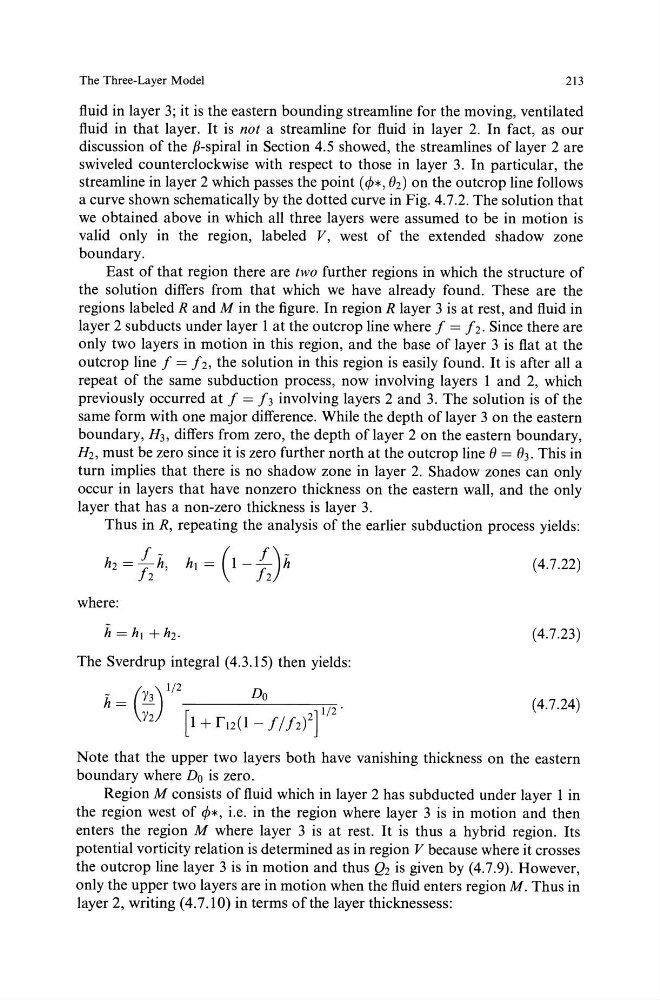
hz = ~ h, h1 = ( 1 - ~) h
(4.7.22)
where:
h = h1 + hz.
(4.7.23)
The Sverdrup integral (4.3.15) then yields:
(4.7.24)
Note that the upper two layers both have vanishing thickness on the eastern
boundary where Do is zero.
Region M consists of fluid which in layer 2 has subducted under layer 1 in
the region west of enters the region M where layer 3 is at rest. It is thus a hybrid region. Its
potential vorticity relation is determined as in region V because where it crosses
the outcrop line layer 3 is in motion and thus Q2 is given by (4.7.9). However,
only the upper two layers are in motion when the fluid enters region M. Thus in
layer 2, writing ( 4. 7.1 0) in terms of the layer thicknessess:
213
fluid in layer 3; it is the eastern bounding streamline for the moving, ventilated
fluid in that layer. It is not a streamline for fluid in layer 2. In fact, as our
discussion of the /3-spiral in Section 4.5 showed, the streamlines of layer 2 are
swiveled counterclockwise with respect to those in layer 3. In particular, the
streamline in layer 2 which passes the point ( a curve shown schematically by the dotted curve in Fig. 4.7.2. The solution that
we obtained above in which all three layers were assumed to be in motion is
valid only in the region, labeled V, west of the extended shadow zone
boundary.
East of that region there are two further regions in which the structure of
the solution differs from that which we have already found. These are the
regions labeled R and M in the figure. In region R layer 3 is at rest, and fluid in
layer 2 subducts under layer 1 at the outcrop line where f = fz. Since there are
only two layers in motion in this region, and the base of layer 3 is flat at the
outcrop line f = fz, the solution in this region is easily found. It is after all a
repeat of the same subduction process, now involving layers 1 and 2, which
previously occurred at f = /3 involving layers 2 and 3. The solution is of the
same form with one major difference. While the depth of layer 3 on the eastern
boundary, H 3 , differs from zero, the depth of layer 2 on the eastern boundary,
Hz, must be zero since it is zero further north at the outcrop line (J = 83• This in
turn implies that there is no shadow zone in layer 2. Shadow zones can only
occur in layers that have nonzero thickness on the eastern wall, and the only
layer that has a non-zero thickness is layer 3.
Thus in R, repeating the analysis of the earlier subduction process yields:
hz = ~ h, h1 = ( 1 - ~) h
(4.7.22)
where:
h = h1 + hz.
(4.7.23)
The Sverdrup integral (4.3.15) then yields:
(4.7.24)
Note that the upper two layers both have vanishing thickness on the eastern
boundary where Do is zero.
Region M consists of fluid which in layer 2 has subducted under layer 1 in
the region west of enters the region M where layer 3 is at rest. It is thus a hybrid region. Its
potential vorticity relation is determined as in region V because where it crosses
the outcrop line layer 3 is in motion and thus Q2 is given by (4.7.9). However,
only the upper two layers are in motion when the fluid enters region M. Thus in
layer 2, writing ( 4. 7.1 0) in terms of the layer thicknessess: