

The Three-Layer Model
211
In distinction to the two-layer model, the ratio of the layer thicknesses is
now a function of the stratification as well as a function of the position of the
outcrop lines.
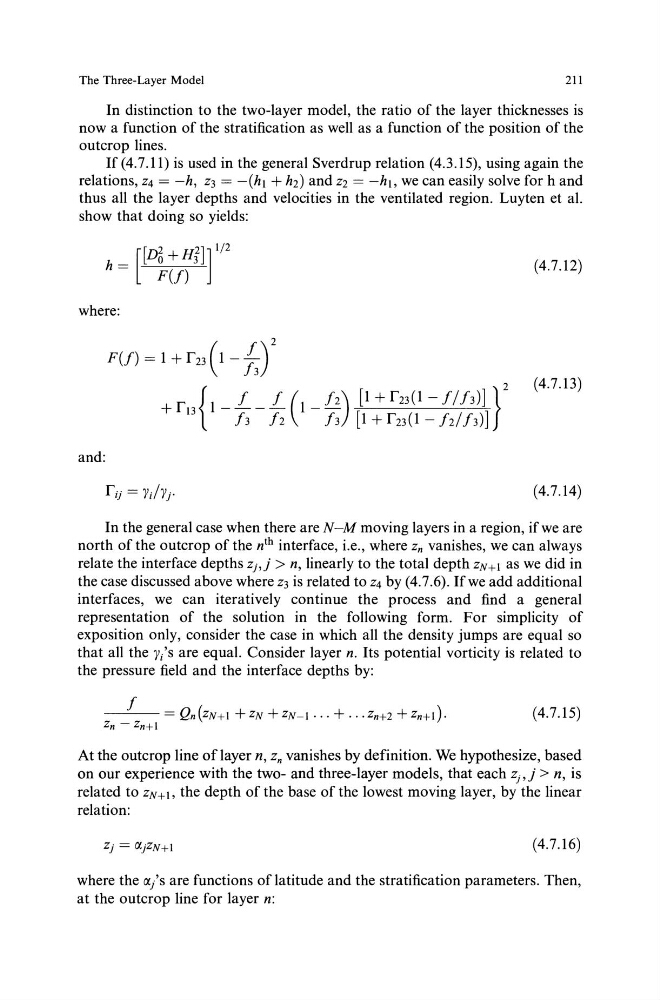
If ( 4. 7.11) is used in the general Sverdrup relation ( 4.3.15), using again the
relations, z4 = -h, z3 =-(hi+ h2) and z2 =-hi, we can easily solve for hand
thus all the layer depths and velocities in the ventilated region. Luyten et al.
show that doing so yields:
= [[D5 +Hl]] I/2
h
F(f)
(4.7.12)
where:
(4.7.13)
and:
(4.7.14)
In the general case when there are N-M moving layers in a region, if we are
north of the outcrop of the nth interface, i.e., where Zn vanishes, we can always
relate the interface depths zbj > n, linearly to the total depth zN+I as we did in
the case discussed above where z3 is related to z4 by ( 4. 7 .6). If we add additional
interfaces, we can iteratively continue the process and find a general
representation of the solution in the following form. For simplicity of
exposition only, consider the case in which all the density jumps are equal so
that all the y;'s are equal. Consider layer n. Its potential vorticity is related to
the pressure field and the interface depths by:
(4.7.15)
At the outcrop line of layer n, zn vanishes by definition. We hypothesize, based
on our experience with the two- and three-layer models, that each z 1 ,j > n, is
related to ZN+J, the depth of the base of the lowest moving layer, by the linear
relation:
(4.7.16)
where the r:x/s are functions of latitude and the stratification parameters. Then,
at the outcrop line for layer n:
211
In distinction to the two-layer model, the ratio of the layer thicknesses is
now a function of the stratification as well as a function of the position of the
outcrop lines.
If ( 4. 7.11) is used in the general Sverdrup relation ( 4.3.15), using again the
relations, z4 = -h, z3 =-(hi+ h2) and z2 =-hi, we can easily solve for hand
thus all the layer depths and velocities in the ventilated region. Luyten et al.
show that doing so yields:
= [[D5 +Hl]] I/2
h
F(f)
(4.7.12)
where:
(4.7.13)
and:
(4.7.14)
In the general case when there are N-M moving layers in a region, if we are
north of the outcrop of the nth interface, i.e., where Zn vanishes, we can always
relate the interface depths zbj > n, linearly to the total depth zN+I as we did in
the case discussed above where z3 is related to z4 by ( 4. 7 .6). If we add additional
interfaces, we can iteratively continue the process and find a general
representation of the solution in the following form. For simplicity of
exposition only, consider the case in which all the density jumps are equal so
that all the y;'s are equal. Consider layer n. Its potential vorticity is related to
the pressure field and the interface depths by:
(4.7.15)
At the outcrop line of layer n, zn vanishes by definition. We hypothesize, based
on our experience with the two- and three-layer models, that each z 1 ,j > n, is
related to ZN+J, the depth of the base of the lowest moving layer, by the linear
relation:
(4.7.16)
where the r:x/s are functions of latitude and the stratification parameters. Then,
at the outcrop line for layer n: