

210
Theory of the Ventilated Thermocline
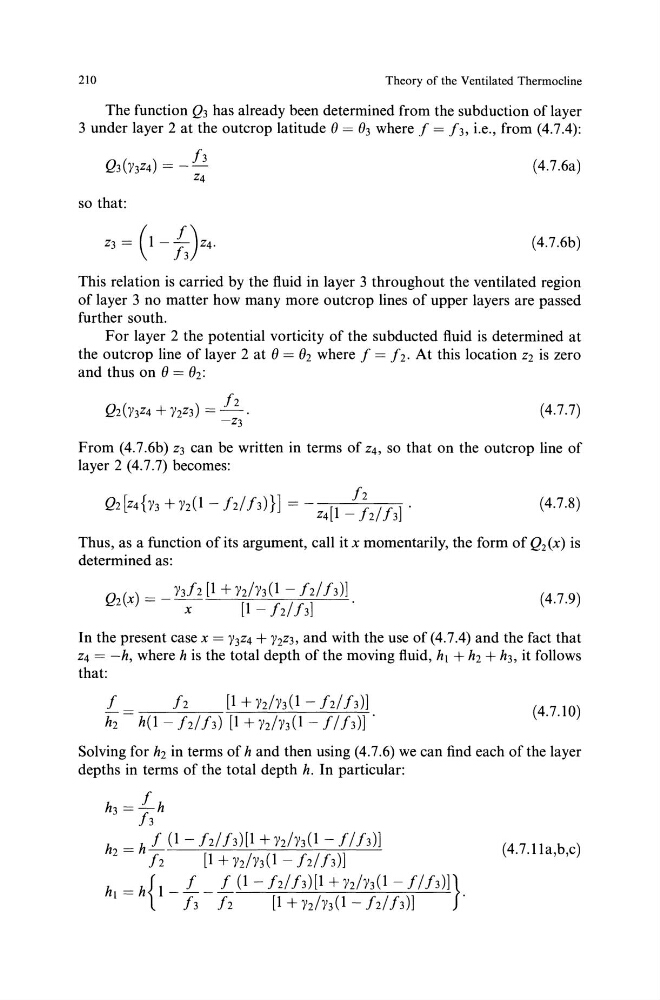
The function Q3 has already been determined from the subduction of layer
3 under layer 2 at the outcrop latitude()= ()3 where f = h, i.e., from (4.7.4):
(4.7.6a)
so that:
(4.7.6b)
This relation is carried by the fluid in layer 3 throughout the ventilated region
of layer 3 no matter how many more outcrop lines of upper layers are passed
further south.
For layer 2 the potential vorticity of the subducted fluid is determined at
the outcrop line of layer 2 at () = ()2 where f = h- At this location z2 is zero
and thus on () = ()2:
(4.7.7)
From (4.7.6b) z3 can be written in terms of z4 , so that on the outcrop line of
layer 2 (4.7.7) becomes:
(4.7.8)
Thus, as a function of its argument, call it x momentarily, the form of Q 2 (x) is
determined as:
(4.7.9)
In the present case x = y 3 z4 + y 2 z3, and with the use of (4.7.4) and the fact that
z4 = -h, where h is the total depth of the moving fluid, h, + h2 + h3, it follows
that:
f
h
[1 + 1'2!1'3(1 -hi h)]
h2- h(1- h/h) [1 +1'2!1'3(1- !/h)].
(4.7.10)
Solving for h2 in terms of h and then using ( 4. 7 .6) we can find each of the layer
depths in terms of the total depth h. In particular:
h3 = j_h
h
h 2 = hf_ (1- hi h)[1 + 1'2/1'3(1- f I h)J
h
[1 + 1'2!1'3(1- hi h)]
h,- h{1-j_- f (1- h/h)[1 +1'2!1'3(1- //h)]}
-
h h
[1 +1'2/1'3(1- h/h)]
.
(4.7.1la,b,c)
Theory of the Ventilated Thermocline
The function Q3 has already been determined from the subduction of layer
3 under layer 2 at the outcrop latitude()= ()3 where f = h, i.e., from (4.7.4):
(4.7.6a)
so that:
(4.7.6b)
This relation is carried by the fluid in layer 3 throughout the ventilated region
of layer 3 no matter how many more outcrop lines of upper layers are passed
further south.
For layer 2 the potential vorticity of the subducted fluid is determined at
the outcrop line of layer 2 at () = ()2 where f = h- At this location z2 is zero
and thus on () = ()2:
(4.7.7)
From (4.7.6b) z3 can be written in terms of z4 , so that on the outcrop line of
layer 2 (4.7.7) becomes:
(4.7.8)
Thus, as a function of its argument, call it x momentarily, the form of Q 2 (x) is
determined as:
(4.7.9)
In the present case x = y 3 z4 + y 2 z3, and with the use of (4.7.4) and the fact that
z4 = -h, where h is the total depth of the moving fluid, h, + h2 + h3, it follows
that:
f
h
[1 + 1'2!1'3(1 -hi h)]
h2- h(1- h/h) [1 +1'2!1'3(1- !/h)].
(4.7.10)
Solving for h2 in terms of h and then using ( 4. 7 .6) we can find each of the layer
depths in terms of the total depth h. In particular:
h3 = j_h
h
h 2 = hf_ (1- hi h)[1 + 1'2/1'3(1- f I h)J
h
[1 + 1'2!1'3(1- hi h)]
h,- h{1-j_- f (1- h/h)[1 +1'2!1'3(1- //h)]}
-
h h
[1 +1'2/1'3(1- h/h)]
.
(4.7.1la,b,c)