

The Three-Layer Model
@
M
R
s (8)
®
'
I
I
~
~
209
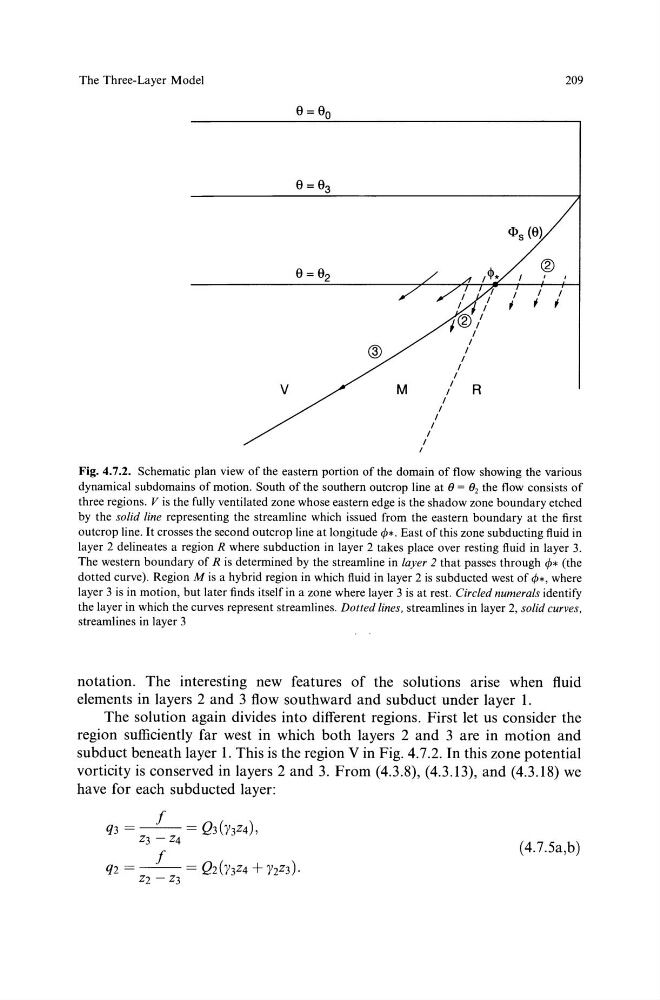
Fig. 4.7.2. Schematic plan view of the eastern portion of the domain of flow showing the various
dynamical subdomains of motion. South of the southern outcrop line at e = e, the flow consists of
three regions. V is the fully ventilated zone whose eastern edge is the shadow zone boundary etched
by the solid line representing the streamline which issued from the eastern boundary at the first
outcrop line. It crosses the second outcrop line at longitude 1>*· East of this zone subducting fluid in
layer 2 delineates a region R where subduction in layer 2 takes place over resting fluid in layer 3.
The western boundary of R is determined by the streamline in layer 2 that passes through 1>* (the
dotted curve). Region M is a hybrid region in which fluid in layer 2 is subducted west of*, where
layer 3 is in motion, but later finds itself in a zone where layer 3 is at rest. Circled numerals identify
the layer in which the curves represent streamlines. Dotted lines, streamlines in layer 2, solid curves,
streamlines in layer 3
notation. The interesting new features of the solutions arise when fluid
elements in layers 2 and 3 flow southward and subduct under layer 1.
The solution again divides into different regions. First let us consider the
region sufficiently far west in which both layers 2 and 3 are in motion and
subduct beneath layer 1. This is the region V in Fig. 4.7.2. In this zone potential
vorticity is conserved in layers 2 and 3. From (4.3.8), (4.3.13), and (4.3.18) we
have for each subducted layer:
(4.7.5a,b)
@
M
R
®
'
I
I
~
~
209
Fig. 4.7.2. Schematic plan view of the eastern portion of the domain of flow showing the various
dynamical subdomains of motion. South of the southern outcrop line at e = e, the flow consists of
three regions. V is the fully ventilated zone whose eastern edge is the shadow zone boundary etched
by the solid line representing the streamline which issued from the eastern boundary at the first
outcrop line. It crosses the second outcrop line at longitude 1>*· East of this zone subducting fluid in
layer 2 delineates a region R where subduction in layer 2 takes place over resting fluid in layer 3.
The western boundary of R is determined by the streamline in layer 2 that passes through 1>* (the
dotted curve). Region M is a hybrid region in which fluid in layer 2 is subducted west of
layer 3 is in motion, but later finds itself in a zone where layer 3 is at rest. Circled numerals identify
the layer in which the curves represent streamlines. Dotted lines, streamlines in layer 2, solid curves,
streamlines in layer 3
notation. The interesting new features of the solutions arise when fluid
elements in layers 2 and 3 flow southward and subduct under layer 1.
The solution again divides into different regions. First let us consider the
region sufficiently far west in which both layers 2 and 3 are in motion and
subduct beneath layer 1. This is the region V in Fig. 4.7.2. In this zone potential
vorticity is conserved in layers 2 and 3. From (4.3.8), (4.3.13), and (4.3.18) we
have for each subducted layer:
(4.7.5a,b)