

The P-Spiral
203
It is the use of the Sverdrup vorticity equation that allows us to relate the
vertical velocity, which is usually too small to be directly observed, with the
meridional velocity, v. Suppose, as in the model, that there is some layer,
n = N, below which the total velocity field is zero. Then if we integrate the
vertical velocity from that great depth, the Sverdrup vorticity equation implies
that:
(4.5.6)
Thus, with (4.5.5):
PYn-1 ~ h kA [-]
f2 ~ V; i = · Un-1 X Un .
(4.5.7)
If the total meridional transport of all the layers beneath layer n is negative the
velocity vector must swing clockwise with depth when moving from layer n - 1
to layer n. Furthermore, from (4.5.4) this vector cross-product becomes larger
with increasing depth if Vn is negative.
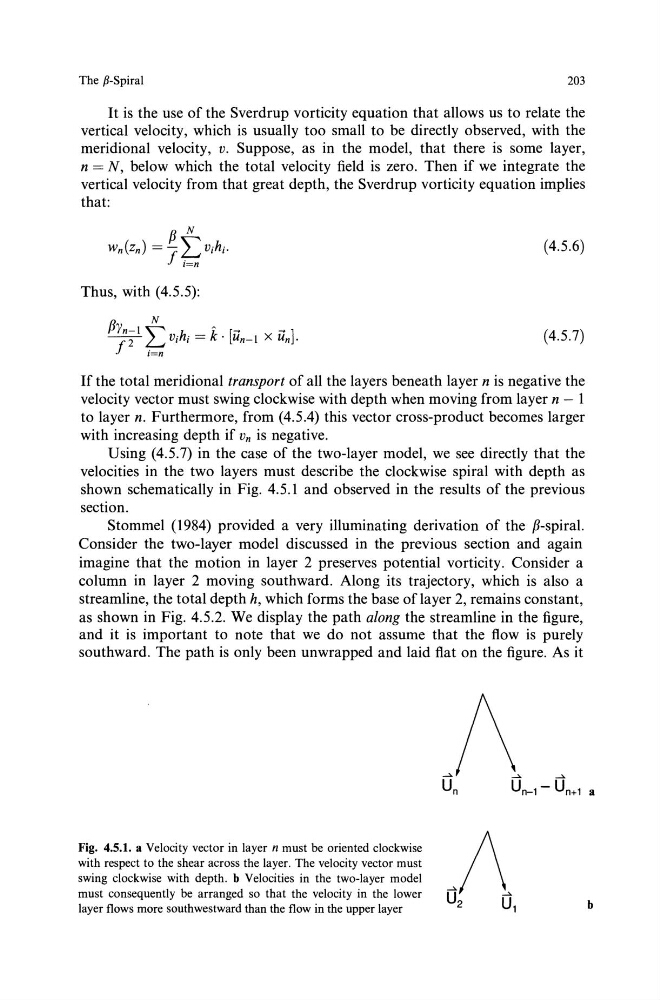
Using (4.5.7) in the case of the two-layer model, we see directly that the
velocities in the two layers must describe the clockwise spiral with depth as
shown schematically in Fig. 4.5.1 and observed in the results of the previous
section.
Stommel (1984) provided a very illuminating derivation of the P-spiral.
Consider the two-layer model discussed in the previous section and again
imagine that the motion in layer 2 preserves potential vorticity. Consider a
column in layer 2 moving southward. Along its trajectory, which is also a
streamline, the total depth h, which forms the base of layer 2, remains constant,
as shown in Fig. 4.5.2. We display the path along the streamline in the figure,
and it is important to note that we do not assume that the flow is purely
southward. The path is only been unwrapped and laid flat on the figure. As it
Fig. 4.5.1. a Velocity vector in layer n must be oriented clockwise
with respect to the shear across the layer. The velocity vector must
swing clockwise with depth. b Velocities in the two-layer model
must consequently be arranged so that the velocity in the lower
layer flows more southwestward than the flow in the upper layer
b
203
It is the use of the Sverdrup vorticity equation that allows us to relate the
vertical velocity, which is usually too small to be directly observed, with the
meridional velocity, v. Suppose, as in the model, that there is some layer,
n = N, below which the total velocity field is zero. Then if we integrate the
vertical velocity from that great depth, the Sverdrup vorticity equation implies
that:
(4.5.6)
Thus, with (4.5.5):
PYn-1 ~ h kA [-]
f2 ~ V; i = · Un-1 X Un .
(4.5.7)
If the total meridional transport of all the layers beneath layer n is negative the
velocity vector must swing clockwise with depth when moving from layer n - 1
to layer n. Furthermore, from (4.5.4) this vector cross-product becomes larger
with increasing depth if Vn is negative.
Using (4.5.7) in the case of the two-layer model, we see directly that the
velocities in the two layers must describe the clockwise spiral with depth as
shown schematically in Fig. 4.5.1 and observed in the results of the previous
section.
Stommel (1984) provided a very illuminating derivation of the P-spiral.
Consider the two-layer model discussed in the previous section and again
imagine that the motion in layer 2 preserves potential vorticity. Consider a
column in layer 2 moving southward. Along its trajectory, which is also a
streamline, the total depth h, which forms the base of layer 2, remains constant,
as shown in Fig. 4.5.2. We display the path along the streamline in the figure,
and it is important to note that we do not assume that the flow is purely
southward. The path is only been unwrapped and laid flat on the figure. As it
Fig. 4.5.1. a Velocity vector in layer n must be oriented clockwise
with respect to the shear across the layer. The velocity vector must
swing clockwise with depth. b Velocities in the two-layer model
must consequently be arranged so that the velocity in the lower
layer flows more southwestward than the flow in the upper layer
b