

202
Theory of the Ventilated Thermocline
proceed from a knowledge of the density field, and hence the vertical shear of
the velocity, to the absolute velocity itself.
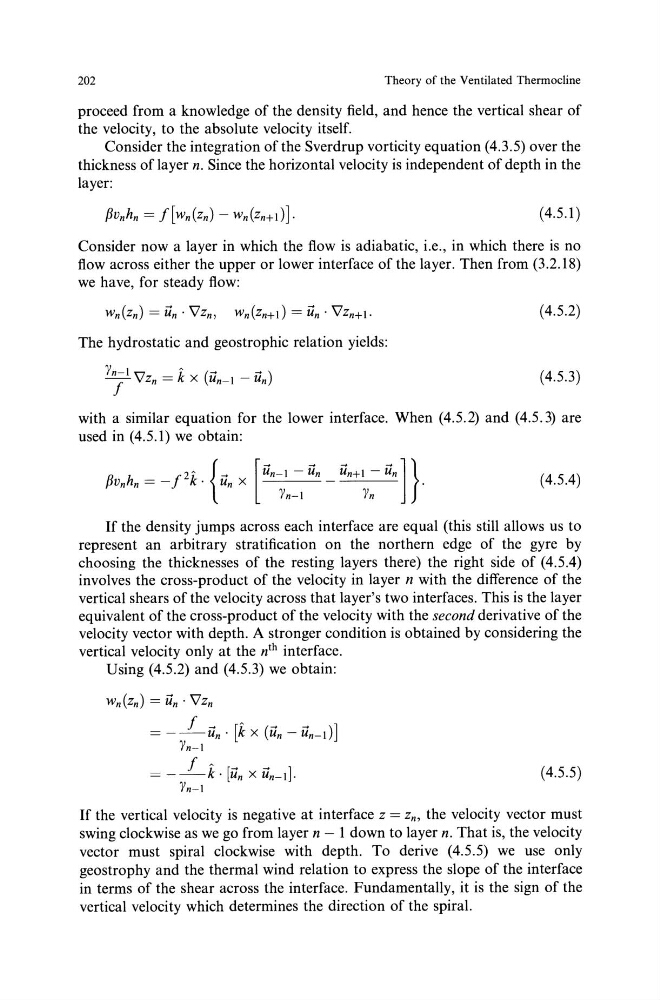
Consider the integration of the Sverdrup vorticity equation ( 4.3.5) over the
thickness of layer n. Since the horizontal velocity is independent of depth in the
layer:
(4.5.1)
Consider now a layer in which the flow is adiabatic, i.e., in which there is no
flow across either the upper or lower interface of the layer. Then from (3.2.18)
we have, for steady flow:
( 4.5.2)
The hydrostatic and geostrophic relation yields:
'Yn-1"'
k' (- )
f v Zn = X Un-1 - Un
( 4.5.3)
with a similar equation for the lower interface. When (4.5.2) and (4.5.3) are
used in (4.5.1) we obtain:
( 4.5.4)
If the density jumps across each interface are equal (this still allows us to
represent an arbitrary stratification on the northern edge of the gyre by
choosing the thicknesses of the resting layers there) the right side of ( 4.5.4)
involves the cross-product of the velocity in layer n with the difference of the
vertical shears of the velocity across that layer's two interfaces. This is the layer
equivalent of the cross-product of the velocity with the second derivative of the
velocity vector with depth. A stronger condition is obtained by considering the
vertical velocity only at the n 1 h interface.
Using (4.5.2) and (4.5.3) we obtain:
Wn(zn) = Un · 'Vzn
= _ _l_Un · [k X (un- Un-1)]
'Yn-1
f k' [- - l
= - - - · Un X Un-1 .
'Yn-1
(4.5.5)
If the vertical velocity is negative at interface z = Zn, the velocity vector must
swing clockwise as we go from layer n- 1 down to layer n. That is, the velocity
vector must spiral clockwise with depth. To derive (4.5.5) we use only
geostrophy and the thermal wind relation to express the slope of the interface
in terms of the shear across the interface. Fundamentally, it is the sign of the
vertical velocity which determines the direction of the spiral.
Theory of the Ventilated Thermocline
proceed from a knowledge of the density field, and hence the vertical shear of
the velocity, to the absolute velocity itself.
Consider the integration of the Sverdrup vorticity equation ( 4.3.5) over the
thickness of layer n. Since the horizontal velocity is independent of depth in the
layer:
(4.5.1)
Consider now a layer in which the flow is adiabatic, i.e., in which there is no
flow across either the upper or lower interface of the layer. Then from (3.2.18)
we have, for steady flow:
( 4.5.2)
The hydrostatic and geostrophic relation yields:
'Yn-1"'
k' (- )
f v Zn = X Un-1 - Un
( 4.5.3)
with a similar equation for the lower interface. When (4.5.2) and (4.5.3) are
used in (4.5.1) we obtain:
( 4.5.4)
If the density jumps across each interface are equal (this still allows us to
represent an arbitrary stratification on the northern edge of the gyre by
choosing the thicknesses of the resting layers there) the right side of ( 4.5.4)
involves the cross-product of the velocity in layer n with the difference of the
vertical shears of the velocity across that layer's two interfaces. This is the layer
equivalent of the cross-product of the velocity with the second derivative of the
velocity vector with depth. A stronger condition is obtained by considering the
vertical velocity only at the n 1 h interface.
Using (4.5.2) and (4.5.3) we obtain:
Wn(zn) = Un · 'Vzn
= _ _l_Un · [k X (un- Un-1)]
'Yn-1
f k' [- - l
= - - - · Un X Un-1 .
'Yn-1
(4.5.5)
If the vertical velocity is negative at interface z = Zn, the velocity vector must
swing clockwise as we go from layer n- 1 down to layer n. That is, the velocity
vector must spiral clockwise with depth. To derive (4.5.5) we use only
geostrophy and the thermal wind relation to express the slope of the interface
in terms of the shear across the interface. Fundamentally, it is the sign of the
vertical velocity which determines the direction of the spiral.