

204
Theory of the Ventilated Thermocline
h
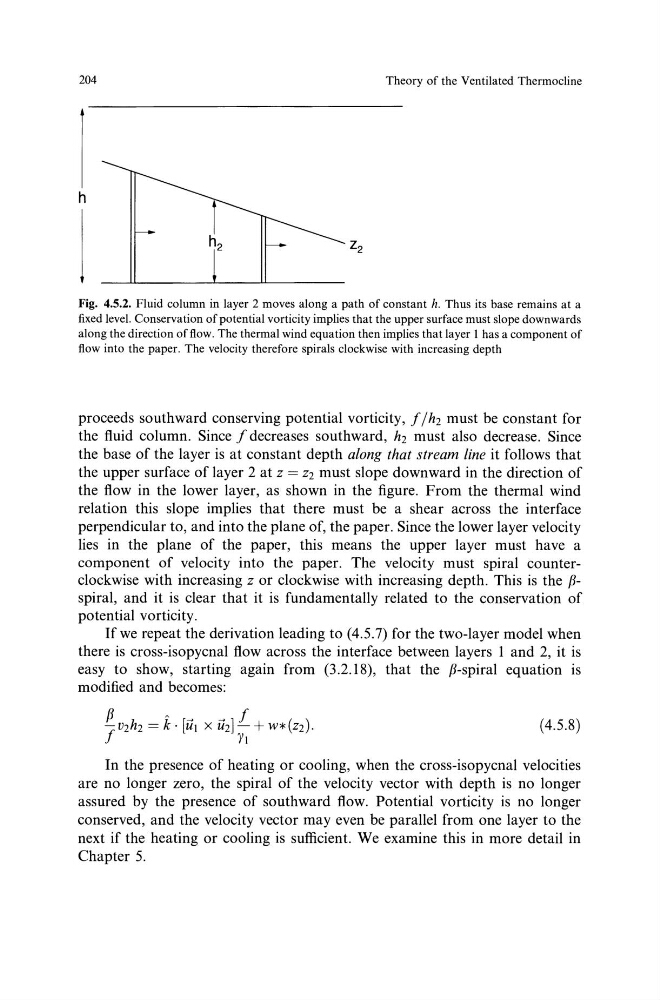
Fig. 4.5.2. Fluid column in layer 2 moves along a path of constant h. Thus its base remains at a
fixed level. Conservation of potential vorticity implies that the upper surface must slope downwards
along the direction of flow. The thermal wind equation then implies that layer I has a component of
flow into the paper. The velocity therefore spirals clockwise with increasing depth
proceeds southward conserving potential vorticity, f jh2 must be constant for
the fluid column. Since f decreases southward, h2 must also decrease. Since
the base of the layer is at constant depth along that stream line it follows that
the upper surface of layer 2 at z = z2 must slope downward in the direction of
the flow in the lower layer, as shown in the figure. From the thermal wind
relation this slope implies that there must be a shear across the interface
perpendicular to, and into the plane of, the paper. Since the lower layer velocity
lies in the plane of the paper, this means the upper layer must have a
component of velocity into the paper. The velocity must spiral counterclockwise with increasing z or clockwise with increasing depth. This is the /3spiral, and it is clear that it is fundamentally related to the conservation of
potential vorticity.
If we repeat the derivation leading to (4.5.7) for the two-layer model when
there is cross-isopycnal flow across the interface between layers I and 2, it is
easy to show, starting agam from (3.2.18), that the /3-spiral equation is
modified and becomes:
(4.5.8)
In the presence of heating or cooling, when the cross-isopycnal velocities
are no longer zero, the spiral of the velocity vector with depth is no longer
assured by the presence of southward flow. Potential vorticity is no longer
conserved, and the velocity vector may even be parallel from one layer to the
next if the heating or cooling is sufficient. We examine this in more detail in
Chapter 5.
Theory of the Ventilated Thermocline
h
Fig. 4.5.2. Fluid column in layer 2 moves along a path of constant h. Thus its base remains at a
fixed level. Conservation of potential vorticity implies that the upper surface must slope downwards
along the direction of flow. The thermal wind equation then implies that layer I has a component of
flow into the paper. The velocity therefore spirals clockwise with increasing depth
proceeds southward conserving potential vorticity, f jh2 must be constant for
the fluid column. Since f decreases southward, h2 must also decrease. Since
the base of the layer is at constant depth along that stream line it follows that
the upper surface of layer 2 at z = z2 must slope downward in the direction of
the flow in the lower layer, as shown in the figure. From the thermal wind
relation this slope implies that there must be a shear across the interface
perpendicular to, and into the plane of, the paper. Since the lower layer velocity
lies in the plane of the paper, this means the upper layer must have a
component of velocity into the paper. The velocity must spiral counterclockwise with increasing z or clockwise with increasing depth. This is the /3spiral, and it is clear that it is fundamentally related to the conservation of
potential vorticity.
If we repeat the derivation leading to (4.5.7) for the two-layer model when
there is cross-isopycnal flow across the interface between layers I and 2, it is
easy to show, starting agam from (3.2.18), that the /3-spiral equation is
modified and becomes:
(4.5.8)
In the presence of heating or cooling, when the cross-isopycnal velocities
are no longer zero, the spiral of the velocity vector with depth is no longer
assured by the presence of southward flow. Potential vorticity is no longer
conserved, and the velocity vector may even be parallel from one layer to the
next if the heating or cooling is sufficient. We examine this in more detail in
Chapter 5.