

196
Theory of the Ventilated Thermocline
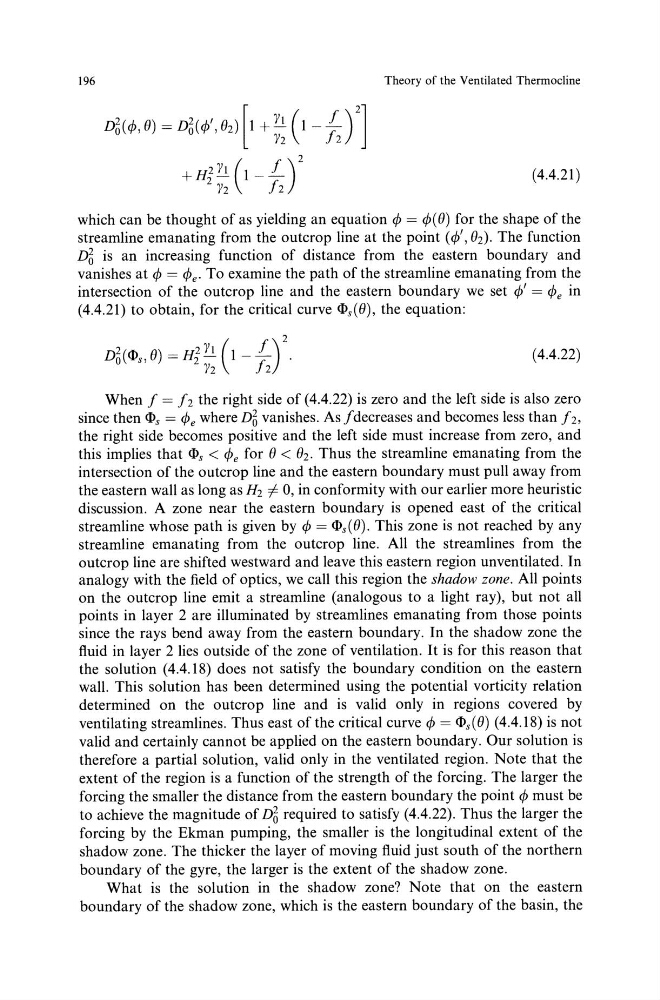
which can be thought of as yielding an equation 4> = 4>(8) for the shape of the
streamline emanating from the outcrop line at the point ( 4>', 82). The function
D~ is an increasing function of distance from the eastern boundary and
vanishes at 4> = rf>e· To examine the path of the streamline emanating from the
intersection of the outcrop line and the eastern boundary we set 4>' = rf>e in
(4.4.21) to obtain, for the critical curve ll>s(8), the equation:
( 4.4.22)
When f = h the right side of (4.4.22) is zero and the left side is also zero
since then ll>s = rf>e where D~ vanishes. As f decreases and becomes less than f 2,
the right side becomes positive and the left side must increase from zero, and
this implies that ll>s < rf>e for () < 82. Thus the streamline emanating from the
intersection of the outcrop line and the eastern boundary must pull away from
the eastern wall as long as H 2 cf- 0, in conformity with our earlier more heuristic
discussion. A zone near the eastern boundary is opened east of the critical
streamline whose path is given by 4> = ll>s(8). This zone is not reached by any
streamline emanating from the outcrop line. All the streamlines from the
outcrop line are shifted westward and leave this eastern region unventilated. In
analogy with the field of optics, we call this region the shadow zone. All points
on the outcrop line emit a streamline (analogous to a light ray), but not all
points in layer 2 are illuminated by streamlines emanating from those points
since the rays bend away from the eastern boundary. In the shadow zone the
fluid in layer 2 lies outside of the zone of ventilation. It is for this reason that
the solution ( 4.4.18) does not satisfy the boundary condition on the eastern
wall. This solution has been determined using the potential vorticity relation
determined on the outcrop line and is valid only in regions covered by
ventilating streamlines. Thus east of the critical curve 4> = ll>s(8) (4.4.18) is not
valid and certainly cannot be applied on the eastern boundary. Our solution is
therefore a partial solution, valid only in the ventilated region. Note that the
extent of the region is a function of the strength of the forcing. The larger the
forcing the smaller the distance from the eastern boundary the point 4> must be
to achieve the magnitude of D~ required to satisfy ( 4.4.22). Thus the larger the
forcing by the Ekman pumping, the smaller is the longitudinal extent of the
shadow zone. The thicker the layer of moving fluid just south of the northern
boundary of the gyre, the larger is the extent of the shadow zone.
What is the solution in the shadow zone? Note that on the eastern
boundary of the shadow zone, which is the eastern boundary of the basin, the
Theory of the Ventilated Thermocline
which can be thought of as yielding an equation 4> = 4>(8) for the shape of the
streamline emanating from the outcrop line at the point ( 4>', 82). The function
D~ is an increasing function of distance from the eastern boundary and
vanishes at 4> = rf>e· To examine the path of the streamline emanating from the
intersection of the outcrop line and the eastern boundary we set 4>' = rf>e in
(4.4.21) to obtain, for the critical curve ll>s(8), the equation:
( 4.4.22)
When f = h the right side of (4.4.22) is zero and the left side is also zero
since then ll>s = rf>e where D~ vanishes. As f decreases and becomes less than f 2,
the right side becomes positive and the left side must increase from zero, and
this implies that ll>s < rf>e for () < 82. Thus the streamline emanating from the
intersection of the outcrop line and the eastern boundary must pull away from
the eastern wall as long as H 2 cf- 0, in conformity with our earlier more heuristic
discussion. A zone near the eastern boundary is opened east of the critical
streamline whose path is given by 4> = ll>s(8). This zone is not reached by any
streamline emanating from the outcrop line. All the streamlines from the
outcrop line are shifted westward and leave this eastern region unventilated. In
analogy with the field of optics, we call this region the shadow zone. All points
on the outcrop line emit a streamline (analogous to a light ray), but not all
points in layer 2 are illuminated by streamlines emanating from those points
since the rays bend away from the eastern boundary. In the shadow zone the
fluid in layer 2 lies outside of the zone of ventilation. It is for this reason that
the solution ( 4.4.18) does not satisfy the boundary condition on the eastern
wall. This solution has been determined using the potential vorticity relation
determined on the outcrop line and is valid only in regions covered by
ventilating streamlines. Thus east of the critical curve 4> = ll>s(8) (4.4.18) is not
valid and certainly cannot be applied on the eastern boundary. Our solution is
therefore a partial solution, valid only in the ventilated region. Note that the
extent of the region is a function of the strength of the forcing. The larger the
forcing the smaller the distance from the eastern boundary the point 4> must be
to achieve the magnitude of D~ required to satisfy ( 4.4.22). Thus the larger the
forcing by the Ekman pumping, the smaller is the longitudinal extent of the
shadow zone. The thicker the layer of moving fluid just south of the northern
boundary of the gyre, the larger is the extent of the shadow zone.
What is the solution in the shadow zone? Note that on the eastern
boundary of the shadow zone, which is the eastern boundary of the basin, the