

The Ventilated Thermocline: The Two-Layer Model
197
depth of the fluid is H2. The same is true on the western boundary of the
shadow zone which is the critical streamline given by h = H2. Thus no flow
enters the shadow zone across either the eastern or western edges of the wedgeshaped region that forms the zone. In the absence of mixing and other nonadiabatic sources of potential vorticity anomalies it is plausible that the layer
remains at rest. Since we are dealing, at the lowest order, with an ideal fluid, the
motion of this isolated region is actually arbitrary, but it seems reasonable to
set the velocity in layer 2 to zero. This is what Luyten et al. (1983) did.
If the velocity in layer 2 is zero in the shadow zone, all the Sverdrup
transport in this region must be carried by the upper layer. Thus, east of the
line ¢ = <1>.(0) the flow in layer 2 is zero, and therefore everywhere in this
region h = H2 or equivalently z3 = Z3. Thus (4.4.17) reduces to:
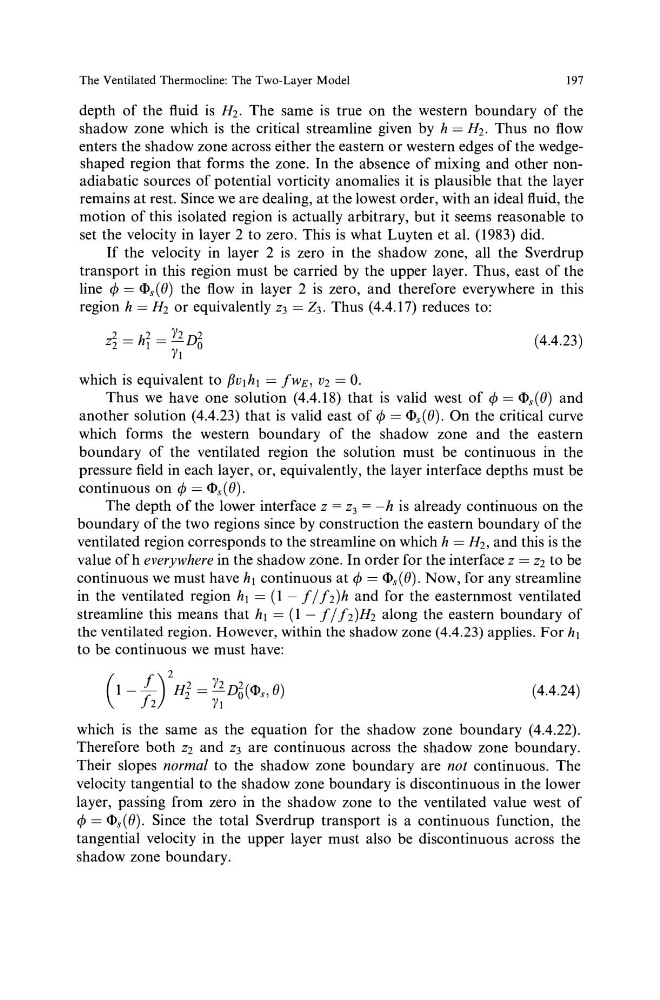
~=hi= Y2 D~
Yt
( 4.4.23)
which is equivalent to f3vtht = fwE, v2 = 0.
Thus we have one solution (4.4.18) that is valid west of¢= .(O) and
another solution (4.4.23) that is valid east of¢= <1>.(0). On the critical curve
which forms the western boundary of the shadow zone and the eastern
boundary of the ventilated region the solution must be continuous in the
pressure field in each layer, or, equivalently, the layer interface depths must be
continuous on¢= <1>.(0).
The depth of the lower interface z = z 3 = -h is already continuous on the
boundary of the two regions since by construction the eastern boundary of the
ventilated region corresponds to the streamline on which h = H2, and this is the
value ofh everywhere in the shadow zone. In order for the interface z = z2 to be
continuous we must have ht continuous at¢= <1>.(0). Now, for any streamline
in the ventilated region ht = (1 - f I h)h and for the easternmost ventilated
streamline this means that ht = (1 - f I h)H2 along the eastern boundary of
the ventilated region. However, within the shadow zone (4.4.23) applies. For h1
to be continuous we must have:
( 1 _ Izr Hi=~~ do( •• 0)
(4.4.24)
which is the same as the equation for the shadow zone boundary (4.4.22).
Therefore both z2 and z3 are continuous across the shadow zone boundary.
Their slopes normal to the shadow zone boundary are not continuous. The
velocity tangential to the shadow zone boundary is discontinuous in the lower
layer, passing from zero in the shadow zone to the ventilated value west of
¢ = <1>.(0). Since the total Sverdrup transport is a continuous function, the
tangential velocity in the upper layer must also be discontinuous across the
shadow zone boundary.
197
depth of the fluid is H2. The same is true on the western boundary of the
shadow zone which is the critical streamline given by h = H2. Thus no flow
enters the shadow zone across either the eastern or western edges of the wedgeshaped region that forms the zone. In the absence of mixing and other nonadiabatic sources of potential vorticity anomalies it is plausible that the layer
remains at rest. Since we are dealing, at the lowest order, with an ideal fluid, the
motion of this isolated region is actually arbitrary, but it seems reasonable to
set the velocity in layer 2 to zero. This is what Luyten et al. (1983) did.
If the velocity in layer 2 is zero in the shadow zone, all the Sverdrup
transport in this region must be carried by the upper layer. Thus, east of the
line ¢ = <1>.(0) the flow in layer 2 is zero, and therefore everywhere in this
region h = H2 or equivalently z3 = Z3. Thus (4.4.17) reduces to:
~=hi= Y2 D~
Yt
( 4.4.23)
which is equivalent to f3vtht = fwE, v2 = 0.
Thus we have one solution (4.4.18) that is valid west of¢= .(O) and
another solution (4.4.23) that is valid east of¢= <1>.(0). On the critical curve
which forms the western boundary of the shadow zone and the eastern
boundary of the ventilated region the solution must be continuous in the
pressure field in each layer, or, equivalently, the layer interface depths must be
continuous on¢= <1>.(0).
The depth of the lower interface z = z 3 = -h is already continuous on the
boundary of the two regions since by construction the eastern boundary of the
ventilated region corresponds to the streamline on which h = H2, and this is the
value ofh everywhere in the shadow zone. In order for the interface z = z2 to be
continuous we must have ht continuous at¢= <1>.(0). Now, for any streamline
in the ventilated region ht = (1 - f I h)h and for the easternmost ventilated
streamline this means that ht = (1 - f I h)H2 along the eastern boundary of
the ventilated region. However, within the shadow zone (4.4.23) applies. For h1
to be continuous we must have:
( 1 _ Izr Hi=~~ do( •• 0)
(4.4.24)
which is the same as the equation for the shadow zone boundary (4.4.22).
Therefore both z2 and z3 are continuous across the shadow zone boundary.
Their slopes normal to the shadow zone boundary are not continuous. The
velocity tangential to the shadow zone boundary is discontinuous in the lower
layer, passing from zero in the shadow zone to the ventilated value west of
¢ = <1>.(0). Since the total Sverdrup transport is a continuous function, the
tangential velocity in the upper layer must also be discontinuous across the
shadow zone boundary.