

The Ventilated Thermocline: The Two-Layer Model
195
h2 are constant on the eastern wall. At the same time, however, the fluid
column in layer 2 that we can imagine moving along the eastern boundary must
keep its potential vorticity, f jh2 , constant, which it clearly cannot, and also
keep h2 constant since f varies with latitude. This contradiction is the source of
the difficulty in extending the solution in its present form to the eastern
boundary.
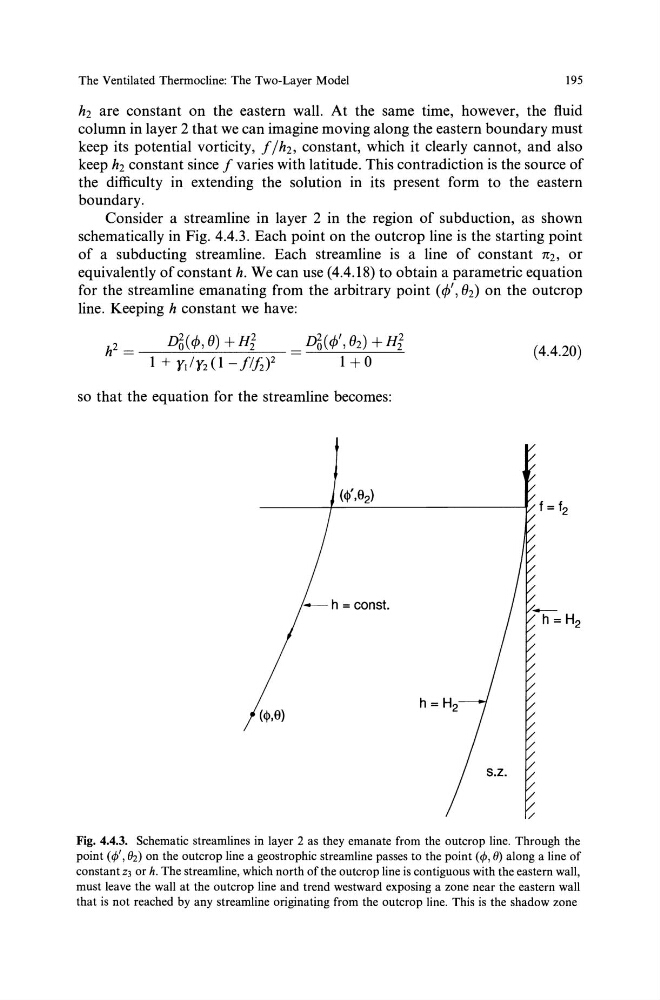
Consider a streamline in layer 2 in the region of subduction, as shown
schematically in Fig. 4.4.3. Each point on the outcrop line is the starting point
of a subducting streamline. Each streamline is a line of constant n2, or
equivalently of constant h. We can use ( 4.4.18) to obtain a parametric equation
for the streamline emanating from the arbitrary point ( ¢', lh) on the outcrop
line. Keeping h constant we have:
D~(c/J',(h) +Hi
1+0
so that the equation for the streamline becomes:
(4.4.20)
Fig. 4.4.3. Schematic streamlines in layer 2 as they emanate from the outcrop line. Through the
point ( cp', 82) on the outcrop line a geostrophic streamline passes to the point ( cp, 8) along a line of
constant z3 or h. The streamline, which north of the outcrop line is contiguous with the eastern wall,
must leave the wall at the outcrop line and trend westward exposing a zone near the eastern wall
that is not reached by any streamline originating from the outcrop line. This is the shadow zone
195
h2 are constant on the eastern wall. At the same time, however, the fluid
column in layer 2 that we can imagine moving along the eastern boundary must
keep its potential vorticity, f jh2 , constant, which it clearly cannot, and also
keep h2 constant since f varies with latitude. This contradiction is the source of
the difficulty in extending the solution in its present form to the eastern
boundary.
Consider a streamline in layer 2 in the region of subduction, as shown
schematically in Fig. 4.4.3. Each point on the outcrop line is the starting point
of a subducting streamline. Each streamline is a line of constant n2, or
equivalently of constant h. We can use ( 4.4.18) to obtain a parametric equation
for the streamline emanating from the arbitrary point ( ¢', lh) on the outcrop
line. Keeping h constant we have:
D~(c/J',(h) +Hi
1+0
so that the equation for the streamline becomes:
(4.4.20)
Fig. 4.4.3. Schematic streamlines in layer 2 as they emanate from the outcrop line. Through the
point ( cp', 82) on the outcrop line a geostrophic streamline passes to the point ( cp, 8) along a line of
constant z3 or h. The streamline, which north of the outcrop line is contiguous with the eastern wall,
must leave the wall at the outcrop line and trend westward exposing a zone near the eastern wall
that is not reached by any streamline originating from the outcrop line. This is the shadow zone