

194
Theory of the Ventilated Thermocline
The further south the fluid moves, the thinner layer 2 becomes in order to
conserve potential vorticity, and layer 1 occupies an increasingly greater
fraction of the total water column.
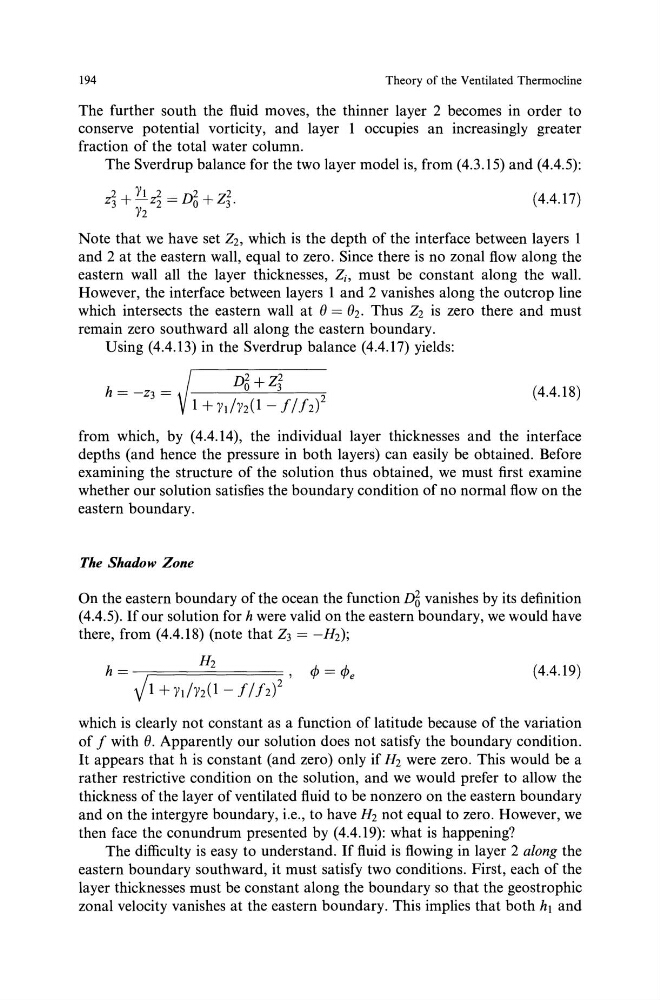
The Sverdrup balance for the two layer model is, from (4.3.15) and (4.4.5):
~ + Yl ~ = D~ + Z~.
Y2
(4.4.17)
Note that we have set Z2, which is the depth of the interface between layers 1
and 2 at the eastern wall, equal to zero. Since there is no zonal flow along the
eastern wall all the layer thicknesses, Zi, must be constant along the wall.
However, the interface between layers 1 and 2 vanishes along the outcrop line
which intersects the eastern wall at (} = fh. Thus Z2 is zero there and must
remain zero southward all along the eastern boundary.
Using ( 4.4.13) in the Sverdrup balance ( 4.4.17) yields:
1 + Yt!Y2(1- f I h) 2
(4.4.18)
from which, by (4.4.14), the individual layer thicknesses and the interface
depths (and hence the pressure in both layers) can easily be obtained. Before
examining the structure of the solution thus obtained, we must first examine
whether our solution satisfies the boundary condition of no normal flow on the
eastern boundary.
The Shadow Zone
On the eastern boundary of the ocean the function D~ vanishes by its definition
(4.4.5). If our solution for h were valid on the eastern boundary, we would have
there, from (4.4.18) (note that Z3 = -H2);
H2
h =
' cP = cPe
Vl +Yt!Y2(1- f/h) 2
(4.4.19)
which is clearly not constant as a function of latitude because of the variation
off with e. Apparently our solution does not satisfy the boundary condition.
It appears that his constant (and zero) only if H 2 were zero. This would be a
rather restrictive condition on the solution, and we would prefer to allow the
thickness of the layer of ventilated fluid to be nonzero on the eastern boundary
and on the intergyre boundary, i.e., to have H2 not equal to zero. However, we
then face the conundrum presented by (4.4.19): what is happening?
The difficulty is easy to understand. If fluid is flowing in layer 2 along the
eastern boundary southward, it must satisfy two conditions. First, each of the
layer thicknesses must be constant along the boundary so that the geostrophic
zonal velocity vanishes at the eastern boundary. This implies that both h1 and
Theory of the Ventilated Thermocline
The further south the fluid moves, the thinner layer 2 becomes in order to
conserve potential vorticity, and layer 1 occupies an increasingly greater
fraction of the total water column.
The Sverdrup balance for the two layer model is, from (4.3.15) and (4.4.5):
~ + Yl ~ = D~ + Z~.
Y2
(4.4.17)
Note that we have set Z2, which is the depth of the interface between layers 1
and 2 at the eastern wall, equal to zero. Since there is no zonal flow along the
eastern wall all the layer thicknesses, Zi, must be constant along the wall.
However, the interface between layers 1 and 2 vanishes along the outcrop line
which intersects the eastern wall at (} = fh. Thus Z2 is zero there and must
remain zero southward all along the eastern boundary.
Using ( 4.4.13) in the Sverdrup balance ( 4.4.17) yields:
1 + Yt!Y2(1- f I h) 2
(4.4.18)
from which, by (4.4.14), the individual layer thicknesses and the interface
depths (and hence the pressure in both layers) can easily be obtained. Before
examining the structure of the solution thus obtained, we must first examine
whether our solution satisfies the boundary condition of no normal flow on the
eastern boundary.
The Shadow Zone
On the eastern boundary of the ocean the function D~ vanishes by its definition
(4.4.5). If our solution for h were valid on the eastern boundary, we would have
there, from (4.4.18) (note that Z3 = -H2);
H2
h =
' cP = cPe
Vl +Yt!Y2(1- f/h) 2
(4.4.19)
which is clearly not constant as a function of latitude because of the variation
off with e. Apparently our solution does not satisfy the boundary condition.
It appears that his constant (and zero) only if H 2 were zero. This would be a
rather restrictive condition on the solution, and we would prefer to allow the
thickness of the layer of ventilated fluid to be nonzero on the eastern boundary
and on the intergyre boundary, i.e., to have H2 not equal to zero. However, we
then face the conundrum presented by (4.4.19): what is happening?
The difficulty is easy to understand. If fluid is flowing in layer 2 along the
eastern boundary southward, it must satisfy two conditions. First, each of the
layer thicknesses must be constant along the boundary so that the geostrophic
zonal velocity vanishes at the eastern boundary. This implies that both h1 and