

The Ventilated Thermocline: The Two-Layer Model
193
one equation between z2 and z3 while the Sverdrup balance provides the
remaining equation required to complete the solution.
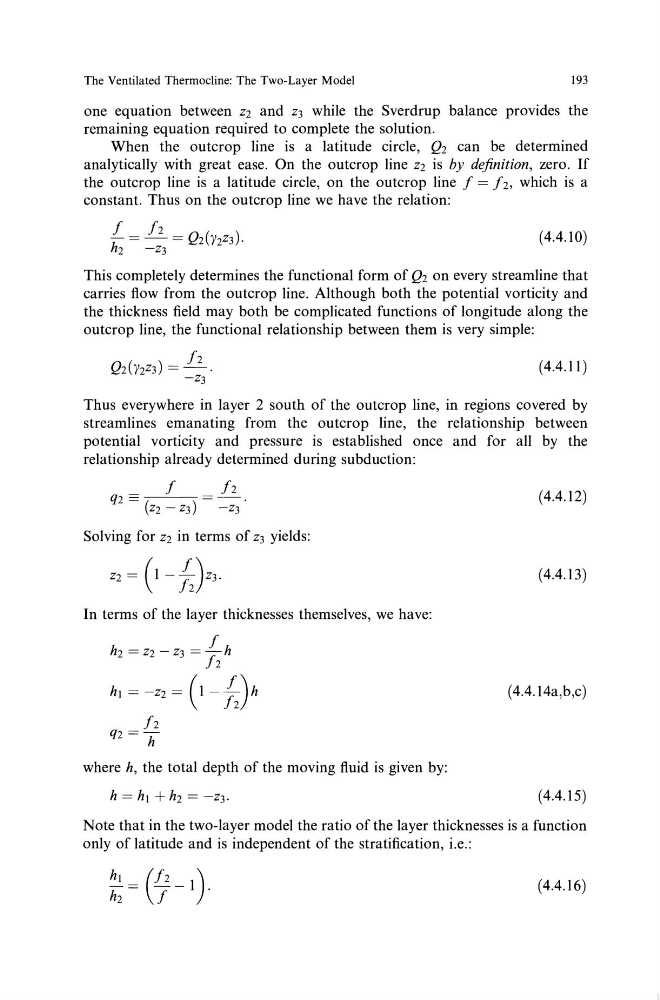
When the outcrop line is a latitude circle, Q2 can be determined
analytically with great ease. On the outcrop line z2 is by definition, zero. If
the outcrop line is a latitude circle, on the outcrop line f = h, which is a
constant. Thus on the outcrop line we have the relation:
(4.4.10)
This completely determines the functional form of Q2 on every streamline that
carries flow from the outcrop line. Although both the potential vorticity and
the thickness field may both be complicated functions of longitude along the
outcrop line, the functional relationship between them is very simple:
(4.4.11)
Thus everywhere in layer 2 south of the outcrop line, in regions covered by
streamlines emanating from the outcrop line, the relationship between
potential vorticity and pressure is established once and for all by the
relationship already determined during subduction:
-
f
h
q2- (z2 - Z3)
-z3
Solving for z2 in terms of z3 yields:
In terms of the layer thicknesses themselves, we have:
h2 = Z2 - Z3 = L h
h
ht = -Z2 = ( 1 - ~) h
h
q2=h
where h, the total depth of the moving fluid is given by:
h = ht + h2 = -z3.
(4.4.12)
( 4.4.13)
(4.4.14a,b,c)
(4.4.15)
Note that in the two-layer model the ratio of the layer thicknesses is a function
only of latitude and is independent of the stratification, i.e.:
(4.4.16)
193
one equation between z2 and z3 while the Sverdrup balance provides the
remaining equation required to complete the solution.
When the outcrop line is a latitude circle, Q2 can be determined
analytically with great ease. On the outcrop line z2 is by definition, zero. If
the outcrop line is a latitude circle, on the outcrop line f = h, which is a
constant. Thus on the outcrop line we have the relation:
(4.4.10)
This completely determines the functional form of Q2 on every streamline that
carries flow from the outcrop line. Although both the potential vorticity and
the thickness field may both be complicated functions of longitude along the
outcrop line, the functional relationship between them is very simple:
(4.4.11)
Thus everywhere in layer 2 south of the outcrop line, in regions covered by
streamlines emanating from the outcrop line, the relationship between
potential vorticity and pressure is established once and for all by the
relationship already determined during subduction:
-
f
h
q2- (z2 - Z3)
-z3
Solving for z2 in terms of z3 yields:
In terms of the layer thicknesses themselves, we have:
h2 = Z2 - Z3 = L h
h
ht = -Z2 = ( 1 - ~) h
h
q2=h
where h, the total depth of the moving fluid is given by:
h = ht + h2 = -z3.
(4.4.12)
( 4.4.13)
(4.4.14a,b,c)
(4.4.15)
Note that in the two-layer model the ratio of the layer thicknesses is a function
only of latitude and is independent of the stratification, i.e.:
(4.4.16)