

192
Theory of the Ventilated Thermocline
subducts beneath the fluid in layer 1. What happens next to the fluid in layer 2
which is forced to subduct beneath layer 1?
The Process of Subduction
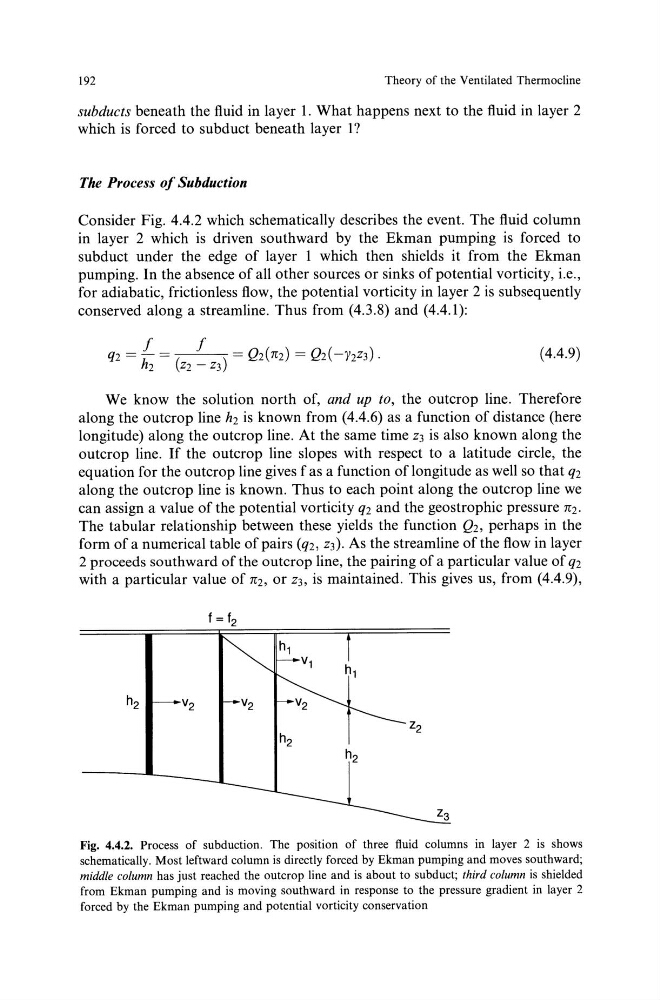
Consider Fig. 4.4.2 which schematically describes the event. The fluid column
in layer 2 which is driven southward by the Ekman pumping is forced to
subduct under the edge of layer 1 which then shields it from the Ekman
pumping. In the absence of all other sources or sinks of potential vorticity, i.e.,
for adiabatic, frictionless flow, the potential vorticity in layer 2 is subsequently
conserved along a streamline. Thus from (4.3.8) and (4.4.1):
f
f
qz = -h = (
) = Qz(nz) = Qz( -y2z3).
2
Zz- Z3
( 4.4.9)
We know the solution north of, and up to, the outcrop line. Therefore
along the outcrop line h2 is known from (4.4.6) as a function of distance (here
longitude) along the outcrop line. At the same time z3 is also known along the
outcrop line. If the outcrop line slopes with respect to a latitude circle, the
equation for the outcrop line gives f as a function oflongitude as well so that q2
along the outcrop line is known. Thus to each point along the outcrop line we
can assign a value of the potential vorticity q2 and the geostrophic pressure n2 .
The tabular relationship between these yields the function Qz, perhaps in the
form of a numerical table of pairs (q2 , z3). As the streamline of the flow in layer
2 proceeds southward of the outcrop line, the pairing of a particular value of q2
with a particular value of n2, or z3, is maintained. This gives us, from (4.4.9),
Fig. 4.4.2. Process of subduction. The position of three fluid columns in layer 2 is shows
schematically. Most leftward column is directly forced by Ekman pumping and moves southward;
middle column has just reached the outcrop line and is about to subduct; third column is shielded
from Ekman pumping and is moving southward in response to the pressure gradient in layer 2
forced by the Ekman pumping and potential vorticity conservation
Theory of the Ventilated Thermocline
subducts beneath the fluid in layer 1. What happens next to the fluid in layer 2
which is forced to subduct beneath layer 1?
The Process of Subduction
Consider Fig. 4.4.2 which schematically describes the event. The fluid column
in layer 2 which is driven southward by the Ekman pumping is forced to
subduct under the edge of layer 1 which then shields it from the Ekman
pumping. In the absence of all other sources or sinks of potential vorticity, i.e.,
for adiabatic, frictionless flow, the potential vorticity in layer 2 is subsequently
conserved along a streamline. Thus from (4.3.8) and (4.4.1):
f
f
qz = -h = (
) = Qz(nz) = Qz( -y2z3).
2
Zz- Z3
( 4.4.9)
We know the solution north of, and up to, the outcrop line. Therefore
along the outcrop line h2 is known from (4.4.6) as a function of distance (here
longitude) along the outcrop line. At the same time z3 is also known along the
outcrop line. If the outcrop line slopes with respect to a latitude circle, the
equation for the outcrop line gives f as a function oflongitude as well so that q2
along the outcrop line is known. Thus to each point along the outcrop line we
can assign a value of the potential vorticity q2 and the geostrophic pressure n2 .
The tabular relationship between these yields the function Qz, perhaps in the
form of a numerical table of pairs (q2 , z3). As the streamline of the flow in layer
2 proceeds southward of the outcrop line, the pairing of a particular value of q2
with a particular value of n2, or z3, is maintained. This gives us, from (4.4.9),
Fig. 4.4.2. Process of subduction. The position of three fluid columns in layer 2 is shows
schematically. Most leftward column is directly forced by Ekman pumping and moves southward;
middle column has just reached the outcrop line and is about to subduct; third column is shielded
from Ekman pumping and is moving southward in response to the pressure gradient in layer 2
forced by the Ekman pumping and potential vorticity conservation